Virginia Durant House tells Fairfax's story through history and suffrage
Fairfax’s library began as Virginia Durant Young’s home and newspaper office. Its survival links everyday town life to the suffrage fight she helped lead.
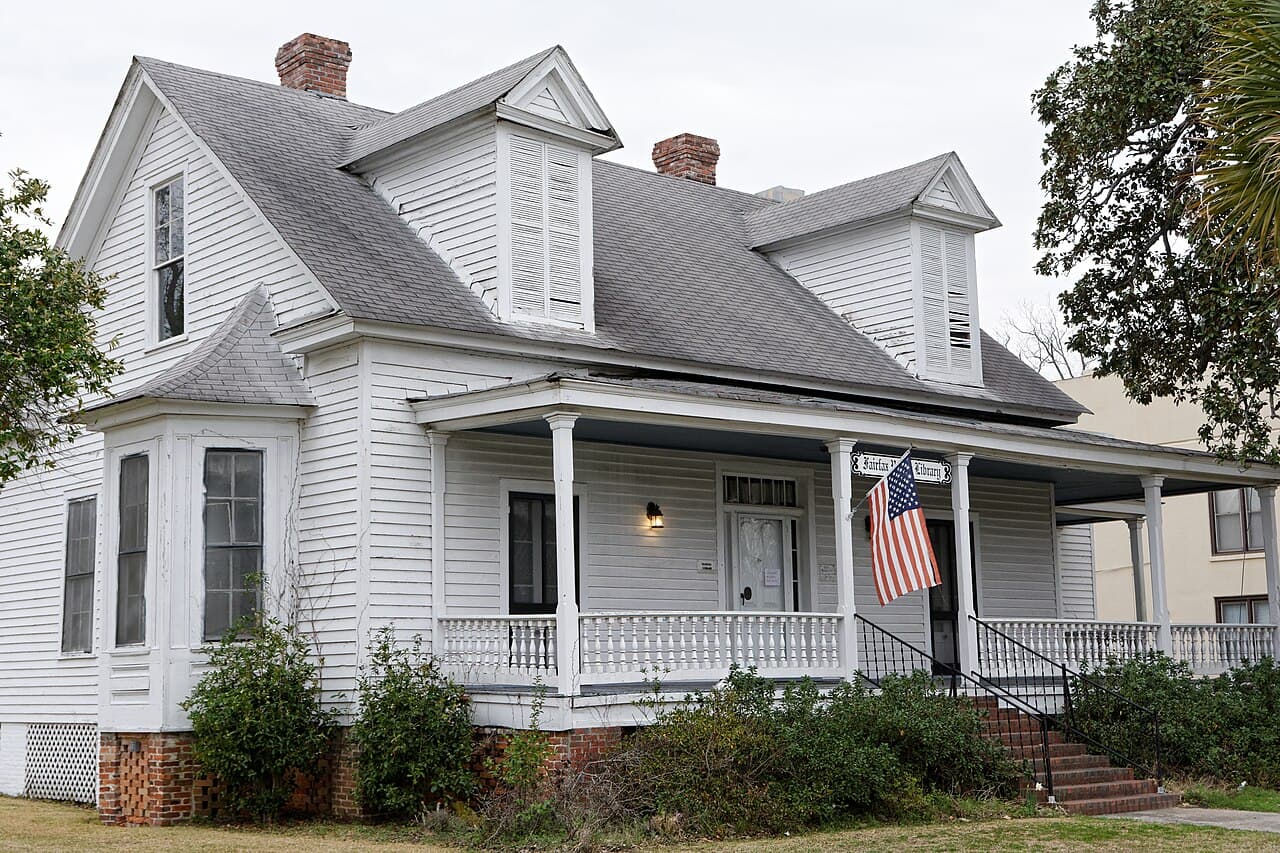
The Virginia Durant House still works for Fairfax because it never stopped belonging to the town. Once the home and office of Virginia Durant Young and Dr. William Jasper Young, the one-and-one-half-story Victorian cottage now houses the Fairfax Public Library next to Fairfax Town Hall on U.S. Highway 278, where its rooms connect daily use with a long public memory.
A house built for both family life and public work
The house was probably built around 1881, soon after the Youngs acquired the property. Its form tells that story in wood and brick: a frame, weatherboarded vernacular Victorian cottage with an irregular U-shaped plan, brick piers, dormers, and a wing that once held Dr. Young’s medical office. The building was enlarged over time, and the National Register documentation describes it as being in excellent condition.
That blend of domestic and professional space is part of what makes the house so distinctive in Fairfax. It was never only a private residence, and it was never only a workplace. The same address supported family life, medical practice, journalism, and reform, which gives the building a layered public meaning that still reads clearly from the street at 503 Allendale-Fairfax Highway.
Virginia Durant Young and the reform network around her
Virginia Durant Young was born in Georgetown, South Carolina, on March 10, 1842, and she married Dr. William Jasper Young in 1880. Over the course of her life, she became a journalist, novelist, humanitarian, political activist, and an internationally recognized leader of the women’s suffrage movement in South Carolina and the nation. The South Carolina Encyclopedia credits her with helping reshape the state’s woman suffrage climate in the 1890s, and that legacy is written into the house itself.
Her work was not confined to one cause or one platform. She joined the Woman’s Christian Temperance Union in 1886, and her suffrage activism was tied to temperance politics and church-based reform networks. In 1890, she helped found the South Carolina Equal Rights Association, then served as its president from 1892 to 1895. She also became editor of the Fairfax Enterprise and, in 1899, its sole owner, turning the house into a newsroom as well as a home.
Her influence reached beyond Fairfax. She was described as the first woman elected to the South Carolina State Press Association, and she worked with Susan B. Anthony for women’s suffrage. Those connections matter because they show that this small building in Allendale County was linked to statewide and national organizing, not just local memory.
From suffrage office to public library
The Virginia Durant House matters today because the Youngs willed their house and books to the town as a library. That decision turned a family property into a civic institution, and the building continues to serve Fairfax as the Fairfax Library and Fairfax Public Library. The shift from private home to public library is not a cosmetic reuse. It is the reason the structure still anchors town life rather than sitting as a preserved shell.
The building was listed in the National Register of Historic Places in 1983, but its value is not only archival. People still come to it for the ordinary business of a library, and that daily use keeps the house woven into local routines. The site also holds a small collection of family artifacts, which gives visitors a more intimate look at the Young household and the life that unfolded there.
Why Fairfax still tells this story through the house
The house stands beside Fairfax Town Hall, which makes its civic role impossible to miss. In one view, Fairfax presents its government building and its library side by side, a reminder that public memory and public service share the same block. The location on U.S. Highway 278 also places the house in the everyday path of residents moving through town, not hidden away as a remote monument.
That setting fits the broader Fairfax story recorded in local history. Dr. Young left the nucleus of the funding for the Allendale County Hospital and required that it be located in Fairfax, a detail that shows the family’s influence on civic development well beyond the house. The South Carolina Encyclopedia’s Fairfax entry also notes that Bell Telephone came to town in 1906, placing the Youngs’ home within a period when Fairfax was steadily building the institutions of modern public life.
For visitors, that context matters because the house is not just about one woman or one era. It represents the way Fairfax grew through reform, health care, communications, and education, with the Youngs at the center of several of those threads. The library function keeps that history active, especially in a town where a familiar public building can still carry the weight of shared memory.
What the Virginia Durant House preserves
The Virginia Durant House preserves more than architecture. It preserves a record of how Virginia Durant Young used the same place to write, organize, and live, and how Fairfax chose to keep that place useful to the public. The building’s Victorian frame, its former medical office, its newspaper work, and its current life as a library all belong to the same story.
Virginia Durant Young died on November 2, 1906, but the house she and Dr. Young left to Fairfax still holds their names in the daily life of the town. In a county where history can feel spread across archives, landmarks, and family memory, this building brings those pieces together in one address.
This article was produced by Prism’s automated news system from verified source data, official records, and press releases, then run through automated quality and moderation checks before publishing. The system is built and supervised by the people who set the standards it runs under. Read our full AI policy.
Know something we missed? Have a correction or additional information?
Submit a Tip