Forest Service advances Heber horse roundup across Apache-Sitgreaves lands
The Forest Service set an April 27 deadline to impound "unauthorized" horses after a private survey estimated about 1,800 animals, far above the territory's 50-104 population cap.
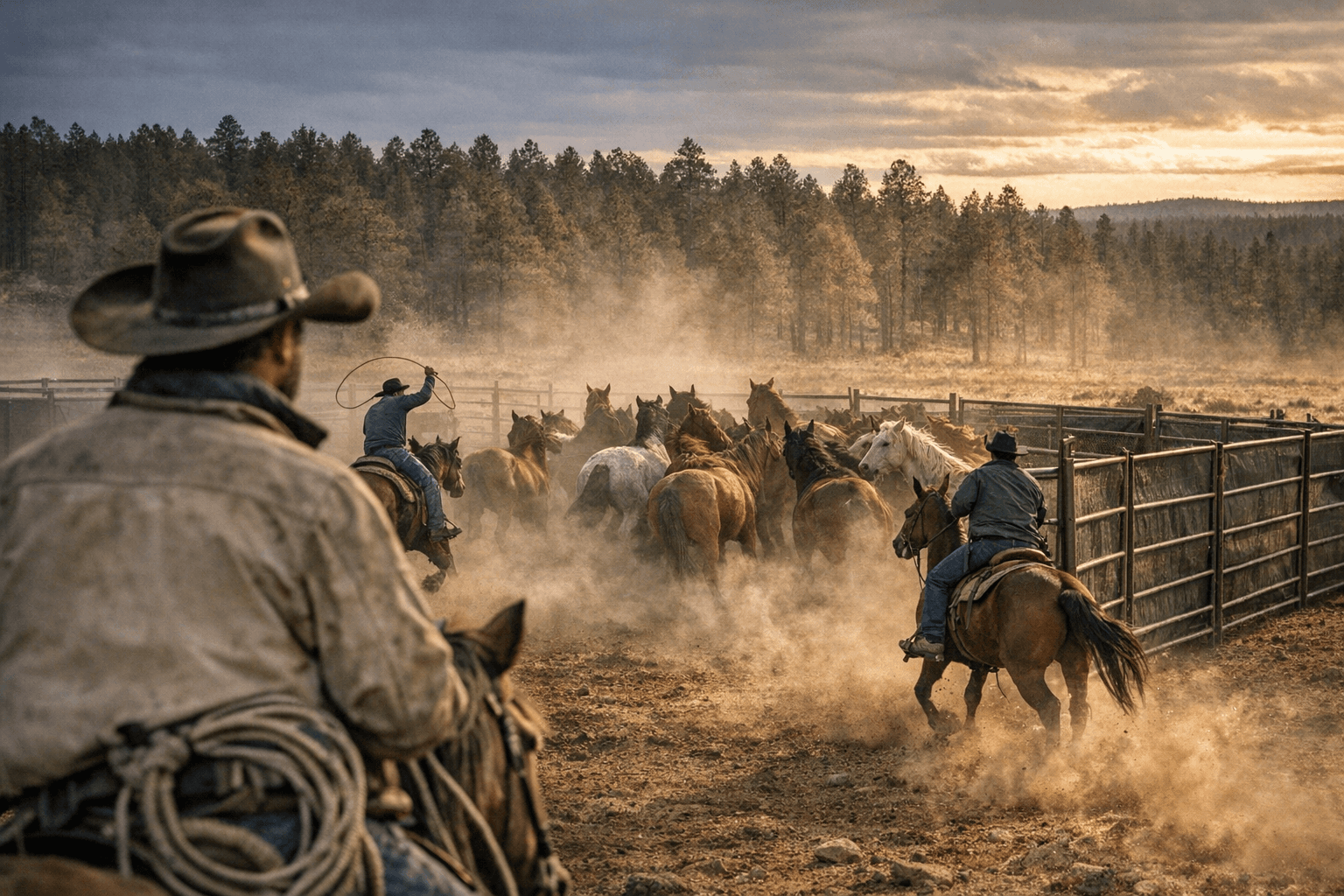
The U.S. Forest Service moved forward with a plan to remove free-roaming horses from the Heber/Overgaard area after issuing a Notice of Intent to Impound Unauthorized Livestock on April 2, 2026, signed in Springerville by Acting Forest Supervisor Joshua Miller. The notice, posted at the Heber post office on or about April 6, 2026, gives an April 27, 2026 deadline after which horses the agency classifies as unauthorized may be seized and removed from Apache-Sitgreaves National Forest lands.
Operational planning rests on a January 29, 2026 Decision Notice and Finding of No Significant Impact that set an Appropriate Management Level, or population cap, of 50 to 104 horses for the Heber Wild Horse Territory. The decision describes the territory as roughly 19,700 acres near Heber-Overgaard, with boundaries shaped by Highway 260 corridor fencing and adjacent private land development across parts of Coconino and Navajo counties. The Forest Service says it will use monitoring and adaptive management under an annual operating plan and may build temporary or permanent infrastructure to carry out removals.
The scale of the task is stark: a late March 2026 private aerial survey conducted by contractor Jackie Hughes of Rail Lazy H Contracting and Consulting LLC estimated about 1,800 horses in the region, with up to a 30 percent upward adjustment to account for animals obscured under canopy. That contractor is already identified in court filings and a January 20, 2026 federal court order as under contract to capture, impound, and sell horses. The gap between the survey estimate and the 50-104 cap frames the central tension driving enforcement actions and community dispute.
Implementation will rely on methods the Forest Service describes as passive trapping techniques, with impounded animals subject to claim by owners who must present proof of ownership and may be charged for impounding, feeding, and care. The Apache-Sitgreaves public information page lists the rangeland program manager contact at 928-333-6309 in Springerville for claimants and questions. The agency also cites ecosystem, watershed, and threats to federally listed species, including impacts in the Black River watershed and riparian damage that local ranchers argue reduces grazing and water availability.
Heber-area ranchers and grazing permittees have long pressed for removals to protect forage and reduce wildfire risk, while horse-advocacy groups and neighbors have raised animal-welfare and cultural concerns, including warnings that trapping can endanger mares during foaling season. Litigation and contested sales have precedent: a federal judge in August 2024 declined to block the sale of 13 unowned horses at a Texas auction, and the broader Salt River Wild Horse Management Group litigation remains active, underscoring the likelihood of legal challenges to new impoundments.
With the April 27 deadline now on the calendar and 2026 operations authorized by the January decision, expect coordinated activity among the Forest Service, county officials, contractors, and stakeholders in the coming weeks and months as removals, impound procedures, and potential appeals play out across the White Mountains.
This article was produced by Prism’s automated news system from verified source data, official records, and press releases, then run through automated quality and moderation checks before publishing. The system is built and supervised by the people who set the standards it runs under. Read our full AI policy.
Did this article answer your question?