Hawaii Lawmakers Advance Conveyance Tax Overhaul to Fund Affordable Housing
A $10M Hawaii property closing would cost sellers $378K in conveyance tax instead of $100K under HB 2049, which the House passed 43-7 to fund affordable housing and DHHL homesteads.
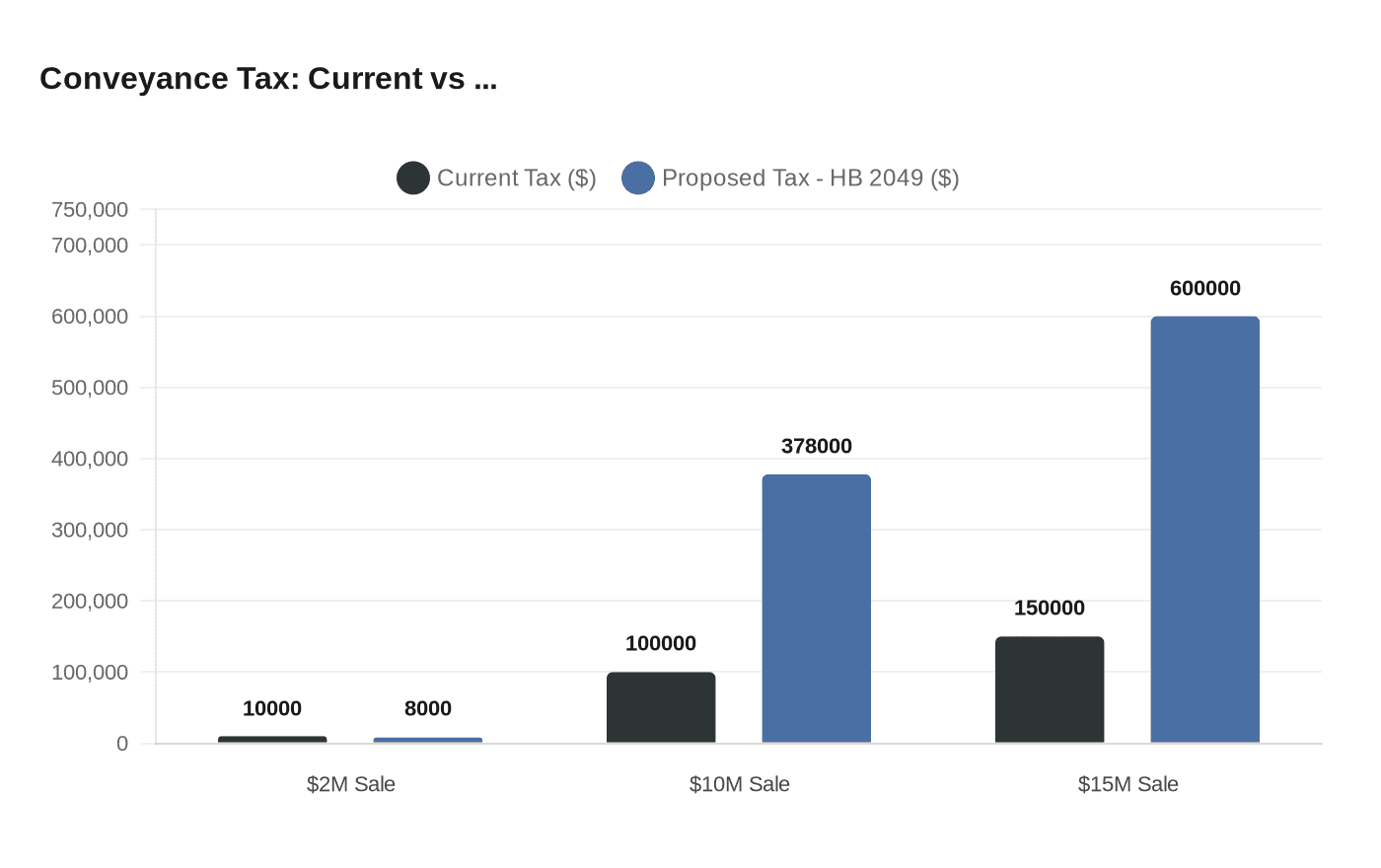
The conveyance tax on a $10 million Hawaii property sale currently runs $100,000, billed to the seller at closing. Under House Bill 2049, that same transaction would cost $378,000. On a $15 million sale along the Kohala Coast, the current $150,000 bill would climb to $600,000. That arithmetic, deliberately engineered into a new marginal-rate structure, sits at the center of one of the most consequential housing-finance debates of the 2026 legislative session, and it lands squarely on the Big Island's luxury real estate market.
The House voted 43-7 in March, with one member absent from the 51-seat chamber, to send HB 2049 to the Senate. Rep. Luke Evslin, the Wailua-Lihue Democrat who chairs the House Housing Committee and co-introduced the bill with 16 colleagues, made the case on the House floor on March 10, the same day the Senate was passing its own competing proposal. "At its heart, it's shifting our current conveyance tax structure to a marginal structure, which is just a more fair structure," he told colleagues. He estimated 75 percent of Hawaii home sales would see a reduced or unchanged tax bill under the proposal.
The design is calibrated to protect mid-range buyers while extracting more from the top of the market. Under current law, Hawaii's seven conveyance-tax brackets apply a flat rate to the entire sale price, ranging from 10 cents per $100 for homes under $600,000 up to $1 per $100 for sales at or above $10 million. An owner-occupant selling a $2 million home pays $10,000 today. Under HB 2049's marginal structure, where higher rates apply only to dollars above each threshold, that same transaction would cost $8,000, a modest reduction. A $10 million purchase, by contrast, would carry a $378,000 bill, nearly four times the current amount. Brackets would be indexed to inflation, preventing typical home-price appreciation from automatically pushing more median transactions into higher-rate territory.
The bill projects generating $167 million in additional annual revenue on top of the roughly $100 million the state already collects, with specific destinations written in. HB 2049 originally directed up to $60 million per year to the Department of Hawaiian Home Lands to develop homesteads for beneficiaries, and up to $40 million for state-backed affordable housing infrastructure, including predevelopment costs and transit-oriented development projects. Senate amendments adopted March 25 scaled the DHHL allocation back to $40 million and folded in elements from both bills, a sign that negotiation between the chambers is active and unresolved.
The Senate's own vehicle, Senate Bill 3028 introduced by Sen. Chris Lee (D, Kailua-Waimanalo-Hawaii Kai), passed the full 25-member Senate unanimously on March 10 but diverges from the House approach: it raises rates on high-value properties by less than HB 2049 and, in its original form, contains no dedicated DHHL funding stream. It would direct proceeds instead to a land conservation fund, an affordable rental housing development fund, a land acquisition fund, and an affordable-housing development fund for transit-oriented development areas.
For the Big Island, where DHHL administers significant land holdings and the housing shortage is driven by limited developable land, vacation-rental demand, and high construction costs, the gap between the two bills is more than an accounting difference. Affordable-housing advocate Will Caron noted in written testimony that Hawaii's conveyance tax rates, ranging from 0.5 to 1.25 percent of purchase price, are far below the 2 to 7 percent levied in high-cost markets like Seattle and San Francisco. "It is a targeted ask for those who have profited most from our islands' scarcity," Caron wrote.
Final rates and earmarks will be settled in the weeks ahead as both chambers negotiate toward a closing package before the session ends.
This article was produced by Prism’s automated news system from verified source data, official records, and press releases, then run through automated quality and moderation checks before publishing. The system is built and supervised by the people who set the standards it runs under. Read our full AI policy.
Did this article answer your question?