Allen Family Homestead highlights Dove Creek’s early farming roots
A 1915 homestead on 160 acres shows how Dove Creek’s bean country was built on dryland farming, family labor, and careful use of every acre.

Leslie V. Allen filed his claim in Dove Creek in 1915 on 160 acres, and added another 80 acres three years later. His place is more than a preserved family site; it is a working map of Dolores County’s land-and-water reality: limited acreage, dryland crops, livestock, and the hard arithmetic of making a living where productive ground is concentrated in a small slice of the county.
A homestead that still reads like a county map
The Allen Family Homestead is also recognized in Centennial Farms & Ranches, a program reserved for Colorado farms and ranches with at least 100 years of continuous family ownership or operation, which puts the site in a small class of agricultural properties with lasting family ties.
The homestead’s story fits the geography around it. Dolores County covers 1,064 square miles, but about 60% of that land is public, managed by the Bureau of Land Management and the U.S. Forest Service. The county stretches from Disappointment Valley at 5,900 feet to Mount Wilson at 14,046 feet, a range that helps explain why farming is concentrated on the workable valley and mesa ground while much of the surrounding landscape remains open, rugged, and thinly settled.
What Leslie V. Allen actually farmed
The Allen place was not just a cattle outfit with a cabin attached. Allen worked the land with horses and grew wheat, cane, corn, and pinto beans, a crop mix that still feels familiar in Dove Creek country. The family also raised chickens, hogs, and cows, which meant the homestead produced both food for the household and products for sale.
Early farming in western Dolores County had to be diversified, especially in a dry climate where a single crop failure could unsettle a year’s income. The Allen family sold eggs, wheat, cane, beans, and wood to the local store, showing that the farm was tied to a local market, not sealed off as a self-sufficient island.
Why the surviving buildings matter now
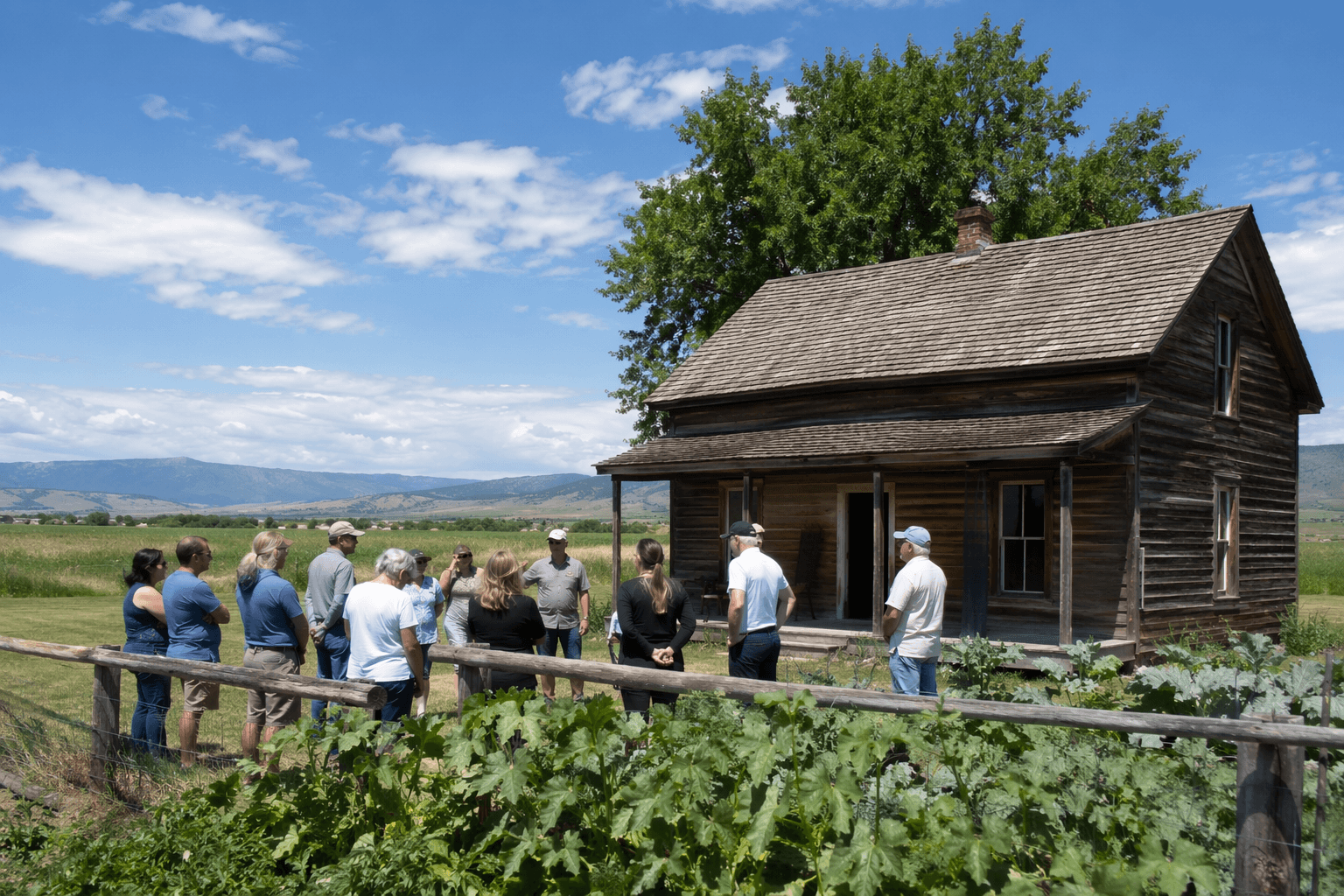
Two historic structures still anchor the site: a log cabin built in 1915 and a granary built in 1935. Those buildings give the homestead a physical continuity that is rare in an agricultural landscape, where working structures are often replaced, moved, or lost to weather and changing use.
The cabin marks the first phase of settlement, when shelter, storage, and proximity to fields mattered more than anything else. The granary reflects a later stage, when keeping harvested grain dry and secure became part of a more established farm system. Together, the structures show how an initial claim turned into a longer-lived agricultural operation.
How the homestead connects to Dove Creek’s present identity
Dove Creek still describes itself as the Pinto Bean Capital of the World, and the surrounding agricultural landscape remains strongly tied to beans, wheat, sunflowers, and alfalfa. That makes the Allen place especially useful as a lens for the town’s identity, because the homestead’s original crop mix looks less like a relic and more like the beginning of a long-running pattern.
Dolores County’s agricultural economy is centered on pinto and Anasazi beans, ranching, and dryland crops. That is a modern expression of the same land-use logic that shaped the Allen farm: use hardy crops, depend on weather, keep livestock in the mix, and make each acre pull its weight. In a county where public land dominates the map and private agriculture occupies the more workable pockets, that formula still matters.
Dryland farming in southwest Colorado is not new. The Ancestral Puebloans farmed the region for centuries before Anglo-European settlement, and winter wheat, beans, and alfalfa are standard dryland crops because they can use residual soil moisture rather than heavy rainfall.
What the Allen story says about stewardship
Leslie V. Allen’s farm depended on horses, diversified crops, livestock, and local sales because the environment demanded flexibility. Today’s producers and landowners still work within that same basic framework, even if the machinery, markets, and water management tools have changed.
This article was produced by Prism’s automated news system from verified source data, official records, and press releases, then run through automated quality and moderation checks before publishing. The system is built and supervised by the people who set the standards it runs under. Read our full AI policy.
Did this article answer your question?