Greensboro residents pack workshop on backyard homes and rental units
Dozens packed McGirt-Horton Branch Library to learn how backyard homes could fit on Greensboro lots as the city pushes toward 10,000 new units by 2030.
Dozens of Greensboro residents filled McGirt-Horton Branch Library on Phillips Ave. to learn whether a backyard cottage, garage apartment or in-law suite could work on their own property. The city’s 4 to 6 p.m. workshop on Wednesday, May 13, put accessory dwelling units, or ADUs, at the center of Greensboro’s housing debate.
City planners said the session would cover current ADU standards, building codes, permitting, design options and financing considerations. That practical focus matched the kind of demand visible in the room: people were not there for a distant planning concept, but to ask how a smaller secondary home might bring in rent, house family members or make better use of lots already inside established neighborhoods.
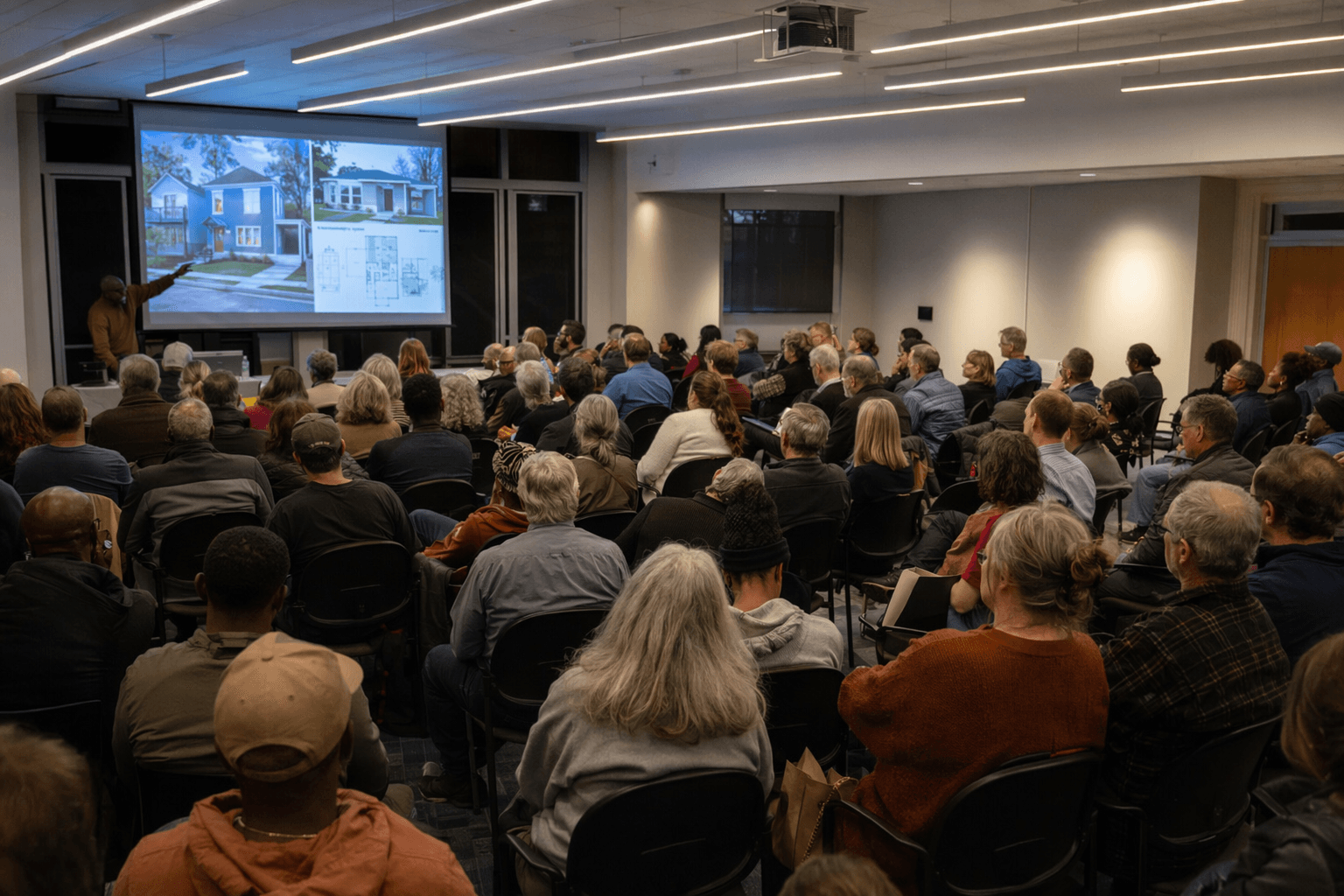
The city defines ADUs as smaller secondary housing units on the same property as a primary residence, either attached or detached. Greensboro has cast them as one of the few ways to add homes without changing the basic scale of older residential streets, and city officials have said the units can support multigenerational households, rental income and gentler density.
Greensboro already loosened the rules. On April 16, 2024, City Council unanimously approved a text amendment to the Land Development Ordinance that removed the square-footage requirement and now allows an ADU to be as large as 50 percent of the primary dwelling. The city also no longer requires the property owner to live in the accessory unit or the main house, and it no longer requires additional parking. ADUs remain permitted in all residential districts as an accessory use to a single-family residence.
Those changes make the zoning path clearer, but not simple. Homeowners still have to deal with design, permitting, building codes and financing, which means the real barrier often shifts from zoning to money and execution. Greensboro’s housing market shows why that matters: the city’s median home price was reported at $323,000 in the first quarter of 2025, $335,000 in the second quarter and $345,000 in the third quarter, while Redfin put the median home price at $303,000 in March 2026.
That price range makes ADUs more realistic for homeowners who already own property and can finance construction than for households trying to buy their first place. Greensboro’s Housing and Neighborhood Development Department says it financed 264 affordable rental units in fiscal year 2024-25, but the city’s broader Road to 10,000 initiative still aims to support 10,000 new housing units by 2030. The ADU push is part of that larger test: whether Greensboro can add housing one backyard at a time, or whether the idea remains a niche option for owners already positioned to build.
This article was produced by Prism’s automated news system from verified source data, official records, and press releases, then run through automated quality and moderation checks before publishing. The system is built and supervised by the people who set the standards it runs under. Read our full AI policy.
Did this article answer your question?