Burns-Belfry museum tells story of emancipation and Reconstruction in Oxford
Burns-Belfry keeps Oxford’s Reconstruction story public, from Freedmen Town’s 1867 church to a restored museum and events center near the Square.
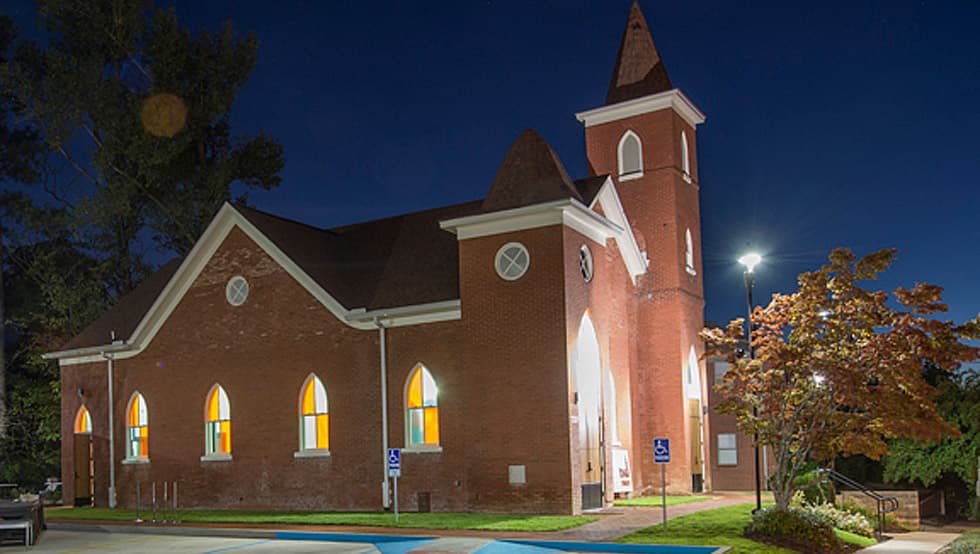
Burns-Belfry Museum and Multicultural Center gives Oxford a place where Reconstruction history is not sealed away in an archive. At 710 Jackson Avenue, near the Oxford Square, the restored Mississippi Landmark now works as both a history museum and an events center, making it part of daily civic life as well as a destination for visitors.
A Reconstruction-era story built into the site
The origin of Burns-Belfry reaches back to 1867, when the widow of William Stearns deeded land to Harrison Stearns. William Stearns had been a professor of law at the University of Mississippi, and Harrison Stearns had been enslaved as his servant, a connection that places the site squarely inside the social upheaval of the first years after emancipation.
Burns Methodist Episcopal Church was organized by freed African Americans who settled in the area known as Freedmen Town after the Civil War. The first church on the site was a frame Methodist Episcopal building erected in 1867 near the Oxford Square, and the current twin-steepled brick church replaced it in 1910. Those three dates, 1867, 1910 and 2013, map the building’s full arc: creation, reinvestment and preservation.
That arc matters in Lafayette County because it shows how Black residents built institutions of their own in the years after slavery ended. The story is not only architectural. It is about land transfer, freed labor, worship, mutual aid and leadership taking root in Oxford at a moment when the terms of civic life were being rewritten.
What visitors encounter today
Burns-Belfry’s interpretive exhibit is built to do more than display objects. Its mission is to preserve African American history and create opportunities for education, engagement and dialogue in service of the broader goal of building community in Oxford-Lafayette County, Mississippi. The museum describes itself as “not a typical history museum,” a distinction that points to its use of interpretive exhibit concepts rather than a purely traditional collection model.
That approach makes the site useful for local families, teachers, church groups and travelers who want a concrete way to understand how emancipation shaped Oxford’s built environment. The building’s location near the Square also gives that history a visible place in the center of town, rather than leaving it scattered across records and memory.
Because Burns-Belfry functions as an events center as well as a museum, it stays active in the present tense. That matters for public history: a site that hosts gatherings, programs and conversations keeps its story in circulation, which is what turns preservation into living use instead of passive display.
Why the preservation story is part of the public value
The 2013 restoration marked a third chapter for the church building, one that moved it from endangered historic structure to renewed public landmark. The restored building is described as a Mississippi Landmark, a designation that recognizes its architectural and cultural importance while helping secure its place in the county’s heritage landscape.
Preservation did not stop with the restoration itself. In 2018, the Oxford Board of Aldermen voted to accept a grant from the North Mississippi Hills National Heritage Area for Burns Belfry, a sign that public-sector support remained part of the site’s future. The Burns-Belfry website also says its development received assistance from the National Trust for Historic Preservation through the Johanna Favrot Fund for Historic Preservation.
The site’s own project history also references a cross-cultural effort to save the town’s first church built by freedmen in 1868. That detail matters because it shows preservation as more than building repair. It is also about who claims the story, who helps fund it and how a community chooses to keep Black heritage visible in a county seat where so much of that history once risked disappearing into the background.
What Lafayette County gains from keeping Burns-Belfry open
Burns-Belfry gives Lafayette County a tangible place to talk about emancipation, Reconstruction and African American institution-building without separating those subjects from the physical town around them. Visitors can stand at a site tied to a freedman community, a University of Mississippi household, a rebuilt church and a later restoration, all within one address on Jackson Avenue.
That layered history has practical value. It deepens heritage tourism near the Oxford Square, gives residents a shared civic landmark and offers a setting where local history can be used for education and dialogue rather than only commemoration. The museum’s public role as a history museum and events center means it can support school learning, community gatherings and cultural programming at the same time.
The risk of neglect is equally concrete. If attention and support fade, Lafayette County loses more than a historic building. It loses one of the clearest places where the county’s Black history, Reconstruction-era land transfer and preservation priorities are joined in a single public site. Burns-Belfry remains important because it is still doing the work of history in the middle of Oxford, not just preserving a past chapter, but keeping that chapter active in the county’s present identity.
This article was produced by Prism’s automated news system from verified source data, official records, and press releases, then run through automated quality and moderation checks before publishing. The system is built and supervised by the people who set the standards it runs under. Read our full AI policy.
Did this article answer your question?