How Isaiah Welch helped shape McDowell County's coal boom
Isaiah Welch’s coal reports, land deals, and railroad lobbying helped put Welch on McDowell County’s map and steer development toward the Elkhorn Valley.
The name Welch is stamped on McDowell County’s map because Isaiah Welch turned coal reports, railroad persuasion, and land speculation into a development strategy that redirected the county’s growth. The town that bears his name sits at the center of that story: it became the county seat, drew rail service, and grew out of the same coal-and-timber economy Welch helped promote.
The man behind the county seat name
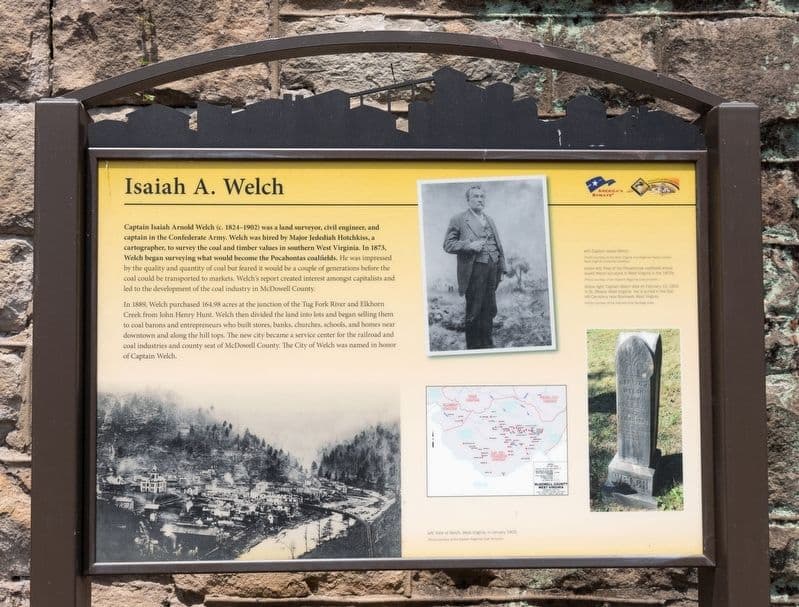
Isaiah Arnold Welch was not a local legend by accident. The West Virginia Encyclopedia describes him as an industrial promoter, land speculator, railroad developer, and Confederate veteran, and places his birth in Doddridge County around 1825. Another historical account identifies him as Captain Isaiah A. Welch, with some documents placing his birth in Charleston on November 3, 1824, a reminder that 19th-century records often leave even basic details split across sources.
Before he became tied to southern West Virginia’s coalfields, Welch had already moved through the restless world of the mid-1800s. West Virginia Public Broadcasting says he went west during the California Gold Rush in the late 1840s and came back without finding his fortune. He later rose to the rank of captain in the Confederate Army and served in the legislature of Confederate Virginia, then pivoted into the kind of postwar promotion work that shaped mountain counties across the state.
How Welch connected land, rail, and coal
Welch’s lasting influence came less from a single mine or one profitable deal than from the way he linked land to transportation and transportation to coal. The Bramwell historical page says he worked as a surveyor for Pocahontas Mines, which fits the role he played in mapping out the coalfield era. Survey work mattered because railroads, investors, and land buyers all depended on the same basic promise: there was enough coal, timber, and accessible ground to justify building out infrastructure.
A historical-marker summary in McDowell County says Welch’s survey reports of rich coal seams in the Elkhorn Valley helped encourage development of the Norfolk and Western Railway. Another local-history account says an 1873 survey by Isaiah Welch reported large quantities of timber and quality coal in the area, helping spur industrial interest in McDowell County. That matters because the county’s boom was never just about digging coal out of the ground. It was about convincing outside capital that the seams were worth reaching, the timber was worth clearing, and the rail line was worth extending.
Welch also put his money where his maps were. The same marker summary says he bought land at the confluence of Elkhorn Creek and Tug Fork in 1888. That location sits in a strategic corridor for transport and extraction, where water routes, rail access, and mineral lands could be folded into one industrial landscape.
Why the railroad route mattered so much
The Norfolk and Western Railway did more than carry freight. In McDowell County, it helped decide which settlements would grow and which would fade. A West Virginia Arts & Heritage post says the Norfolk and Western rail line ran to the county-seat area of Welch by 1891 instead of to Perryville, now English. That detail captures the economic logic of the era in plain terms: the rail line followed the place that could best serve mining and shipping, and the town that won the route won the future.
Perryville’s later identity as English marks the shift in county geography that came with coal development. The county seat moving into the Welch area tied government, commerce, and rail access together in a way that reinforced the town’s central place in the county. In a coalfield county, the route a railroad chose could shape where people lived, where stores opened, and where public business got done.
What Welch reveals about McDowell County’s coal boom
McDowell County was built through the same economic system Welch spent his career promoting: railroad expansion, land speculation, coalfield development, and the sale of an industrial future to investors and rail executives. His story shows how outsiders and insiders alike used surveys, legal titles, and transportation plans to turn remote mountain territory into an extractive economy connected to national markets.
That system had a human face in Welch’s work. He was not just a name on a town sign; he was a surveyor, promoter, and land buyer whose claims about coal and timber helped make the Elkhorn Valley legible to rail and mining interests. In that sense, the county’s identity was built from more than geology. It was built from the people who interpreted that geology, packaged it for investors, and made the case for rails to come through.
Why his name still matters on the map
Welch’s name remains important because it points directly to the moment McDowell County’s landscape was reorganized around coal. The town named for Captain Isaiah Welch stands as a reminder that the county seat, the railroad corridor, and the mining district were all part of the same development story. Residents who know Welch only as a place name are seeing the end result of a much bigger process: a surveyor’s reports, a railroad’s route, a land purchase in 1888, and a county that was pulled into the coal economy by design.
Welch died in St. Albans in Kanawha County on February 15, 1902, at about 76. By then, the county that bears his name had already been folded into the railroad-and-coal order he helped advocate, and that order still shapes how McDowell County reads its own map.
This article was produced by Prism’s automated news system from verified source data, official records, and press releases, then run through automated quality and moderation checks before publishing. The system is built and supervised by the people who set the standards it runs under. Read our full AI policy.
Did this article answer your question?