Menominee tribal offices began as 1929 hospital, later closed in 1961
A former 1929 hospital now houses Menominee tribal government, tying Keshena's daily services to the tribe's long return to self-rule. Its rooms still map that history.
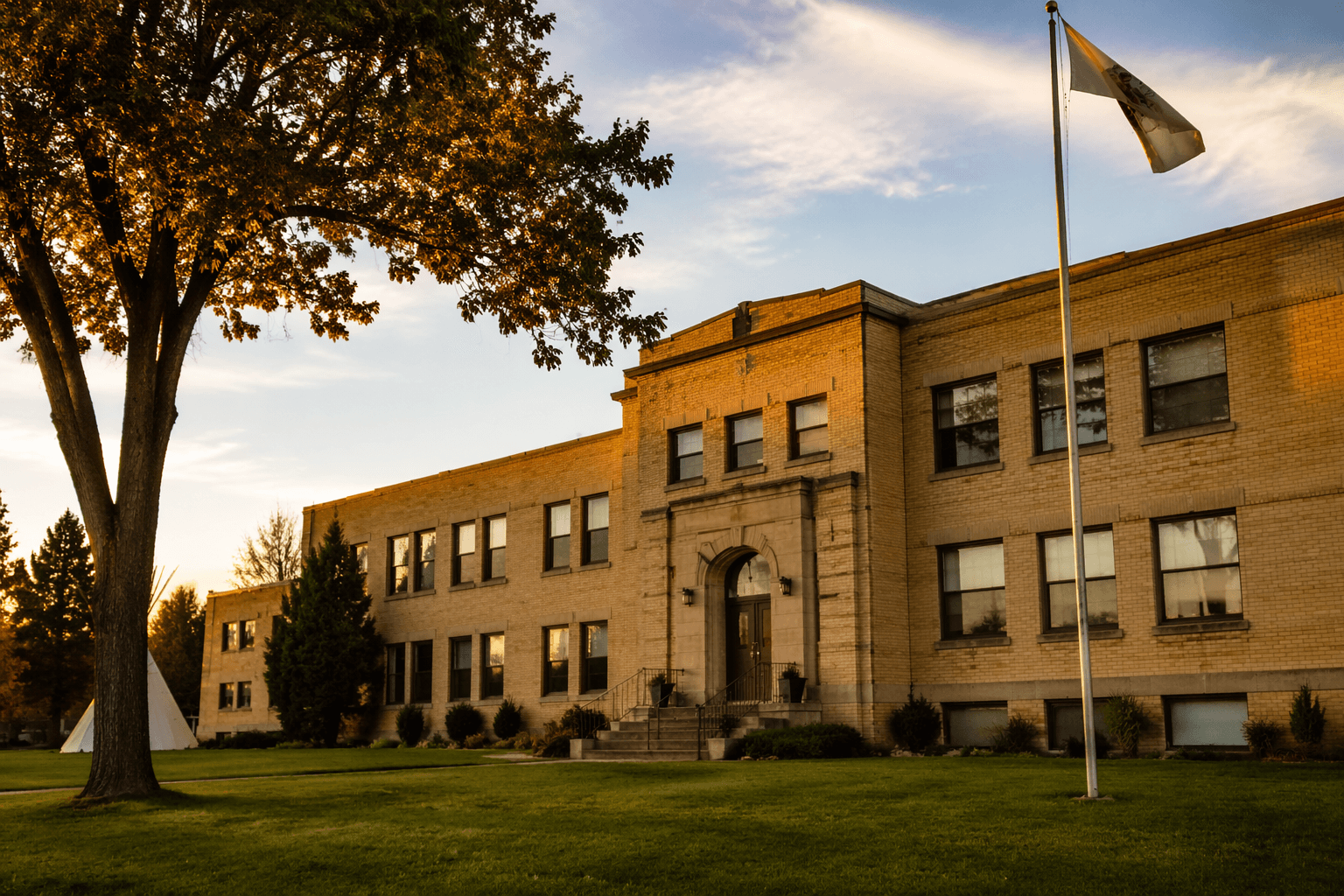
The Menominee Tribal Offices Building is one of the clearest civics lessons in Menominee County because its walls hold three different governments in one place. It began as St. Joseph’s Hospital in Keshena, then became a county office building after the hospital closed, and later turned into the headquarters of the Menominee Restoration Committee and today’s tribal offices.
From hospital to public institution
The building opened in 1929 as St. Joseph’s Hospital, expanded with wings in 1930, and had 60 beds. Its construction cost $63,073.23, a figure that gives a rare and concrete picture of what reservation infrastructure looked like in the early twentieth century. The hospital was staffed largely by mission volunteers, with only the doctor drawing a salary, showing how health care on the Menominee Indian Reservation depended on a patchwork of religious, tribal, and mission support.
That original use mattered beyond medicine. A hospital in the center of Keshena was a public-facing institution, a place where residents encountered care, authority, and administration in one setting. When tribal offices later moved into the same structure, the building kept serving the same broad civic function, even as the government inside it changed.
The 1961 closure and what it meant
The turning point came in 1961, when the hospital closed because it did not meet state fire standards and the tribe could not afford the upgrades needed to keep it operating. The closure happened after the Menominee Termination Act, enacted on June 17, 1954, had upended the tribe’s federal status and depleted the tribal treasury. That sequence is important: the building did not just age out of use, it became a casualty of a political decision that strained the financial base needed to keep basic services running.
Menominee County was created in 1959 after termination, so by the time the hospital shut down, county government had already become part of the region’s administrative reality. The building then served as county offices until 1973. That makes the structure more than a relic of one era; it was a stopgap civic center during a period when the tribe’s government had been dismantled and local administration had to keep going in a new, unstable form.
Restoration politics turned the building into a headquarters
The next chapter began with DRUMS, the Determination of Rights and Unity for Menominee Shareholders, which formed in 1970. Ada Deer helped lead that effort, and she later chaired the Menominee Restoration Committee. DRUMS was not symbolic politics alone. It grew out of a practical fight to recover Menominee governance, and it created the political pressure that made restoration possible.
On December 22, 1973, President Richard Nixon signed the Menominee Restoration Act into law. The act became effective in 1975, and the lands of Menominee County reverted to reservation status in April of that year. After the county-office period ended, the old hospital became headquarters for the Menominee Restoration Committee, then evolved into the tribal office complex used today. That transition makes the building a physical marker of restored authority: the same address that once housed a hospital and then county administration became a seat of Menominee self-government.
What happens inside the building now
The building’s interior shows how tribal government works in daily life. At different times, the basement housed the Tribal Jail, the police department occupied the first floor, and former hospital rooms were converted into offices, meeting rooms, finance, legal, enrollment, and administration spaces. Those uses are not abstract functions. They are the places where residents deal with identity documents, legal issues, public safety, fiscal decisions, and the basic machinery of tribal governance.
That mix of offices helps explain why the building still matters to residents who may never think of it as a historic site. It is where governance becomes tangible. Enrollment affects family records and membership status. Finance and administration shape budgets and operations. Legal offices deal with the formal side of tribal authority. Police and jail space tie the building to public safety. A former hospital turned government complex is not just a preserved structure; it is an everyday service center.
A longer story of sovereignty and public health
The building also fits into a broader Menominee story of land, health, and sovereignty. Menominee history dates back about 10,000 years. In the 1800s, the tribe occupied an estimated 10 million acres, and today the Nation’s land base is little more than 235,000 acres. Those numbers show why a single building can carry so much meaning: when land and institutions were reduced so sharply, any surviving place that traces the recovery of authority becomes especially important.
Health care eventually returned to a tribal-run model. In 1977, the Menominee Tribal Clinic says the tribe secured Congressional and Hill-Burton funds to build the first Indian-owned and operated health facility in the United States. That achievement gives the old hospital a second civic arc. It began with mission-supported care in 1929, closed under the strain of termination in 1961, and was followed by a restored tribal health system that could claim ownership and control.
Why the building matters to Menominee County now
For Menominee County, the value of the Tribal Offices Building is that it makes government visible. The structure shows how a hospital funded before termination became a county office stopgap after closure, then became a restoration-era headquarters as Menominee self-rule returned. Residents see, in one place in Keshena, the shift from imposed administrative control back to tribal decision-making.
That is why the building remains more than a preserved address. It links public service to place, and it links today’s offices to the political struggle that brought them back. In a county shaped by termination, restoration, and renewal, the Menominee Tribal Offices Building turns the history of sovereignty into something residents can walk past, enter, and use.
This article was produced by Prism’s automated news system from verified source data, official records, and press releases, then run through automated quality and moderation checks before publishing. The system is built and supervised by the people who set the standards it runs under. Read our full AI policy.
Did this article answer your question?