Fort East Martello’s unfinished towers became a Key West museum
Fort East Martello was built for a war it never fought, then turned into the Florida Keys’ first museum. Its unfinished towers now anchor Key West’s civic memory.

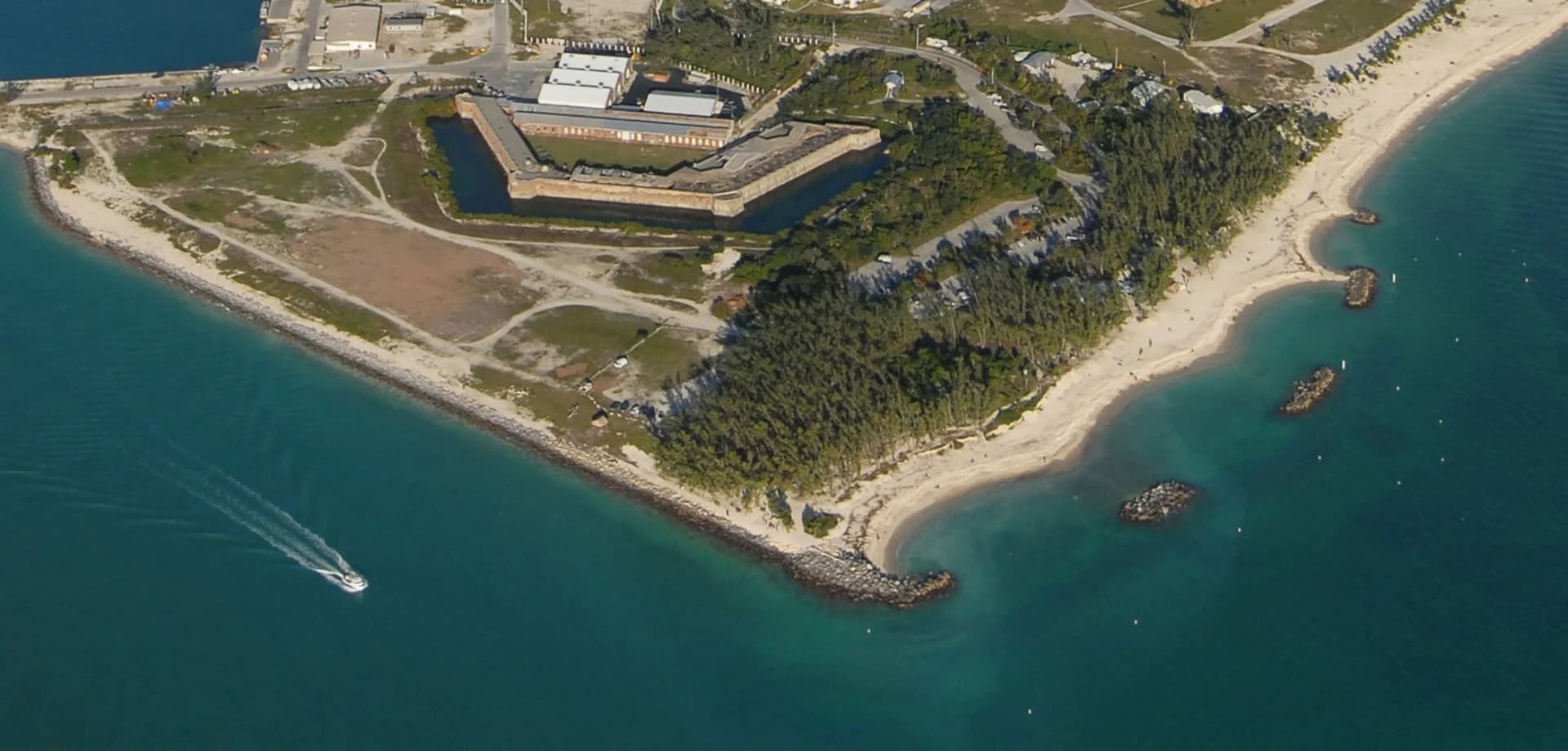
Fort East Martello is one of Monroe County’s clearest examples of reuse with a public purpose: a Civil War-era fort that never fired a shot became the Florida Keys’ first museum. The site began as part of a federal defense plan, but its real afterlife came when local preservation turned unfinished military concrete into a place for history, art, and public programming.
From harbor defense to unfinished towers
The fort’s story starts in 1822, when U.S. Navy surveyors identified Key West sites where fort guns could command the harbor. By 1836, U.S. Army Col. Joseph Gilmore Totten and French military engineer Simon Bernard had drawn up a sweeping plan for nine forts. Cost cut that vision down to one large fort and two advanced batteries, the East and West Martello Towers, and those towers became part of the federal Third System of coastal defenses built between 1818 and 1867.
That larger military system mattered because Fort East Martello was never an isolated local project. It was part of a national effort to ring the coastline with permanent fortifications. In Key West, though, the work lagged, and the towers were not completed in time to serve in battle. Fort East Martello was never armed, never engaged in combat, and never became the wartime stronghold its planners had imagined.
A fort that outlived its original mission
The unfinished design is what makes the site so revealing. Fort East Martello sits at the intersection of federal planning, local geography, and practical limits, showing how Key West absorbed a military project that no longer fit its original purpose. Instead of becoming a battlefield, the fort became a durable piece of the island landscape, one that later generations would reinterpret rather than replace.
During World War II, the site found a new role as a training facility for the U.S. Navy and U.S. Army. That reuse extended its life at a moment when many old military installations were being abandoned or torn down. After the war, the structure fell into disuse and decay, a familiar fate for obsolete defenses that had no peacetime function until preservation gave them one.

How the first museum of the Florida Keys took shape
The major turning point came in 1950, when the Key West Art & Historical Society opened Fort East Martello Museum. The society describes it as the first museum of the Florida Keys, and that claim carries more than ceremonial weight. It marks the moment the county began turning a leftover fortification into a civic institution, one built not to guard the harbor but to interpret the island’s past.
The restoration was hands-on and local. Volunteers cleared years of debris and dust, and the work followed the fort’s original 1860s design. That detail matters because the museum was not created by erasing the fort’s military identity. It was built by preserving the unfinished form that had been left behind, making the structure itself part of the exhibit.
The site’s historic standing was formalized in 1972, when it was added to the National Register of Historic Places. The National Park Service identifies the National Register as the federal list of historic places worthy of preservation, created under the National Historic Preservation Act of 1966. For Fort East Martello, that listing recognized not just age, but a rare combination of military architecture, local preservation, and public reuse.
What you see inside now
The museum’s collections stretch far beyond the fort’s original purpose. Its exhibits include works by Cuban folk artist Mario Sanchez and the hauntingly famous Robert the Doll, tied to artist Robert Eugene Otto. The building also holds Civil War relics, Stanley Papio’s metal sculptures, and material connected to the wrecking and cigar-manufacturing industries that shaped the Keys.

The broader museum program covers more than 200 years of Florida Keys history. That includes Henry Flagler’s Overseas Railway, lighthouse life, Civil War-era fort casemates, and Key West’s role in art and literature. The effect is deliberate: visitors move from military architecture into the cultural record of the island, from walls built for defense to exhibits built for memory.
Because the fort is part of a larger museum network, it also functions as a gateway to the county’s other historic sites. Monroe County owns and maintains multiple historic properties, four of which have been developed into museums: Pigeon Key, the Key West Lighthouse & Keeper’s Quarters, East Martello Civil War Fort, and West Martello Civil War Fort. The Key West Art & Historical Society operates four museums in Key West, including Fort East Martello, the Key West Museum of Art & History, the Key West Lighthouse & Keeper’s Quarters, and the Tennessee Williams Museum.
Why Fort East Martello still matters in Monroe County
Fort East Martello is useful to Monroe County because it shows how public identity can be built from what was left unfinished. The original military project was reduced by cost, delayed by time, and never used in battle, yet the structure became more important after its intended function failed. That trajectory mirrors a recurring Keys pattern: old infrastructure is not just preserved, it is repurposed into civic meaning.
The fort also anchors a local museum system that treats preservation as infrastructure of a different kind. Monroe County’s historic properties, combined with the society’s exhibitions and programming, turn military remnants, railroad history, lighthouse work, folk art, and folklore into a connected public record. Family museum days and free community days extend that record beyond the exhibit cases, keeping the site active as a place for residents as well as visitors.
What survives at Fort East Martello is more than a fort and more than a museum. It is a built example of how Key West turned military leftovers into a durable part of civic life, and why an unfinished tower on the edge of the island can still tell a complete Monroe County story.
This article was produced by Prism’s automated news system from verified source data, official records, and press releases, then run through automated quality and moderation checks before publishing. The system is built and supervised by the people who set the standards it runs under. Read our full AI policy.
Did this article answer your question?