NHC tracks Bay of Campeche system, no threat to Florida Keys
Forecasters said a Bay of Campeche low was no Keys threat, but they were watching whether it could survive Mexico and re-form over the Gulf next week.
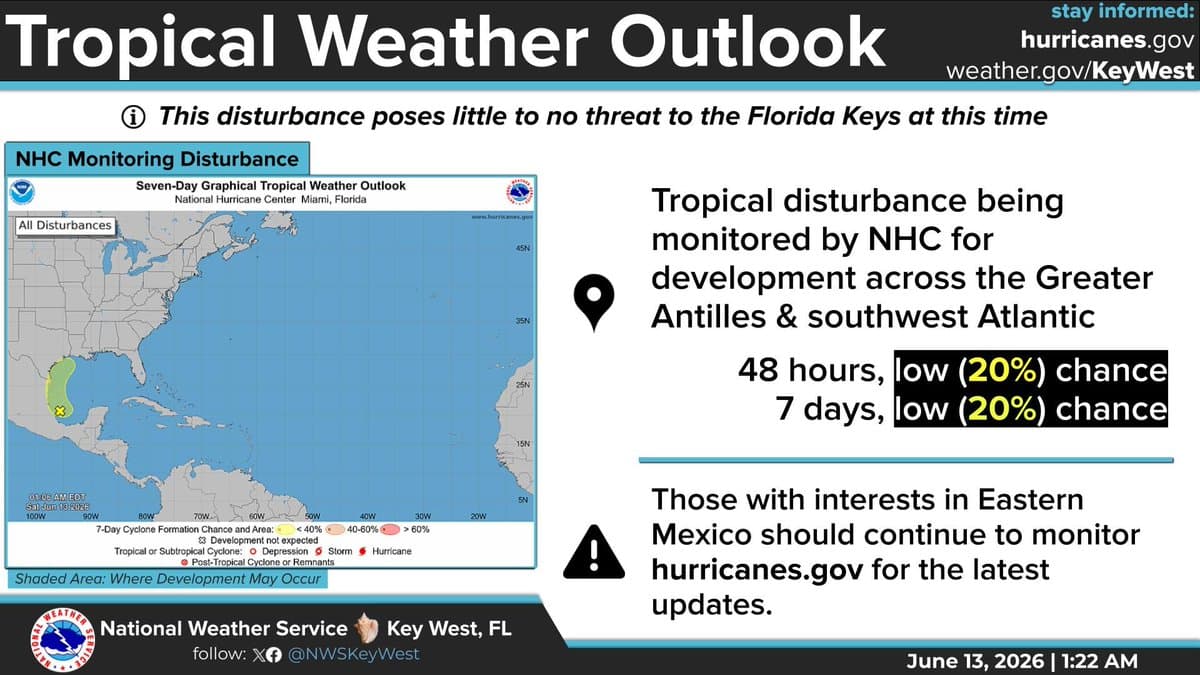
A broad low over the Bay of Campeche was not a Florida Keys threat, but it was the kind of system Monroe County watches closely because the forecast can change quickly once it crosses land. The National Hurricane Center said showers and thunderstorms around the disturbance remained disorganized and that significant development was not expected before it moved inland over eastern Mexico within about 12 hours.
The hurricane center’s outlook, issued Friday, gave the system a 30% chance of formation in the next 48 hours and a 30% chance over seven days. It said the low could re-emerge over the northwestern Gulf of America on Tuesday or Wednesday, where conditions were expected to be only marginally conducive for development.

For the Florida Keys, the message from National Weather Service forecasters in Key West was straightforward: no threat from this system. Their local climate update said the Bay of Campeche disturbance carried only a 10% chance of development in both 48 hours and seven days, with rain and thunder chances in the Keys expected to stay elevated only briefly before easing early next week.
What would have to change for Monroe County to notice the system more directly is fairly specific. The low would have to survive its move across eastern Mexico, stay organized enough to re-emerge over open water, and then find enough support in the northwestern Gulf to strengthen. Even then, the National Hurricane Center said the environment there looked only marginally favorable, which kept the near-term risk low for South Florida and the island chain.
Still, Monroe County Emergency Management treats early-season systems as a reminder, not a false alarm. Hurricane season runs from June 1 through November 30, and county guidance continues to stress preparedness, including re-entry sticker programs for residents and property owners. That caution makes sense in the Keys, where the county says coastal flooding can occur even when a storm is not directly nearby because of the islands’ low elevation and porous limestone.
For Monroe County, the concern was not this disturbance alone. It was the speed with which a quiet Gulf setup can shift, and how quickly the Keys can feel the effects of a storm that never makes a direct landfall.
This article was produced by Prism’s automated news system from verified source data, official records, and press releases, then run through automated quality and moderation checks before publishing. The system is built and supervised by the people who set the standards it runs under. Read our full AI policy.
Did this article answer your question?