Kivgiq brings North Slope communities together through dance and fellowship
Messenger races, elders, and young dancers turned Kivgiq into a six-day reunion that linked villages, families, and a growing online audience.
Kivgiq gave North Slope residents something that is easy to miss from the outside: a working network of family ties, shared memory, and public hospitality. The six-day gathering in Utqiaġvik brought people into Barrow High School Gym for dance, storytelling, gift-giving, and the practical business of being together, while thousands more followed online from Alaska, the lower 48, Canada, New Zealand, the Philippines, and beyond. For a borough spread across vast distance, the event functioned less like a stand-alone festival and more like a civic link between villages, generations, and households.
A gathering built on movement, travel, and welcome
The North Slope Borough set Kivgiq 2025 for February 10-15, with the theme translated as “Community strength through individual action.” That framing fit the way the celebration worked in practice: participants came from across Alaska and the circumpolar world, including Russia and Canada, and the borough’s event page also provided travel support details for visitors, including an Alaska Airlines discount code and a meeting fare code for travel to Utqiaġvik. Those logistics matter because Kivgiq is not a neighborhood event. It is a region-wide gathering that asks families, dancers, elders, and organizers to coordinate across weather, distance, and expense.
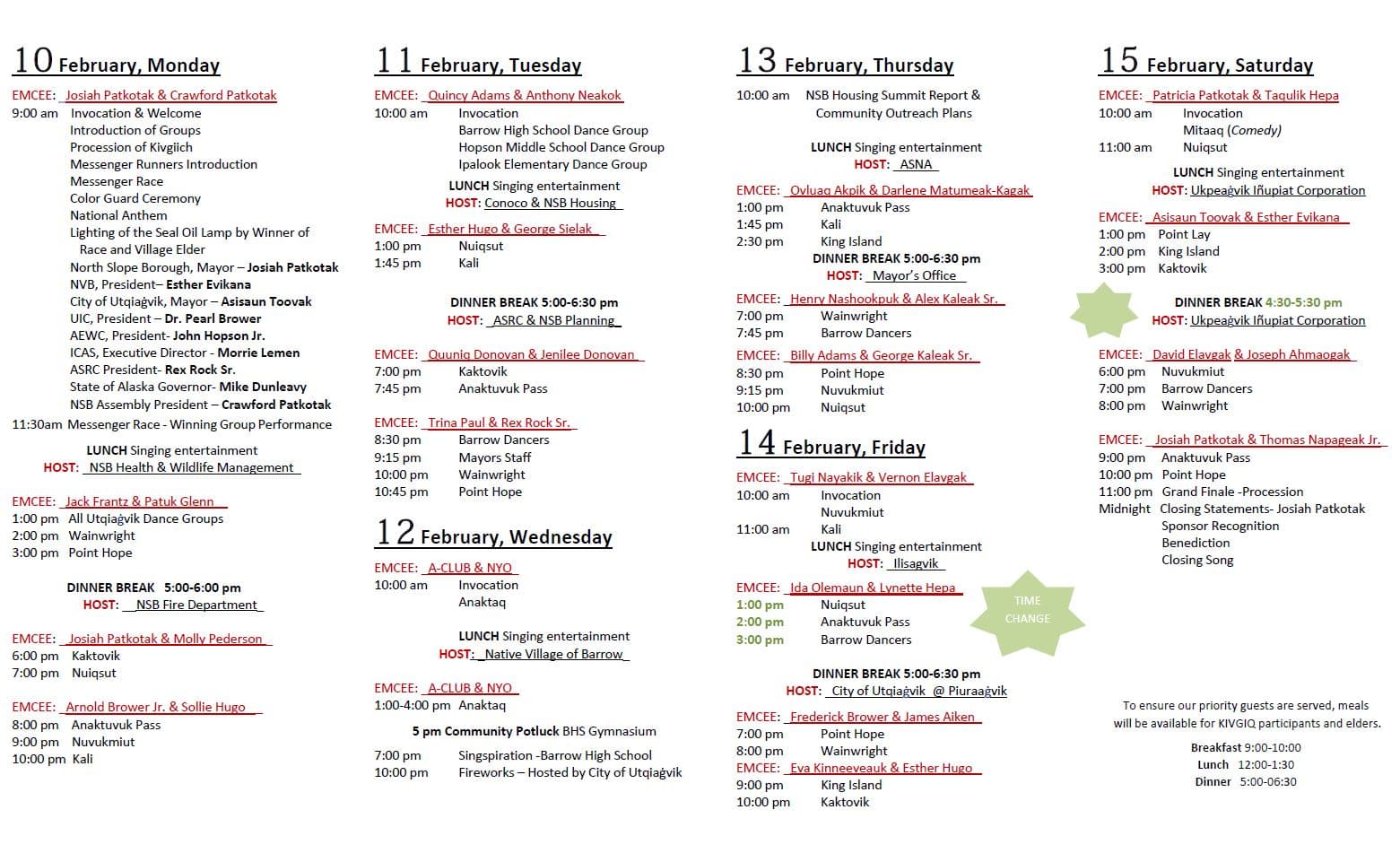
The main venue was Barrow High School Gym, where the program brought together traditional dances, arts and crafts, bartering, storytelling, and gift giving. The official agenda also placed North Slope leaders and institutions at the center of the gathering, including North Slope Borough Mayor Josiah Aullaqsruaq Patkotak, Native Village of Barrow President Esther Evikana, City of Utqiaġvik Mayor Asisaun Toovak, and Iisaġvik College President Dr. Pearl Brower. That combination of ceremony and institutional support shows how Kivgiq operates as shared community infrastructure, not just a stage for performance.
Messenger runners and the old exchange system
The 2025 agenda made clear that Kivgiq still carries the shape of its older trade-and-invitation roots. It began with a procession of Kivgiich Messenger Runners and the Messenger Race, a role that connects today’s gathering to the historic system in which the fastest runners traveled to neighboring villages to invite people to come. KNBA’s coverage described the race as taking place outside Barrow High School over about 150 yards, and the runner representing Wainwright finished first, giving Wainwright dancers the honor of opening the event.

That opening mattered because it linked speed, pride, and inter-village reciprocity in a single moment. Performances were listed from Utqiaġvik, Wainwright, Point Hope, Kaktovik, Nuiqsut, Anaktuvuk Pass, Nuvukmiut, and Kali, turning the gym into a map of North Slope and broader Iñupiaq connections. The program also included the lighting of the seal oil lamp, a community potluck, singing entertainment, fireworks hosted by the City of Utqiaġvik, and meals set aside for participants and elders, all of which gave the event a rhythm that was ceremonial, social, and practical at once.
Why Kivgiq still reaches across generations
The borough describes Kivgiq as an ancient Iñupiaq tradition, and the historical record shows why its return matters so much. A scholarly article says Iñupiaq people celebrated Kivgiq for centuries before earlier forms were discontinued in the early 20th century because of social, economic, and environmental pressures. The modern version was reconstructed in 1988 after a lapse of more than 70 years, with the explicit goal of strengthening collective identity and ethnic pride, and the first modern Kivgiq drew more than 2,000 participants. The borough says the revival took place under then-Mayor George Ahmaogak, placing him at the center of that restoration.
What stands out in 2025 is not just continuity, but renewal. KNBA reported that Susan Patkotak, 19, received a standing ovation for a new dance she created about being unable to dance when she was younger. That moment showed younger residents taking an active role in carrying tradition forward, not only learning inherited forms but also adding their own experience to them. Kivgiq made room for that kind of expression alongside elder knowledge, which is part of why the event still feels current rather than archival.
Healing, remembrance, and the work of being together
Participants described the gathering in terms that went beyond celebration. David Elavgaq of the Tagiugmiut Dancers said Kivgiq felt like healing after the long, dark winter days. Anaktuvuk Pass elder Sollie Hugo said the event mattered because residents had lost relatives during the year and needed to lift themselves up together. Those comments point to one of Kivgiq’s most important social functions: it gives people a public place to grieve, reconnect, and restore one another after isolation and loss.
Assembly Member Thomas Napageak Jr. of Nuiqsut said Kivgiq reminds people who they are and the deep connections they share. Mayor Josiah Aullaqsruaq Patkotak said he was grateful to staff, community dance leaders, volunteers, and sponsors, which reflects how many hands it takes to make the event work. In a region where families are separated by long distances and harsh conditions, that kind of organized gathering is more than ceremonial. It is a form of social maintenance.
Food, audience, and the scale of the gathering
Kivgiq 2025 also showed how the tradition now reaches far beyond the walls of the gym. The borough said more than 700 people attended in person, while more than 9,400 unique viewers watched online and collectively logged over 7,500 hours of coverage. That audience came from Alaska, the U.S., Canada, New Zealand, the Philippines, and other places, extending the celebration into a global circle of viewers who still found meaning in a North Slope event rooted in place.
Traditional foods served during the festival included maktak, caribou, and goose soup, reinforcing the event’s role as a shared table as much as a stage. That combination of food, dance, messenger runs, and inter-village participation shows why Kivgiq endures. It keeps families moving toward one another, gives young people a place to step forward, and lets elders see the traditions they carried continue to live in public.
This article was produced by Prism’s automated news system from verified source data, official records, and press releases, then run through automated quality and moderation checks before publishing. The system is built and supervised by the people who set the standards it runs under. Read our full AI policy.
Did this article answer your question?