North Slope Borough fire model relies on volunteers and career crews
When a village fire starts on the North Slope, local volunteers are the first line before weather and distance slow backup. The system depends on them.
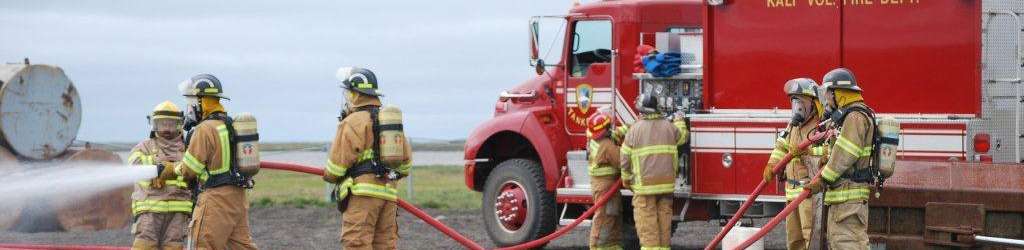
When a village fire starts on the North Slope, the first crew on scene is usually local, not distant. Villages sit far apart, winter weather can turn fast, and road access is limited or nonexistent, so the first critical minutes depend on whoever is already there with turnout gear, training, and enough hands to act.
How the borough’s fire model is built
The North Slope Borough Fire Department says its mission in the FY26-27 budget is to safeguard life and property through a dedicated blend of community volunteers and professional personnel. An earlier FY22-23 budget used nearly the same framework, saying the department’s job is to preserve life and property using community volunteers and career personnel to deliver ground and air emergency medical services, rescue, fire suppression, prevention, and training.
That mission matters because it describes a system designed for distance. A village fire on the North Slope is not just about pulling hose or forcing a door, it is about getting enough people to the scene, keeping them coordinated, and making sure someone can also handle medical care, scene safety, and the next call that comes in before the first one is over.
The local names behind the response
The borough’s village fire pages make that structure concrete. The Fire Department maintains a Village Volunteer Fire Department page, a village operations section, a training section, and a Become a Volunteer page, which shows that staffing and readiness are ongoing public safety work. The contacts page also identifies the people residents actually work with: Deputy Fire Chief Kalen K. Texeira and Battalion Chief Philip Sittichinli.
In Utqiagvik, the contacts page lists Anthony Neakok as Fire Chief/Director. In Anaktuvuk Pass, Brian Gordon is listed as Village Fire Chief for the volunteer fire department at 1027 Access Rd. The village contacts page gives one main department phone number, 907-852-0234, and fax number, 907-852-0235, for those village fire operations contacts.
That local structure matters because in a small community, the responder is often a neighbor, a relative, or someone whose family has lived with the same weather, snowmachine routes, and housing conditions as everyone else on the block.
Medevac is part of fire protection, not separate from it
On the North Slope, fire response and medical transport are tied together. The Fire Department’s Aeromedical division partners with the Search and Rescue Department to provide critical care medical transport throughout the borough. The North Slope Borough Search and Rescue Department says its mission is to provide safe, reliable, and rapid airborne response to medical evacuation, search and rescue missions, and other emergencies across the North Slope region.
That airborne capacity fills a gap that geography creates. A 2022 borough release on the new PC-24 air ambulance said the aircraft provides a crucial life-support link for 9,800 residents across nearly 95,000 square miles of harsh territory. When a fire victim, trauma patient, or ill resident needs to move fast, that aviation network can be the difference between treatment and delay.
What the jobs actually require
The borough’s public job listings show how broad village fire work really is. A North Slope Borough Firefighter/EMT posting says the job responds to emergencies, performs fire suppression, rescue, emergency care during ground and air ambulance transport, and assists with departmental training. A Village Fire Lieutenant posting says village firefighters respond to fire suppression, rescue, and emergency care during ground ambulance transport, while also helping with supervision and training.
A Village Fire Chief posting for Point Lay goes even further, saying the chief commands fire, rescue, and emergency medical operations in the village and provides supervision, leadership, and training for emergency responders. That is not a narrow specialty job. It is a multi-role public safety assignment that has to work in a place where the next town over may be too far away to matter in the first hour.
Training and staffing are the pressure points
The fire model is only as strong as the people available to run it. A North Slope Borough Facebook video said the volunteer firefighter roster is at its lowest in years, a warning sign in a system that depends on local responders to start the incident response before outside help can arrive. In a borough built on long distances and harsh weather, a thinner roster affects every household, because one fewer trained volunteer can mean fewer people to staff the engine, fewer hands to move a patient, and more strain on the responders who are already working.
There are also signs that the borough is trying to rebuild the pipeline. A Barrow Volunteer Fire Department Facebook post marked the completion of the 2026 North Slope Borough State of Alaska Firefighter 1 Academy, showing that formal training remains part of the recruitment strategy. Another Barrow Volunteer Fire Department post said Fire Chief Brian Gordon has dedicated himself to serving the Anaktuvuk Pass community for more than 29 years, a reminder that long service and local knowledge still anchor the volunteer side of the system.
Why the volunteer side changes the outcome
The borough’s model works because volunteers and career crews are not separate worlds. Volunteers are often the first ones to a burning house, the first to help with rescue, and the first to stabilize a scene until additional resources arrive. Career personnel, aeromedical crews, and Search and Rescue extend that response into transport, advanced care, and larger incidents, but they depend on the local front line to hold the scene together.
In a place where backup can be delayed by weather, darkness, and sheer distance, the volunteer roster is not an extra layer. It is the layer that keeps a village fire from becoming a tragedy before the rest of the system can reach it.
This article was produced by Prism’s automated news system from verified source data, official records, and press releases, then run through automated quality and moderation checks before publishing. The system is built and supervised by the people who set the standards it runs under. Read our full AI policy.
Did this article answer your question?