Utqiagvik’s Iñupiat Heritage Center keeps culture and whaling traditions alive
Utqiagvik’s Iñupiat Heritage Center is where Elders, artists, and whaling crews still work side by side to teach language, make tools, and pass on living traditions.

Inside a building on 5421 N Star St. in Utqiagvik, culture is not just displayed. It is practiced, repaired, taught, and handed down in real time, from whaling crews working on skin boats to artists shaping and showing their crafts.
The Iñupiat Heritage Center sits at the center of that daily life. It is a National Park Service affiliated area linked to New Bedford Whaling National Historical Park, and it opened and was dedicated in February 1999. The North Slope Borough says its mission is simple and ambitious at once: bring people together to promote and perpetuate Iñupiat history, language, and culture.
A working landmark in the borough seat
Utqiagvik is the North Slope Borough seat and administrative center, and the Heritage Center fits squarely inside that civic landscape. The building is not only a stop for visitors passing through the northernmost city in the United States. It is part of the borough’s cultural infrastructure, used by families, teachers, artists, and whaling crews who need a place that can handle both public display and community work.
That dual purpose is built into the structure itself. The National Park Service describes the center as a spacious facility with exhibits, artifact collections, a library, a gift shop, and a traditional room. The borough also says the center supports Iñupiat artists by giving them a place to work and showcase arts and crafts, which makes the building useful long after the exhibition floor is quiet.
What happens in the traditional room
The Traditional Room is where the center’s living function becomes easiest to see. The borough says it is used for construction or repair of traditional whaling boats and other subsistence tools, and the National Park Service says Elders-in-Residence and Artists-in-Residence use the room to demonstrate and teach crafts. In February and March, whaling crews build, repair, and cover their skin boats there, turning the room into an active worksite rather than a symbolic space.
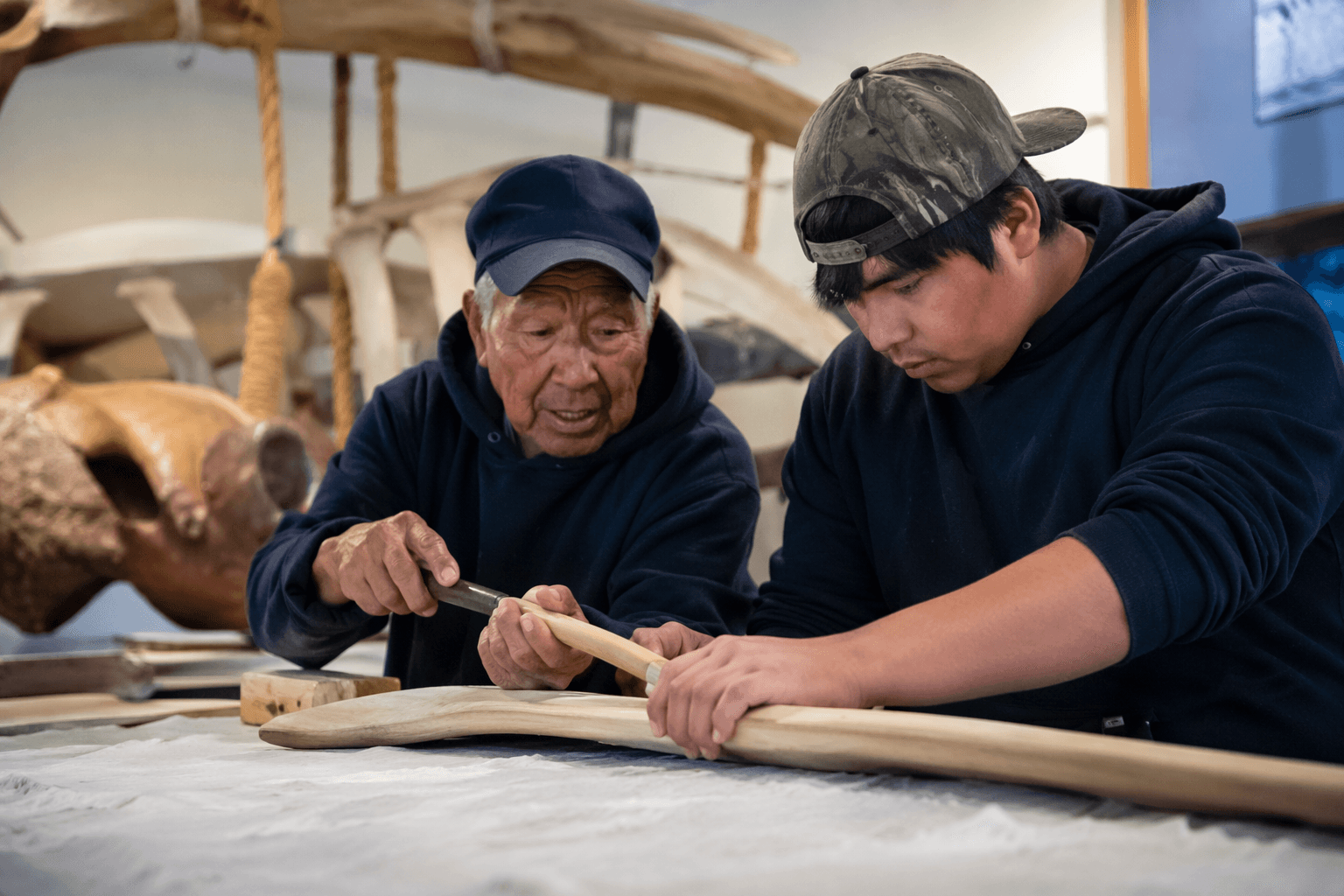
That matters because the work is tied to skills that cannot be preserved by display alone. A repaired boat, a covered skin boat, or a finished tool carries knowledge of materials, timing, weather, and technique. The center makes room for that knowledge to stay in use, with Elders, artists, and crews working where younger people can see the process instead of only the finished object.
The building’s flexibility extends beyond whaling and crafts. The borough says it has a multi-purpose room and classroom that can be rented for events, outreach classes, and department meetings. That makes the center useful as a neighborhood gathering place and as a borough resource, not just as a museum stop.
Language work reaches beyond the walls
The Heritage Center is also part of the borough’s language effort. The borough says the Iñupiat History, Language, and Culture Department worked with Rosetta Stone to create an Iñupiatun version of the software and offers free online licenses to the public. That puts language access into homes and schools across the borough, not just inside the center itself.
The educational reach is broad. The borough says the Heritage Center participates in programs and projects meant to preserve and perpetuate local Iñupiat culture in Utqiagvik and all of the villages that make up the North Slope Borough. That regional role matters because the center is not serving one neighborhood or one audience. It helps support a cultural network that stretches across the coast and inland villages, where language use, craft traditions, and subsistence knowledge all remain connected.
The borough also describes its museum and heritage work as grounded in the philosophical foundation of the qargi, the traditional communal house and learning space. That helps explain why the center blends gathering, teaching, and making. It is designed to function the way a qargi functions: as a place where knowledge is shared in person, through work, conversation, and observation.
Part of a larger IHLC system
The Iñupiat Heritage Center does not stand alone. The IHLC Central Office manages and operates both the Heritage Center and the Simon Paneak Memorial Museum. That gives the borough a coordinated cultural system, with the center in Utqiagvik linked to other preservation and education work across the North Slope.
IHLC also hosts or participates in events including Kivgiq, Elders & Youth conferences, and community outreach workshops. Those programs give the Heritage Center a role that goes beyond static interpretation. It becomes part of the borough’s calendar of cultural exchange, where young people, elders, artists, and community members meet in settings shaped around learning and continuity.
That institutional structure matters because it shows the center is not an isolated attraction. It is one part of a larger public effort to support language, preserve oral history, and keep Iñupiat cultural practice visible in daily life.
Why the history inside the building still matters now
The National Park Service places the center within a longer story of Iñupiat bowhead whaling and 19th-century commercial whaling. Its interpretation links the people of Utqiagvik to a period when New England whalemen came north for bowhead whale baleen and blubber, while Alaska Native people supplied food, shared clothing designs adapted to Arctic conditions, and sheltered shipwrecked crews. That history is not presented as something sealed off in the past; it runs into subsistence whaling today.
The affiliation with New Bedford Whaling National Historical Park connects Utqiagvik to New Bedford, Massachusetts, but the strongest story is still local. The Heritage Center is where Iñupiat language, art, whaling knowledge, and teaching continue to move from one generation to the next. In a borough where distance is measured in villages and seasons as much as miles, that kind of place remains essential.
This article was produced by Prism’s automated news system from verified source data, official records, and press releases, then run through automated quality and moderation checks before publishing. The system is built and supervised by the people who set the standards it runs under. Read our full AI policy.
Did this article answer your question?