Myers Grade School blends history and learning in Cannelton
Myers Grade School still anchors Cannelton as a working landmark, thought to be Indiana’s oldest public school building in continuous operation.

Myers Grade School still matters in Cannelton because it is both a classroom and a landmark. The building at 615 Taylor Street is part of a living public-school system that also includes Cannelton Jr. Sr. High School at 109 S 3rd Street and William Bennett Early Learning Center at 411 Washington Street. Perry County tourism materials describe Myers as thought to be the oldest public school building in continuous operation in Indiana, and possibly in the United States, which gives the school a rare place in the county’s present-day story.
A historic building that still serves students
What makes Myers stand out is not just its age, but the fact that it still functions inside a modern district. Cannelton City Schools describes its mission as creating a secure and respectful community setting where everyone is encouraged toward personal and global excellence, and Myers remains one of the places where that mission is carried out every day. In a town as compact as Cannelton, the decision to keep a historic school in use says as much about civic priorities as any preservation plaque could.
That continuity matters because it keeps the district’s history visible without freezing it in place. Myers is not a boarded-up reminder of an earlier era or a building preserved only for tours and photographs. It remains part of the everyday geography of public education, which means students, families, and staff still move through a structure that has anchored local life for generations.
The late-1860s roots that still shape the district
The school’s timeline tells the story of Cannelton’s educational roots. Perry County tourism materials place Myers Grade School’s opening in 1869, while Cannelton City Schools traces the district’s work back to 1868 and says it has been shaping future leaders since then. The one-year difference does not weaken the story; it points to how quickly the district and the building became intertwined in the same late-1860s chapter of the town’s history.
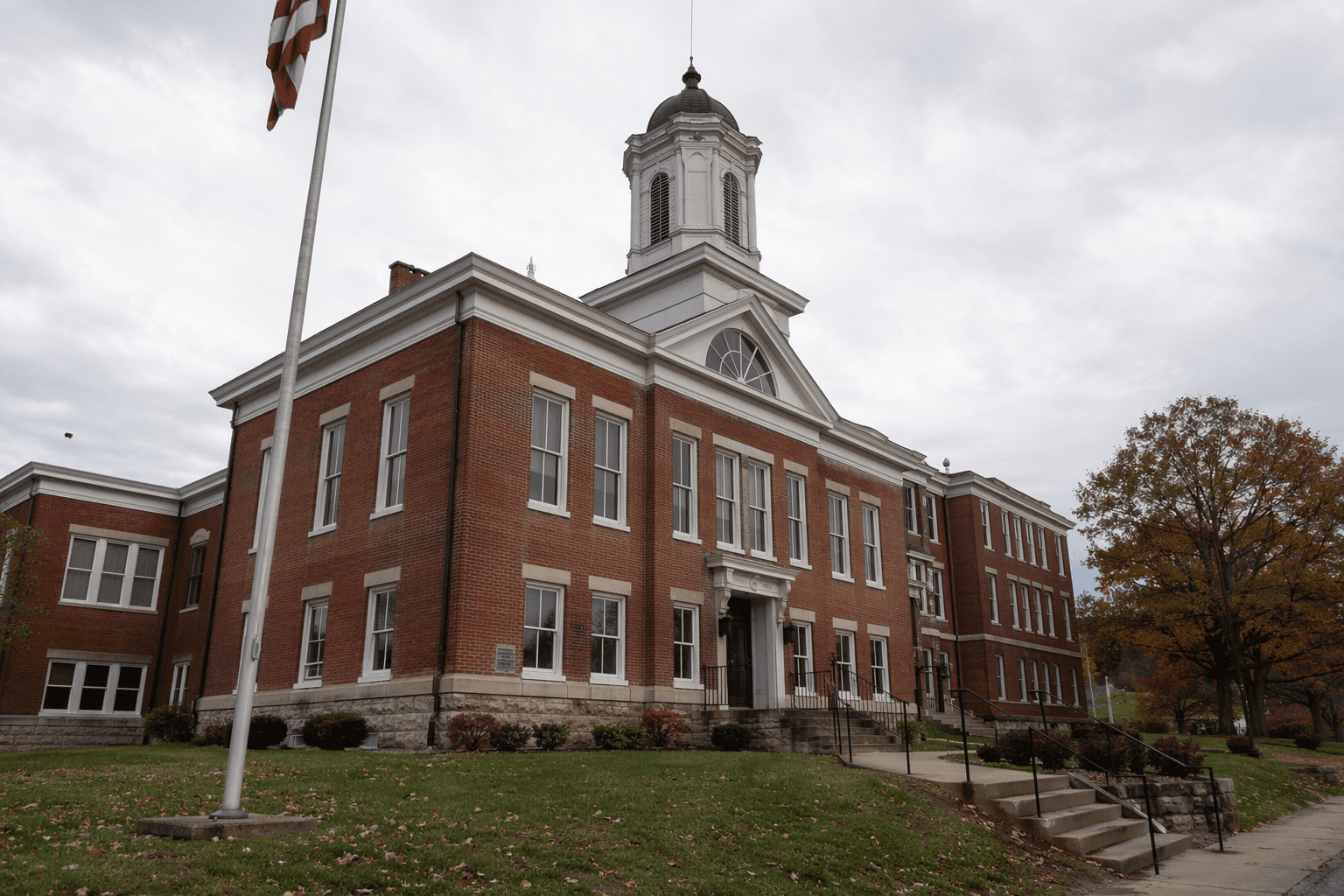
That matters in a place where institutions carry a deep memory. A school that has stood in the same community for more than a century and a half becomes part of how residents orient themselves to the town itself. Myers is not only a marker of how long Cannelton has educated children locally, but also a reminder that the district’s identity was being built at the same time the building was coming into use.
Why the name The Free School still resonates
Local history materials identify Myers Grade School as The Free School, a name that helps explain why the building still holds meaning beyond its brick and mortar. The name suggests public access, shared ownership, and a school that belongs to the whole community, not to one generation alone. In Cannelton, where people tend to recognize institutions by the role they play in town life, that kind of name carries real weight.
The legacy also helps explain why alumni and parents continue to care about the building long after they leave its classrooms. Schools in small towns often become shorthand for neighborhood memory, family history, and the experience of growing up in one place. Myers has that kind of power because it is both familiar and exceptional: familiar because it still serves children, exceptional because so few public-school buildings anywhere can claim such long, continuous use.
What Myers says about preservation and progress
Keeping Myers in active use shows how Cannelton balances modernization with preservation. The district does not have to choose between new facilities and old ones in a simple either-or way; it uses a compact network of buildings that includes the historic Myers site, the junior-senior high school on South Third Street, and the early learning center on Washington Street. That arrangement lets the district preserve a recognized landmark while keeping instruction spread across spaces that still meet current needs.
There is also a practical lesson here for taxpayers and neighborhood continuity. A building that stays in service does more than survive, it keeps value circulating through the community by remaining useful. Myers gives Cannelton a visible example of stewardship that is not abstract: a school known by generations, still occupied by students, still part of the district’s daily life, and still defining the way the town understands its own past and its present at the same time.
How to understand Myers in the town today
Seen from Taylor Street, Myers Grade School is more than an old schoolhouse with a story attached to it. It is one of the places where Cannelton’s educational history is still being written, alongside the district’s other active campuses and its stated commitment to respect, security, and excellence. The building’s age, its nickname, and its continued use all point to the same conclusion: this is a landmark that was preserved by remaining useful.
That is why Myers still matters now. It links the late 1860s to the present in a way residents can see, name, and drive past every day, and it shows how Perry County can protect a landmark without putting it in the past tense.
This article was produced by Prism’s automated news system from verified source data, official records, and press releases, then run through automated quality and moderation checks before publishing. The system is built and supervised by the people who set the standards it runs under. Read our full AI policy.
Did this article answer your question?