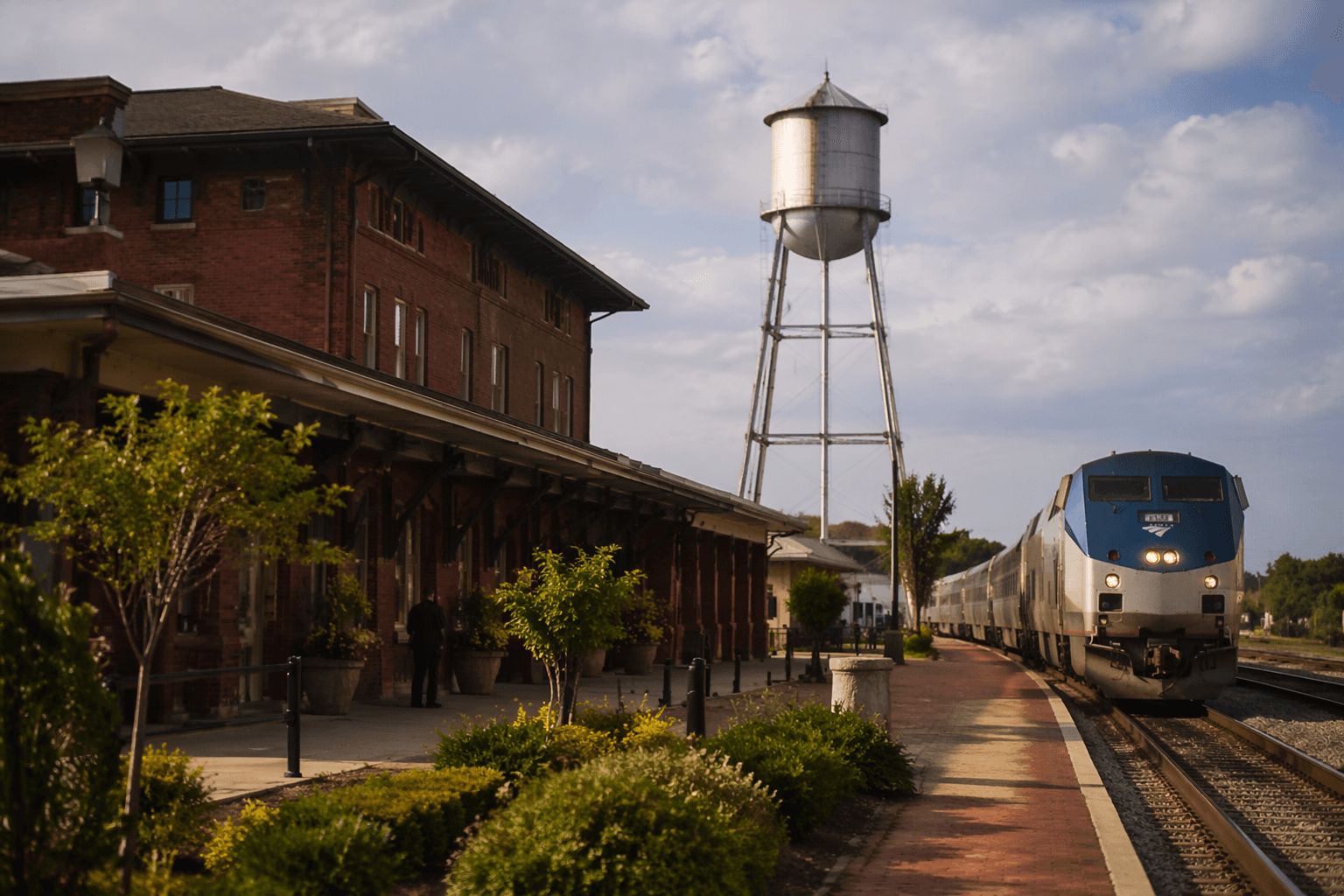
Marks downtown historic district offers walkable tour of county history
Marks’ one-square-mile historic district turns downtown into a short walk, and the depot’s next reuse could bring more foot traffic, business activity, and civic life.

Marks’ downtown historic district condenses the county seat into about one square mile, so the story of Quitman County can be read block by block on foot. Listed on the National Register on March 11, 2024, the district contains 88 resources, including 67 contributing buildings and structures that help define the place today.
A walkable core in the county seat
The district sits in the center of Quitman County in the northern part of the Yazoo-Mississippi Delta region in northwest Mississippi, and its boundaries are tight enough to make a self-guided walk practical. It is roughly bounded by Peach Street on the east, Chestnut Street on the north, Third Street on the west, and Humphreys Avenue, Walnut Street, Maple Street, and Main Street on the south. That compact grid is one reason the district works as a real downtown-use guide instead of a symbolic preservation label.
Start at the Quitman County Courthouse, the clearest civic anchor in Marks. The courthouse was built in 1910-11, designed by Chamberlin & Associates in the Neoclassical style, and designated a Mississippi Landmark in 1990; one county post places its construction in 1911, when the county seat moved to Marks. Recent local reporting says the building has secured more than $700,000 in restoration funding to protect its dome, windows, and the civic services that still make downtown matter every day.
From the courthouse, the route naturally turns toward East Main Street and the rail-era commercial edge of the district. The district’s nomination describes a cohesive collection of early- to mid-20th-century commercial, agricultural, transportation, and governmental buildings, and that mix is visible in the property list itself. Potato Warehouse #1, Storage Warehouse #2, Big 3 Lumber Company, and a Cotton Gin Engine at 300 Cherry Street show how storage, lumber, and farm processing once sat close to the center of county government.
What to look for on the walk
- At the courthouse, the key detail is not just the architecture but the function. It still ties the downtown grid to county government, which keeps the surrounding blocks active for filings, meetings, and routine business.
- On East Main Street, the rail history becomes visible through the old Marks Y&MV Railroad Depot. Great American Stations says the former passenger depot opened in 1904 and still stands about a block south of the Amtrak station, which helps explain why the street pattern and railroad story belong together.
- At 300 Cherry Street, the Cotton Gin Engine points to the agricultural side of the county seat’s economy. Paired with the warehouse and lumber properties, it shows that downtown Marks was never just offices and storefronts, but also a working storage and processing district.
- Big 3 Lumber Company, now associated with the Quitman County Economic & Tourism Board, links the historic core to present-day reuse conversations. That connection matters because the future of a district like this depends on whether older buildings can still carry useful daily functions.
The district is significant for commerce and politics and government, and that combination explains why it reads so clearly on foot. The streets are close together, the uses are layered, and the resources are still grouped in a way that makes the town’s historical economy legible without a map full of interpretive clues.
Why the district carries economic weight now
The National Register is the nation’s official list of cultural resources worthy of preservation, and Mississippi has more than 1,300 National Register listings statewide. In Marks, the county says the designation is meant to do more than recognize old buildings: it is supposed to attract private investment, generate jobs, enhance property values, and augment state and local revenues through rehabilitation of historic structures.
That policy framework matters because downtowns like Marks are being judged less by what they once were than by what they can still do. A historic district can help move stalled properties back into service, especially when rehabilitation tax incentives are available for older buildings. In practical terms, that can mean storefronts with a reason to open, sidewalks with more reason for people to use them, and public buildings that continue to anchor the center of town.
The depot is the next test case
The biggest single question in the district is the old Marks Y&MV Railroad Depot. The county’s depot flyer describes it as a split-level wood-frame railroad depot built in the early 1900s, in fair to poor condition, and currently unusable as a farmers market because of its former restaurant use. A county funding request places the building in the Yazoo and Mississippi Valley Railroad system, which was incorporated in 1882 under Illinois Central ownership, and says the latest restaurant use ended in 2019, leaving the depot vacant.
That history gives the building a clear place in the downtown story. It is not an isolated landmark, but part of a rail-and-commerce corridor that once linked transportation, retail, and public life in the same small footprint. If the county stabilizes the structure and moves ahead with the tourism-zone planning already reflected in its document repository, the depot could become one of the few buildings in Marks with the potential to generate regular pedestrian traffic outside county office hours.
That is the practical consequence residents would notice first. A successful reuse would not just preserve a building; it would change how people move through East Main Street, where they park, which blocks they pass through, and which small businesses benefit from daily foot traffic. The county’s materials point toward site plans, a cost estimate, and a farmers market concept, which means the next phase is less about vision than about whether those plans can be turned into usable space.
Why this district works as a downtown guide
What makes the Marks downtown historic district useful is that it is small enough to experience in one visit but rich enough to explain the county’s larger economy. The courthouse shows how government took root in Marks after the county seat moved. The depot shows the rail connection that helped build the commercial core. The warehouses, lumber company, and cotton gin engine show how agriculture and storage kept that core busy.
For Quitman County, the district now functions as both a walking route and a policy map. If the courthouse restoration continues and the depot moves from vacancy toward reuse, the changes will not be abstract. They will show up in the daily life of downtown Marks: more reasons to walk, more reasons to stop, and a stronger center of gravity for civic and small-business activity.
This article was produced by Prism’s automated news system from verified source data, official records, and press releases, then run through automated quality and moderation checks before publishing. The system is built and supervised by the people who set the standards it runs under. Read our full AI policy.
Did this article answer your question?