Glen Hill Cemetery preserves Rockwall County's Black pioneer history
Glen Hill Cemetery is Rockwall County’s last clear trace of The Settlement, a Black community erased from the modern map. Its protection now depends on deed records and county action.
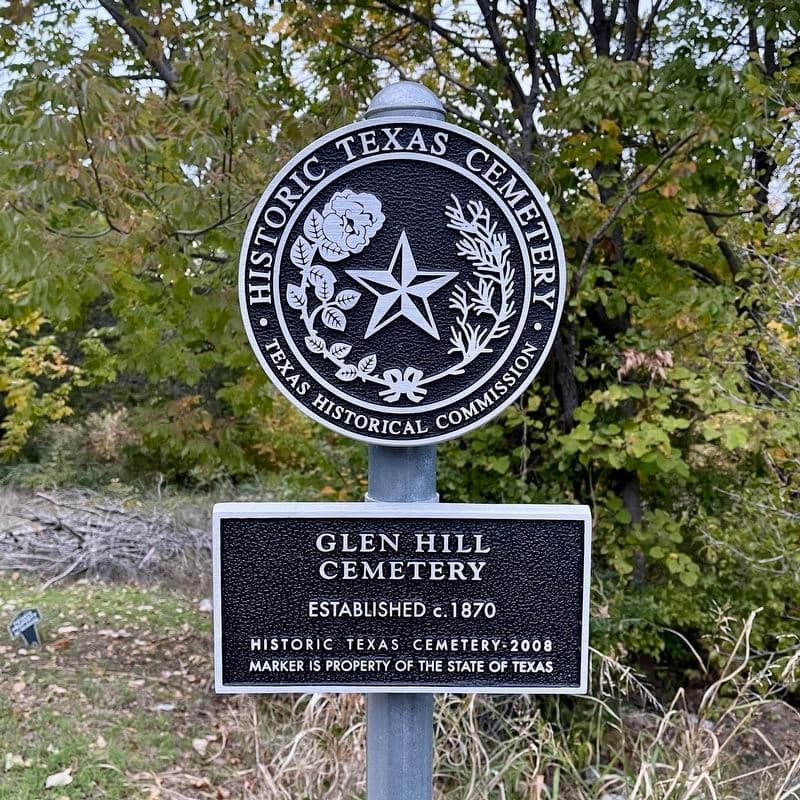
The small cemetery on Glen Hill Way sits about 300 feet west of Ridge Road/FM 740, but its footprint tells a much larger story than 1.27 acres. Glen Hill Cemetery is the sole surviving piece of The Settlement, also known as The Bottoms, the African American community that once stood near today’s Harbor development in Rockwall. Its survival makes it one of the county’s most important public records of Black pioneer life, and one of the few places where that history is still visible on the ground.
A burial ground that records a vanished community
The Texas Historical Commission places Glen Hill Cemetery’s establishment circa 1870 and classifies it under cemetery, African American topics, and pioneers. Those subject codes matter because they identify the site as more than a resting place for the dead. They mark it as evidence of early settlement, family networks, and the post-Civil War Black history that helped shape Rockwall County long before suburban growth remade the area.
The Rockwall County GIS StoryMap gives the site its sharpest local context. It identifies Glen Hill as a historic African American burial ground and says it is the only remaining portion of The Settlement or The Bottoms. That means the cemetery is not just nearby to the erased neighborhood, it is the neighborhood’s last surviving physical record. In a county where roads, retail, and waterfront development now define the landscape, that kind of remnant carries public value that cannot be replaced once it is lost.
Why the designation matters now
Historic Texas Cemetery recognition, which Glen Hill received in 2008, is not symbolic decoration. The Texas Historical Commission says the designation records a cemetery’s location and boundaries in county deed records, helps alert current and future landowners to the burial ground’s presence, and serves as a prerequisite for an Official Texas Historical Marker. Those protections are the difference between a place that can be remembered and a place that can be inadvertently overlooked as land changes hands.
That is where the preservation burden becomes concrete. Rockwall County’s deed records, current landowners along Glen Hill Way, and the Texas Historical Commission all have a role in making sure the cemetery remains identifiable and protected. Without that documentation, a small site like Glen Hill can become vulnerable to neglect, boundary confusion, and the slow disappearance that often follows suburban expansion.
The Texas Historical Commission’s atlas notes more than 12,000 cemeteries statewide, placing Glen Hill within a much larger preservation effort across Texas. But the statewide scale does not reduce the local urgency. It underscores how often cemeteries become the last surviving proof of communities that were never fully preserved elsewhere.
What The Settlement reveals about Rockwall County
The Settlement, or The Bottoms, fits the Texas State Historical Association’s definition of a freedmen’s settlement: a post-emancipation community formed by formerly enslaved people and their descendants. That history is central to understanding why a cemetery can carry so much weight. In many freedmen’s communities, churches, homes, schools, and businesses disappeared first, leaving burial grounds as the most durable evidence that families lived, worked, and built lives there.
THC’s African American history guide places family cemeteries alongside Rosenwald schools, civil rights archives, and historic neighborhoods as key parts of Texas Black heritage. Glen Hill belongs in that company. Its graves may be simple, but the site documents migration, kinship, and endurance in a county that later evolved from early settlement into a suburban area near Dallas.

Rockwall County’s own history page traces the county name to the natural rock wall discovered in the early 1850s. That origin story often gets told as a landmark tale of discovery and naming, but Glen Hill reminds readers that the county’s human history also includes Black families who settled, stayed, and created lasting community on land that now appears transformed.
What could be lost without active preservation
If Glen Hill loses visibility or protection, the loss will not be abstract. The first thing at risk is documentation: the exact location, boundaries, and historical meaning that keep the site legible in county records and planning decisions. The second is maintenance, because even a protected cemetery can deteriorate if no one is responsible for clearing, marking, and monitoring it.
The third is legal protection. Historic Texas Cemetery status is the mechanism that ties the site to deed records and alerts future landowners. Without that line of defense, the cemetery’s place in a changing landscape becomes easier to ignore. The fourth is descendant access, which depends on the site remaining identifiable and reachable to families seeking burial information, remembrance, and continuity.
County recognition matters too. A site can be historically important and still function as a footnote in local planning unless county officials treat it as part of the public record. In a place as development-heavy as the land near The Harbor, recognition is not ceremonial. It is the practical step that keeps preservation from being erased by routine change.
The next concrete steps
The work ahead is straightforward, even if it is not easy. The Texas Historical Commission’s designation framework already gives Rockwall County the tools to keep Glen Hill documented in deed records, and the county can continue to use those records to keep the cemetery visible in land-use decisions. Present and future landowners near Glen Hill Way need that information to remain part of every transaction that touches the site.
- keep the cemetery’s location and boundaries visible in county records
- preserve physical access to the 1.27-acre site
- maintain recognition of Glen Hill as part of The Settlement’s surviving history
- support any future marker or interpretive work tied to the historic designation
- treat the cemetery as a county heritage site, not an isolated burial ground
For Rockwall County, the next steps are clear:
Glen Hill Cemetery is small enough to miss and important enough to lose. Its preservation now will determine whether Rockwall County keeps one of the last surviving records of its Black pioneer history or lets that history fade from view once again.
This article was produced by Prism’s automated news system from verified source data, official records, and press releases, then run through automated quality and moderation checks before publishing. The system is built and supervised by the people who set the standards it runs under. Read our full AI policy.
Did this article answer your question?