Royse City’s Futuro House stands as rare space-age landmark
Royse City’s UFO-shaped Futuro House is one of roughly 60 survivors, making a Highway 276 oddity a rare asset as the city keeps growing.
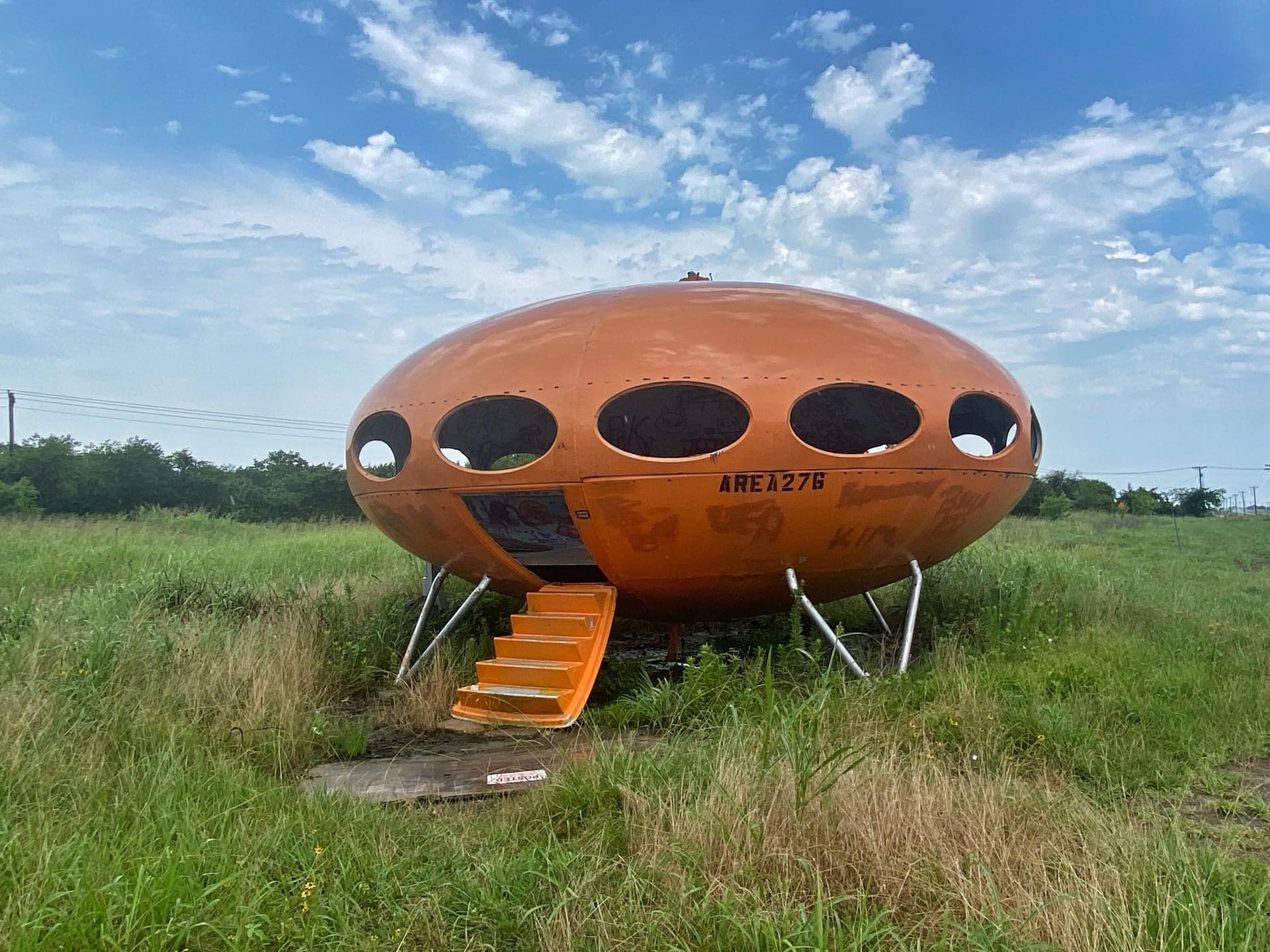
Along Highway 276 in Royse City, a UFO-shaped Futuro House sits on an overgrown lot, and its rarity is what gives it value now. Designed in the 1960s by Finnish architect Matti Suuronen, the prefabricated vacation home is one of about 100 built, with about 60 still surviving today.
A space-age object with hard numbers behind it
The Futuro House was not conceived as a novelty for novelty’s sake. DOCOMOMO International describes it as the world’s first serially produced plastic house, originally developed in 1965 as a quick-to-heat ski cabin for difficult terrain. The design was assembled from 16 fiberglass-reinforced panels and formed a compact 25-square-meter living space, a size that helps explain why it could be moved and reused rather than treated like a fixed suburban house.
That combination of portability and futuristic styling placed the house squarely in the moment when space travel, new materials and modern living were reshaping design. Royse City’s example still carries that history in plain view. Even before a visitor knows the backstory, the rounded shell and low-profile base signal that this is not an ordinary roadside building, but a surviving artifact from a specific architectural experiment.
How the Royse City house got here
The local biography is as unusual as the shape. The house was first bought in Garland, then moved to Royse City by two brothers who used it as both a business and a bachelor pad. It was later sold again and eventually abandoned, leaving the structure to age on its Highway 276 lot as the city changed around it.
That arc matters because it shows how adaptable the Futuro concept was supposed to be. A building designed to be mobile, temporary and practical for rough terrain ended up becoming fixed to one North Texas corridor, where its story outlasted its original purpose. One local account remembers a family first noticing it in the early 1990s, startled enough by the shape to stop and look, which is the same reaction many passersby still have when they spot it through the weeds.
By late 2014, the exterior had received a fresh coat of bright orange paint, while the interior had been gutted and covered in graffiti. The shell later carried the tag Area 276, a nod to both the highway and the UFO folklore that naturally gathers around a building like this. Those changes did not erase its significance; they added another chapter to a structure that has already moved through invention, reuse, decay and attention.
Why this Royse City landmark is unusually scarce
The Texas Historical Foundation says the Royse City Futuro House was one of about 100 built, and roughly 60 survive today. That means more than half are already gone, and every remaining example carries extra weight because the total pool is so small. A 2016 Atlas Obscura roundup said fewer than 50 Futuro Houses survived worldwide at that time, which shows how quickly scarcity can tighten around a once-futuristic design.
Atlas Obscura also describes the Royse City example as one of only a few remaining moveable ski chalets of its kind. That detail matters because it shifts the conversation from kitsch to preservation. The house is not valuable simply because it is odd; it is valuable because it is one of the clearest local examples of a global design trend that has nearly vanished.
For Rockwall County, that scarcity gives the building a different kind of importance than a typical roadside curiosity. A landmark with only a handful of surviving peers can function as a destination, a teaching tool and a branding device all at once. The question is not whether it is quirky enough to draw attention. It already does that. The question is whether Royse City lets the attention work for the city.
What growth in Royse City changes
Royse City’s 2030 comprehensive plan says the city is adding new restaurants, new stores and lots of people, while still aiming to preserve a real sense of community. That growth makes the Futuro House more than a relic on the edge of town. In a place where subdivisions and commercial corridors can make one city look much like another, a structure like this offers a visual identity that cannot be duplicated with standard development.
That is where the stakes become concrete. If the Futuro House is preserved and interpreted well, it can serve as a roadside attraction, a local history stop and a distinctive symbol for a city that is growing fast enough to need one. If it is left to fade, Royse City loses one of the few landmarks that tells an unusual story about the region before the next wave of retail pads and rooftops arrives.
The house also works as a preservation test case. Midcentury oddities are easy to dismiss when land values rise and visible decay sets in, but the Royse City example shows how a rare structure can become more meaningful as its surroundings change. With about 60 surviving Futuro Houses left in the world, the one on Highway 276 is not just part of the landscape. It is part of the shrinking inventory of space-age architecture that still gives North Texas a story no subdivision can replace.
This article was produced by Prism’s automated news system from verified source data, official records, and press releases, then run through automated quality and moderation checks before publishing. The system is built and supervised by the people who set the standards it runs under. Read our full AI policy.
Did this article answer your question?