Skyline Parkway, Duluth’s historic scenic spine, offers overlooks and trails
Skyline Parkway is more than a scenic drive: its 28 miles link Duluth neighborhoods, overlooks and Brighton Beach, with history built into the road itself.
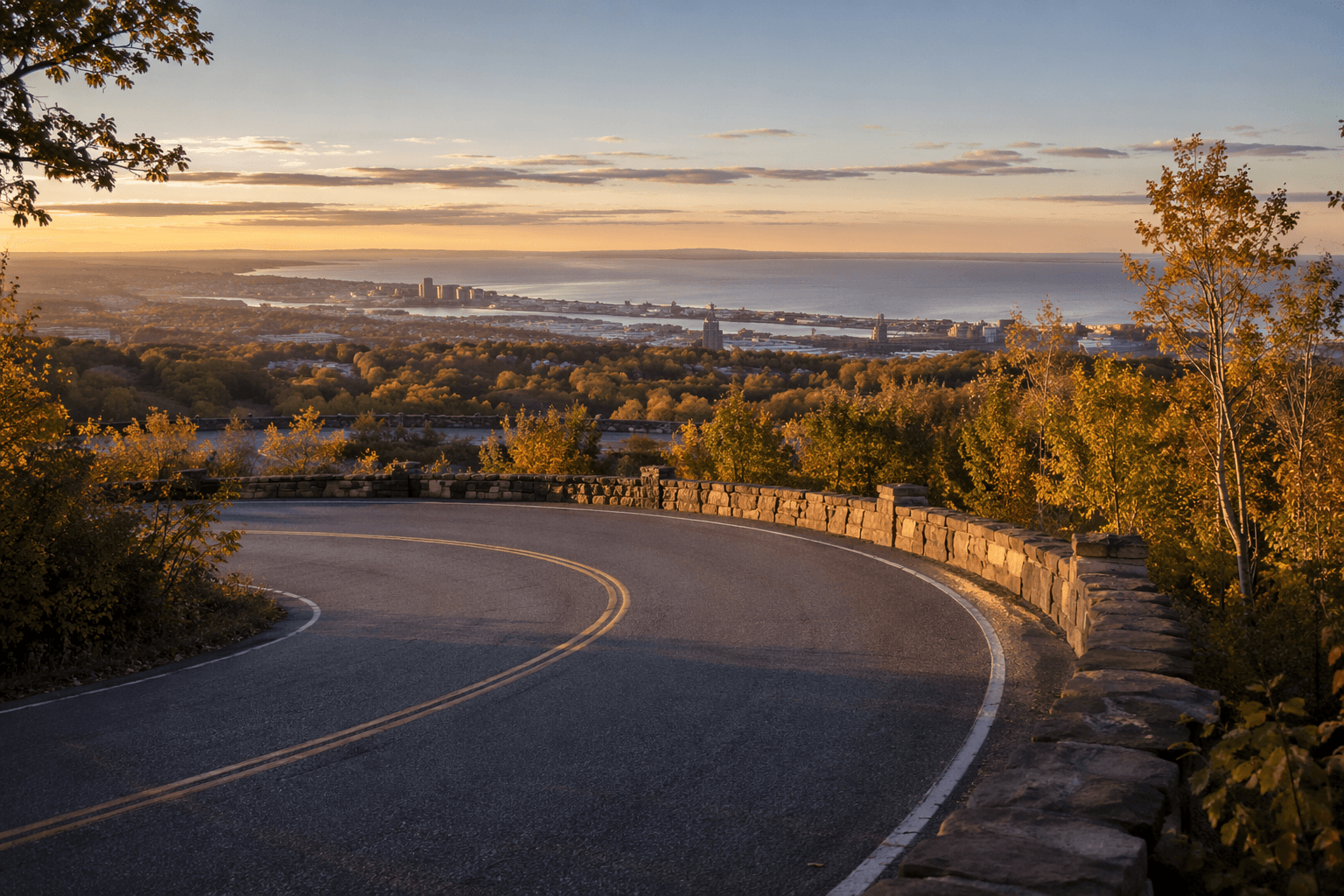
Skyline Parkway is Duluth’s scenic spine because it does more than look out over the city and lake. The road connects neighborhoods on the hilltop, opens onto a string of overlooks, and carries drivers toward trailheads, parks, and Lake Superior access from Lincoln Park to Brighton Beach. Its value today comes from that mix of movement and access: it is still a working corridor for seeing, reaching, and using the city’s upper edge.
A boulevard built out of Duluth’s hillside
Skyline Parkway did not begin as a single grand project. The City of Duluth says seven separate sections of a 28-mile boulevard were later consolidated and officially dedicated as Skyline Parkway in 1929, but the route’s roots go back much farther. The first section was created in 1891, and Samuel Snively, who built the original drive around 1900, later pushed for many more miles of the route.
That history matters because the parkway reflects a larger Duluth story: the city turned steep terrain and rugged height into public infrastructure instead of leaving the hilltop landscape to private use. The road’s historic bridges, planned overlooks, and enduring alignment show that the route was designed to be used, not just admired. It remains one of the clearest examples of how Duluth shaped its geography into a civic asset.
The parkway’s preservation has also become part of its identity. Duluth continues to document and protect its character, and the route’s designation as a State Scenic Byway in 2001 gives that effort another layer of recognition. For anyone reading the road as more than a pretty drive, that designation confirms what locals have long known: Skyline Parkway is both a transportation corridor and a public landscape with a defined public purpose.
What you get from the route now
The practical draw of Skyline Parkway is the number of places it puts within easy reach. The city describes the parkway as a route with many observation overlooks, and the parks and trails alongside it support hiking, cross-country skiing, bird watching, and other outdoor use. That makes it useful in every season, even when the scenery changes from summer green to winter snow.
The road works especially well as a slow-moving connector. A short drive can link residential stretches with trail access, historic bridge crossings, and overlook pull-offs that turn the city and harbor into a sequence of views rather than one fixed panorama. That is part of the parkway’s continuing economic and recreational value: it moves visitors toward places where they stop, walk, and spend time in Duluth.
For locals, the route is also a practical access spine. It helps tie together the city’s upper neighborhoods with parks and recreation areas, making it easier to reach places for a walk, a ski, or a lake-facing pause without treating each destination as a separate trip. The road’s usefulness comes from that continuity, with each section adding another point of entry into the landscape.
Lincoln Park to Brighton Beach: the corridor’s real payoff
The stretch that matters most now is the one that links everyday Duluth with its lakefront edge. From Lincoln Park on the west side of the corridor to Brighton Beach at the eastern end, Skyline Parkway functions as a passage between neighborhood life and shoreline access. That is where the road’s historic design and present-day use meet most clearly.
Kitchi Gammi Park, also known as Brighton Beach, is one of the strongest anchors at the east end. The city says the park preserves public access to Lake Superior and offers a rocky beach with picnic tables and grills. That makes it a simple but important stop: the parkway does not just frame the lake from above, it gets you down to the shoreline itself.
The east-end sequence is part of what gives the road lasting relevance. Drivers can move from inland overlooks to a lakefront park without leaving the corridor’s larger historical frame. Stone bridges, historic parkway signage, and the shoreline at Brighton Beach give the route recognizable landmarks that are easy to return to, whether the goal is a short outing or a longer exploration of Duluth’s hilltop edge.
How to use Skyline Parkway well
The best way to approach Skyline Parkway is as a string of connected experiences rather than a single destination. Some stops are about views, others about trail access, and others about history, but they all fit the same public corridor. That makes the route especially useful for people who want a flexible outing that can be as quick or as long as the day allows.
- Observation overlooks that make the hilltop setting easy to read
- Trail connections for hiking, cross-country skiing, and bird watching
- Historic bridges and signage that reveal how the route was built up over time
- Brighton Beach and its rocky shoreline, picnic tables, and grills at the lake end
A practical plan is to watch for the features the parkway does best:
What keeps Skyline Parkway relevant is that none of those pieces is separate from the others. The overlooks, trails, and shoreline access all sit inside a corridor that was assembled over decades, then recognized as a scenic byway and preserved as part of Duluth’s public landscape. In a city defined by steep grades and lake views, the parkway still does what it was built to do: connect people to the top of the hill, the edge of the lake, and the history in between.
This article was produced by Prism’s automated news system from verified source data, official records, and press releases, then run through automated quality and moderation checks before publishing. The system is built and supervised by the people who set the standards it runs under. Read our full AI policy.
Did this article answer your question?