Loyal to Local Passport Program Brings Nearly $277,000 to Jamestown Area
Jamestown Area Chamber of Commerce data show the 2025–2026 Loyal to Local Passport Program recorded $276,910 in tracked spending across 83 participating businesses during the holiday campaign. Local residents will learn who participated, how the program boosted local revenue and community ties, what the tracked figures mean, and policy ideas to strengthen future campaigns.
1. Key program totals and timeline
The Chamber reported $276,910 in tracked spending during the 2025–2026 holiday Loyal to Local Passport campaign, with activity reported to the Chamber as of the January 9, 2026 update. The campaign included 83 participating businesses and generated more than 1,000 passport submissions, making it a sizable seasonal stimulus for the Jamestown-area retail and service sector. Those headline numbers establish the campaign as a concentrated, measurable effort to reroute holiday dollars into the local economy.
2. Passport completion and prize structure
Hundreds of submitted passports met the program’s $250 threshold for a completed passport, and area businesses donated more than $10,000 in prizes to reward participation. The $250 completion benchmark likely encouraged multi-stop shopping patterns, keeping shoppers inside the local marketplace longer and increasing average transaction frequency. Prize contributions add direct promotional value to businesses while also reducing the net cost of shopping locally for consumers who win.
3. Average tracked spending per business and per passport
Dividing the tracked total by participating firms implies an average of roughly $3,337 in recorded sales per participating business (276,910 / 83 ≈ $3,337). With more than 1,000 passport submissions, the tracked total also implies roughly $270 in recorded spending per passport, on average. Those averages help put the aggregate figure in perspective: the program produced meaningful incremental receipts for individual firms while spreading activity across a broad base of small businesses.
4. Why the tracked total likely understates full economic impact
Chamber officials cautioned that the $276,910 figure probably underrepresents total local spending tied to the campaign because many participants spent more than what was captured on passports. Common reasons for undercounting include purchases above entries tracked on passports, ancillary spending (dining, fuel, multiple visits), and purchases at participating stores that were not submitted or recorded with passport stamps. From an economic standpoint, the recorded figure should be treated as a conservative lower bound rather than a full accounting of the program’s monetary impact.
5. Short-term fiscal effects and multiplier considerations
Even the tracked total feeds directly into local business receipts and, by extension, sales tax collections and payroll for employees. The immediate fiscal boost can improve month-to-month cash flow for small firms facing winter-season volatility. Economists would also note a local multiplier effect: each dollar spent locally tends to generate additional rounds of spending within the community as businesses pay wages, buy supplies, and reinvest, so the true economy-wide impact likely exceeds the $276,910 recorded.
6. Benefits to small businesses beyond sales
Participation conveys marketing and customer-retention benefits that extend past one campaign. For smaller merchants, being included among the 83 participating businesses raises visibility, attracts new shoppers, and helps build loyalty among repeat customers who complete passports. The donation of more than $10,000 in prizes also signals community buy-in among business owners and provides low-cost promotional leverage that can translate into longer-term customer relationships.
7. Community and social value of the campaign
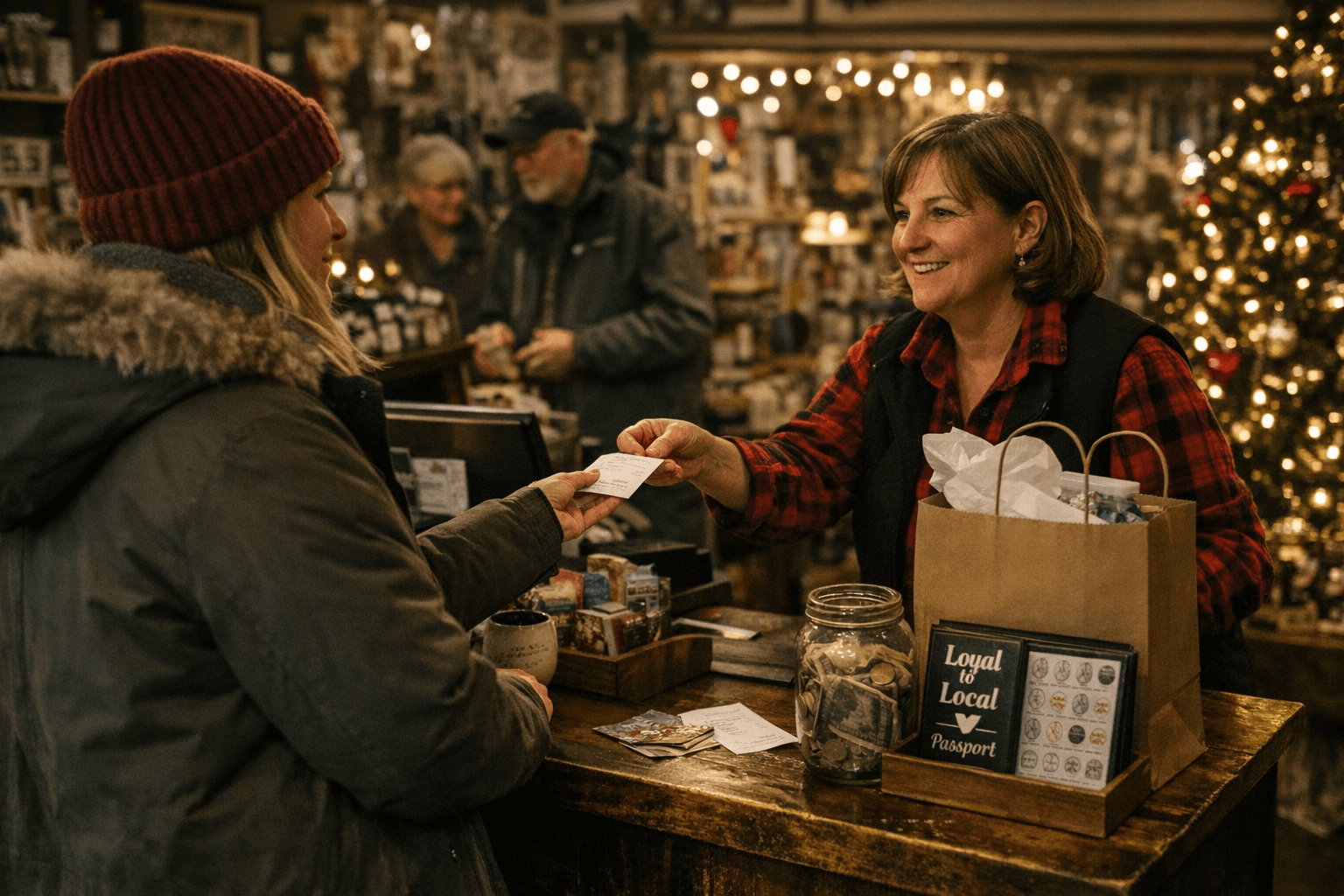
The Loyal to Local Passport Program functions as both an economic and social initiative: it concentrates holiday shopping locally while creating communal momentum around supporting neighbors and hometown businesses. Increased foot traffic in downtown and neighborhood commercial corridors can have spillover effects for restaurants and service providers, and the program’s social framing reinforces civic pride. For residents, the campaign offers a tangible way to see how individual purchasing choices affect the local economy.
8. Data and measurement improvements to consider
To capture more of the program’s full economic value in future campaigns, officials might expand tracking mechanisms, such as a digital passport option, optional sales reporting, or short post-campaign surveys, to better quantify ancillary spending and repeated visits. Improved metrics would help policymakers and the Chamber estimate tax revenue effects, identify which business categories benefited most, and justify public or private funding for future programs.
9. Policy implications and program design recommendations
Local policymakers can view the passport as a cost-effective lever for economic development during peak retail months. Considerations for future rounds include broadening participation to more storefronts, scaling prize pools to incentivize higher spending tiers, partnering with municipal marketing budgets, and exploring year-round "shop local" promotions to smooth seasonal volatility. These adjustments can strengthen the program’s ability to retain consumer dollars in Stutsman County over the long run.
10. How residents can maximize local impact next season
Residents who want to amplify the program’s benefits can aim to complete passports by concentrating purchases at participating businesses, spreading discretionary spending across local providers, and taking advantage of prize opportunities. Personal choices to prioritize local shops have measurable community effects, supporting payrolls, sustaining commercial districts, and keeping tax dollars circulating locally.
11. Long-term trend and what this means for Jamestown-area resilience
This Loyal to Local iteration adds to a broader trend of community-driven economic strategies that prioritize retention of local spending. While $276,910 is a partial accounting, the program’s structure, 83 businesses engaged, thousands of shopper interactions, and $10,000-plus in donated prizes, demonstrates a resilient local ecosystem willing to coordinate marketing, incentives, and measurement. Sustained, iterative programs like this can help stabilize small-business revenue and strengthen Jamestown-area economic resilience over time.
This article was produced by Prism’s automated news system from verified source data, official records, and press releases, then run through automated quality and moderation checks before publishing. The system is built and supervised by the people who set the standards it runs under. Read our full AI policy.
Did this article answer your question?