How railroads built Tyrone into a Texas County shipping hub
Tyrone grew where the rails stopped, and that choice still explains why some Panhandle places thrived while others faded.
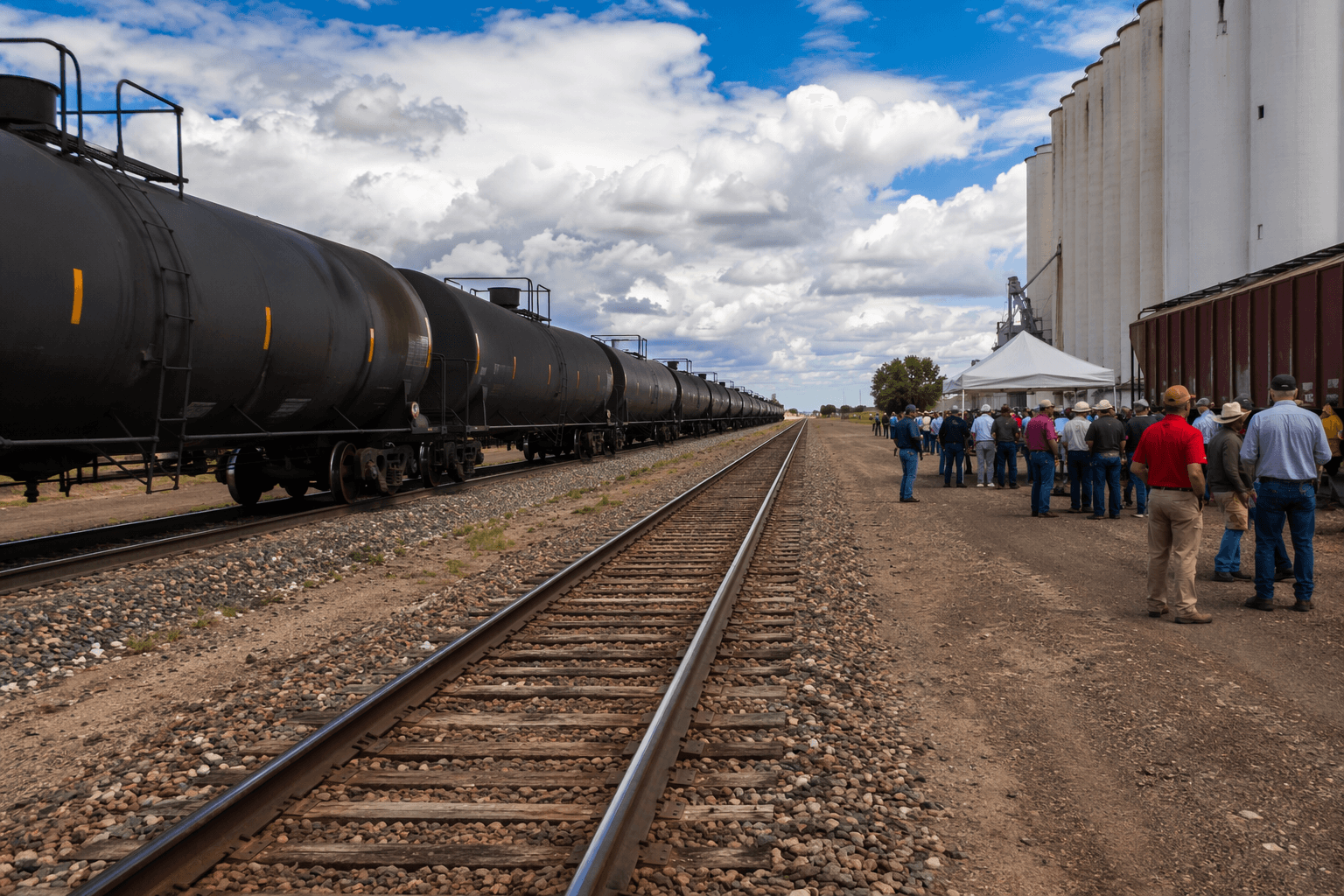
Tyrone sits in the northeastern corner of Texas County on U.S. Highway 54, midway between Hooker and Liberal, Kansas, but its real map was drawn by rail lines. Long before it became a settled town, the site worked as a cattle-watering stop called Shade’s Well after the Chicago, Kansas and Nebraska Railway finished its line south to Liberal in 1888 and built a spur with pens and loading chutes. That single investment turned open country into a shipping point for herds moving in from five states and territories, showing how one railroad decision could redirect trade, settlement, and land values across the Panhandle.
Texas County itself was part of the same larger state-building pattern. It is one of the three Oklahoma Panhandle counties created at statehood in 1907 from Beaver County, and at 2,048.82 square miles it remains Oklahoma’s second largest county. Since 1907, Guymon has served as the county seat, which matters because county government, road access, and market access have always been part of the same geography in this corner of Oklahoma.

Tracks, depots, and a town that moved with the railroad
The next turning point came in 1901 and 1902, when the Chicago, Rock Island and Pacific Railway pushed southwest and a “new” Tyrone grew up at the tracks. The town received postal designation in July 1902, and by 1905 its depot complex was complete. That sequence is the key to understanding Tyrone’s layout and its economy: businesses, grain handling, and social life clustered where freight and passengers could actually stop.
By 1909, the rail town had enough activity to support an estimated 500 residents, two churches, a public school, a bank, several stores, a cotton gin, a feed yard, a brass band, and a pool hall. Those details matter because they show a community that was no longer just a shipping point. It had become a place where commerce, civic life, and leisure all depended on the railroad being there first.
Tyrone’s incorporation was approved by the state legislature in March 1915, but its economy was already moving in the direction the tracks had set. The town’s trade area stretched almost 600 square miles, from Kansas to the Beaver, also called the North Canadian River. That reach tells you how a small Panhandle town could dominate a wide rural district when rail loading, grain handling, and cattle shipping were close enough to make distance manageable.
Agriculture made the railroad pay
Tyrone never relied on one crop or one market. In 1912 it had only about 260 residents, yet it already had two grain elevators, wheat as its main product, and cattle raising as an important supplement. By 1927, wheat production kept five elevators busy, a clear sign that the town’s economy had become an agricultural funnel for the surrounding countryside.
That shipping function helped determine which businesses could survive. Farmers and ranchers who could feed wheat or livestock into the rail system had a reliable route to market, while nearby places without comparable access had a harder time building the same density of stores, banks, and service businesses. In that sense, Tyrone was a winner because it sat on the right track at the right time, and the wider Panhandle landscape shows the loser’s side of the same equation: communities bypassed by major freight lines tended to remain thinly settled or fade more quickly.
The town’s later business pattern still reflects that history. During the 1940s and 1950s, approximately a dozen businesses remained open, including an elevator. Even after population swings and changing transportation patterns, the elevator stayed part of the local economy, a reminder that grain handling remained central long after the first railroad boom.
The town’s paper trail records the boom-and-bust cycle
The best window into Tyrone’s early years is The Tyrone Observer, which began publication on May 5, 1904. It came out every Friday and sold for one dollar a year in 1904, with a banner line urging readers to uphold Republican principles and foster the resources of Tyrone and Beaver County. H.W. Hill published it, and the paper ran from 1904 into the mid-1940s, giving the town a rare documentary record of railroad-era Panhandle life.
The Gateway to Oklahoma History now holds 233 issues from 15 years of the paper’s run, with the earliest held date October 7, 1904 and the last July 5, 1945. For a town this size, that paper trail is unusually rich. It captures the daily rhythm of a rail shipping center where wheat, cattle, local business, and politics all depended on the same transportation corridor.
Population shifts followed transportation and weather
Tyrone’s population history tracks the fortunes of the Plains economy. The first official census in 1930 counted 482 people, and by 1940 the population had fallen to 257 as Dust Bowl drought and the Great Depression punished agricultural towns across the region. The town recovered to 456 in 1960 and reached 988 in 1980, a peak that shows how small towns can rebound when local agriculture, highway access, and regional trade remain viable.
The 2020 census put Tyrone at 729 residents. That number is smaller than the 1980 high, but it still places the town firmly on the map as one of the Panhandle communities that survived the long decline that hit many rail-dependent places after the railroad era changed. Tyrone’s continued presence is the result of an old advantage that never fully disappeared: it was built where freight, roads, and rural trade already converged.
What Tyrone’s story says about the Panhandle now
Tyrone is not just a historical footnote in Texas County. It is a case study in planning and economic geography, showing how a spur, a depot, and a grain elevator can shape where people live, where businesses cluster, and which towns endure. The Chicago, Kansas and Nebraska Railway made Shade’s Well into a shipping stop in 1888; the Chicago, Rock Island and Pacific Railway turned that stop into a town a little more than a decade later; and wheat, cattle, and trade territory kept it alive after the first rail rush passed.
That history still matters in the Panhandle because transportation access remains a basic condition of survival. Towns with links to highways, elevators, markets, and county services can still pull in trade from far beyond their borders. Tyrone’s long arc shows how quickly a place can rise when infrastructure arrives, and how hard it is for any community in Texas County to thrive without it.
This article was produced by Prism’s automated news system from verified source data, official records, and press releases, then run through automated quality and moderation checks before publishing. The system is built and supervised by the people who set the standards it runs under. Read our full AI policy.
Did this article answer your question?