Afghanistan Releases American Researcher Dennis Coyle After Months in Detention
Dennis Coyle, a 64-year-old Colorado researcher held in near-solitary confinement for 14 months, was freed in Kabul on Eid al-Fitr after the UAE and Qatar helped broker his release.
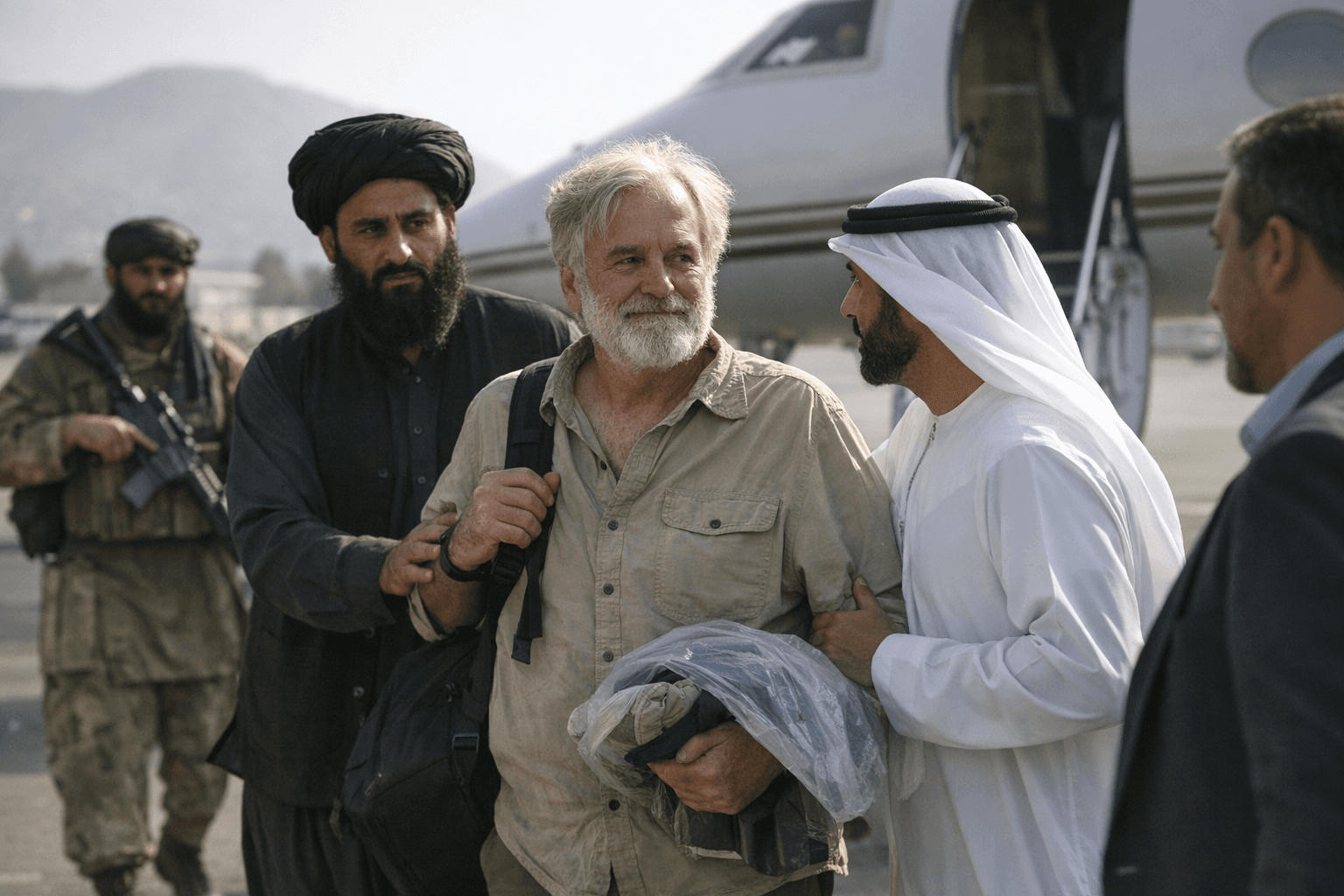
Afghan authorities released American academic Dennis Coyle on Tuesday after holding him for over a year, with Afghanistan's Taliban-run foreign ministry saying the release came on the occasion of Eid al-Fitr, the Muslim holiday marking the end of Ramadan. The 64-year-old language researcher from Pueblo, Colorado, had spent 14 months in Taliban custody with no formal charges ever publicly stated against him, his family said.
A statement from the ministry said Coyle had been released in Kabul following an appeal from his family and after Afghanistan's Supreme Court "considered his previous imprisonment sufficient." In a separate statement, the ministry indicated the United Arab Emirates and Qatar had helped mediate Coyle's release, and said Foreign Minister Amir Khan Muttaqi had met in Kabul with former U.S. Special Representative for Afghanistan Zalmay Khalilzad ahead of the release.
A Taliban senior official involved in prisoner negotiations told CBS News that the Taliban and U.S. had been holding talks since the last week of February. Afghanistan released Coyle "based on humanitarian sympathy and goodwill, and believes that such steps can further strengthen the atmosphere of trust between countries," the Foreign Ministry said, adding that Kabul hoped both nations would find solutions to remaining problems through constructive dialogue.
Coyle was detained on January 27, 2025, six days after fellow American Ryan Corbett was released at the start of President Trump's second term. Coyle, who spent nearly two decades in Afghanistan conducting language research, had been held by the Taliban General Directorate of Intelligence in near-solitary confinement with no charges filed, according to his family. His sister Molly Long described the conditions bluntly: "There were no charges, no trial, he's sitting in a basement, I would say resoundingly for hostage diplomacy reasons, which is a deplorable reason to put any family through this."
The James W. Foley Legacy Foundation documented that Coyle was held in near-solitary conditions, requiring permission even to use the bathroom, and without access to adequate medical care. He had returned to Afghanistan with assurances of support from the Taliban-led government and had been back for 18 months when he was detained, despite holding a valid visa.
The path to his release followed a series of escalating U.S. government actions. On June 2, 2025, the State Department officially designated Coyle as wrongfully detained under the Robert Levinson Hostage Recovery and Hostage-Taking Accountability Act. Earlier this month, Secretary of State Marco Rubio formally placed Afghanistan on the U.S. list of countries engaged in wrongful detentions. Rubio demanded the release of Coyle and fellow detainee Mahmood Habibi, calling on the Taliban to "commit to cease the practice of hostage diplomacy forever." He also condemned the broader pattern: "The Taliban continues to use terrorist tactics, kidnapping individuals for ransom or to seek policy concessions. These despicable tactics need to end."
The U.S. State Department had accused Afghanistan of engaging in "hostage diplomacy," a designation Afghanistan's government rejected, saying Afghan authorities arrest people for violating laws, not to make a deal. The Trump administration and the Afghan government had been secretly negotiating the release of U.S. detainees for months, though talks were reported to have stalled over Afghan officials' insistence that the Americans release Muhammad Rahim, described as the last Afghan inmate held at Guantánamo Bay.
Last June, the U.S. government officially designated Coyle as wrongfully detained under the Robert Levinson Hostage Recovery and Hostage-Taking Accountability Act, a status that unlocks select government tools and elevates the priority of efforts to secure his release. Long had credited that attention at the highest levels: "This is the president's top priority, we can feel that. It feels inspiring to know that President Trump knows my brother's name and has it in his purview."
Afghan authorities are believed to hold at least one other U.S. national: Mahmood Habibi, an Afghan American businessman who worked as a contractor for a Kabul-based telecommunications company and vanished in 2022. The FBI and Habibi's family have said they believe he was taken by Taliban forces, but Afghan authorities have denied holding him. Habibi's brother Ahmad welcomed Coyle's release but said "we hope that our family will soon have the same feeling of relief, when Mahmood is returned home."
The United States does not recognize the Taliban as Afghanistan's legitimate government and lacks a diplomatic presence in the country, complicating release negotiations that are often conducted by Qatar as an intermediary on behalf of the U.S. In September 2025, the Taliban had freed U.S. citizen Amir Amiri from an Afghan prison in what was described as a bid to normalize relations with the United States, making Coyle's release the latest in a pattern of individual cases resolved through a combination of diplomatic pressure and third-party mediation. At least five U.S. prisoners have been freed from Afghanistan over the past year, with the Trump administration having publicly demanded the release of three Americans while Afghan officials maintained they held only two.
Know something we missed? Have a correction or additional information?
Submit a Tip