AI boom drives record convertible-bond surge in Corporate America
AI-linked borrowers drove about $34 billion in convertible issuance in four months, putting Corporate America on pace to top last year’s record and reshape financing costs.
Artificial intelligence is not just inflating stock prices in Corporate America. It is pulling a record wave of companies into the convertible-bond market, where about $34 billion of U.S. issuance flowed in the first four months of 2026, more than double the same stretch a year earlier and enough to put the market on track to break 2025’s full-year record of more than $120 billion.
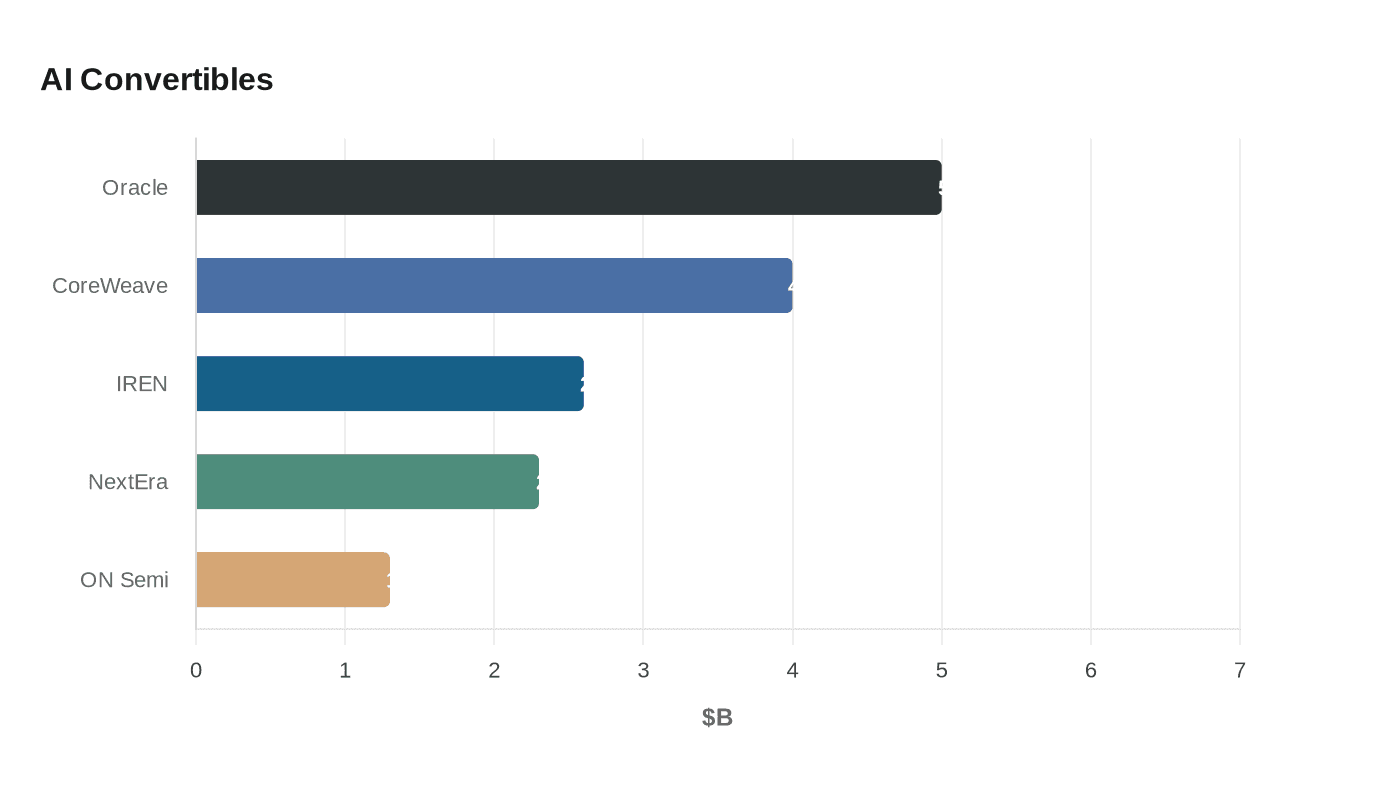
Roughly half of this year’s issuance has been tied in some way to AI, showing how the boom is moving beyond venture capital and megacap equity gains into the plumbing of corporate finance. Big names have led the charge. Oracle raised $5 billion in convertibles, CoreWeave sold $4 billion, and Australia-based IREN Limited tapped investors for $2.6 billion. NextEra Energy added $2.3 billion and On Semiconductor $1.3 billion, underscoring that the AI build-out is drawing in power suppliers and chip makers as well as companies closer to the software stack.
The appeal is straightforward in a market where borrowing costs remain high. Treasury yields were at 16-month highs, making straight debt more expensive, while convertibles can offer a lower coupon than conventional bonds and still give investors equity upside if a company’s share price climbs above the conversion price. For issuers, that trade-off can unlock funding for data centers, cloud expansion and power infrastructure without paying the full cost of traditional debt. For investors, it means betting that the AI rally will endure long enough for the conversion option to matter.
Michael Youngworth, managing director at Bank of America Securities, said much of the supply is tied to spending plans. “A lot of the issuance is about build out capital expenditure, particularly AI,” he said. That spending is colliding with another corporate need: refinancing. A growing share of the market is being used to roll over pandemic-era debt that is now reaching its typical five- to six-year maturity window, giving companies a reason to lock in funding before refinancing gets harder.
The surge has also opened the door to unusually aggressive terms. Tempus AI has been able to raise money on structures that would have looked odd in past credit cycles, including zero-coupon deals with no principal increase at maturity. Earlier in 2026, by Feb. 18, 18 companies had already raised nearly $13.6 billion in equity-linked securities, according to Bloomberg data, suggesting the acceleration began well before the April tally. If AI spending stays hot, converts will keep serving as a bridge between enthusiasm in equity markets and the capital-intensive reality of building the infrastructure behind the boom. If valuations cool, the same structure could leave investors holding the dilution they thought the rally would postpone.
Know something we missed? Have a correction or additional information?
Submit a Tip