Artemis II Crew Launches Toward Moon, First Crewed Deep Space Mission in 50 Years
Commander Reid Wiseman, a widower and single father, called his first video call from lunar orbit the greatest moment of his life.
Reid Wiseman had barely reached orbit before calling home. The Artemis II commander, a widower raising two teenage daughters alone since his wife Caroll "Taylor" Wiseman died in 2020, described the video call as "the greatest moment of my entire life": "For a moment, I was reunited with my little family."
That call was not incidental. For NASA, the communications link between crew and family is woven into mission architecture, because family stability, the agency has long recognized, is mission stability.
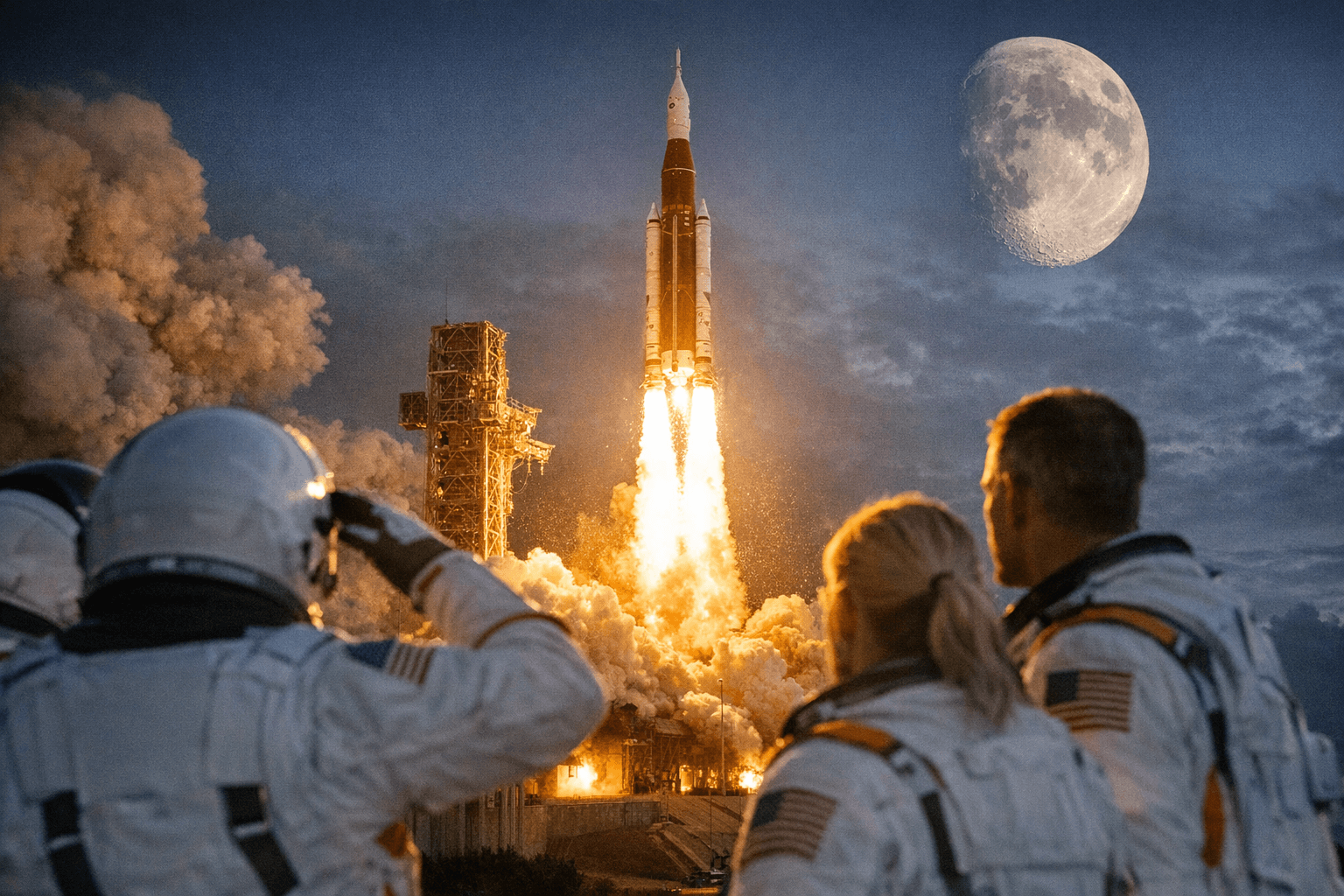
Artemis II launched April 1, 2026 at 6:35 PM EDT from Launch Pad 39B at Kennedy Space Center in Florida, sending four astronauts on a roughly 10-day, approximately 600,000-mile round-trip flyby of the Moon. It was the first crewed mission beyond low Earth orbit since Apollo 17 in December 1972. The crew, aboard NASA's Orion spacecraft launched atop the Space Launch System rocket, will not land; the mission is a lunar flyby designed to prove the system before future surface attempts, and is expected to surpass the Apollo 13 distance record of 248,655 miles from Earth, set in 1970. The hardware carrying them represents more than two decades of development and more than $40 billion in investment.
But the mission, as NASA frames it, began two and a half years earlier, at the April 2023 crew assignment.
The preparation extracted immediate costs from the families. Beginning March 18, 2026, the crew entered medical quarantine in Houston, two weeks before launch, cutting off physical contact to protect crew health before flight. By launch day, the four astronauts could not embrace their families. Pilot Victor Glover, 49, married to Dionna Odom Glover and the father of four daughters, named what that restriction represented: his family had endured "the third quarantine of this series, and all the years of training and the travel." The night before launch, in a long-standing NASA tradition, the crew gathered with their families at the Kennedy Space Center beach house, a facility with a balcony overlooking the Atlantic Ocean, close but not close enough to touch.
To carry families through the mission itself, NASA assigns each crew family a dedicated Earth-bound astronaut as a personal liaison. Glover credited that structure directly, saying he was "really grateful to that team that helps us to get ready."
The crew walking to the Astrovan on launch morning offered a snapshot of what four families have absorbed over three years. Mission Specialist Jeremy Hansen, 50, a former Royal Canadian Air Force colonel and the first Canadian to travel to the Moon, heard one of his daughters shout "Go Canada!" from the crowd. Wiseman flashed a heart sign toward his daughters. Mission Specialist Christina Koch, 47, who holds the record for the longest single spaceflight by a woman with 328 days aboard the International Space Station, noted she had "inoculated" most of her support network to her departures through prior missions. Before launch, she had told her dog: "It's only 10 days. It's not going to be as long as last time."
The infrastructure supporting Artemis families has roots in the Apollo era. In the 1960s and 1970s, NASA installed squawk boxes in astronaut homes, direct feeds from mission control, and assigned agency representatives to live with families during missions. When Apollo 13's oxygen tank exploded in 1970, Fred Haise's wife Mary learned of the crisis through a Walter Cronkite television report before NASA's liaison arrived; Neil Armstrong came through her back door to sit with her. Out of that shared vulnerability, the Apollo wives founded the Astronaut Wives Club in 1966. Apollo 13 commander Jim Lovell's wife Marilyn Lovell distilled the experience plainly: "You're on a mission together."
The families of Wiseman, Glover, Koch, and Hansen are now on that mission. Splashdown is planned in the Pacific Ocean off San Diego within 10 days of launch.
This article was produced by Prism’s automated news system from verified source data, official records, and press releases, then run through automated quality and moderation checks before publishing. The system is built and supervised by the people who set the standards it runs under. Read our full AI policy.
Did this article answer your question?