Three Mystery Orcas New to Seattle Waters Delight Watchers Near Downtown
Three orcas never before recorded in the Salish Sea surfaced in Elliott Bay with Seattle's skyline behind them on April 1, stunning researchers who hadn't seen unknown adult whales here in 25 years.
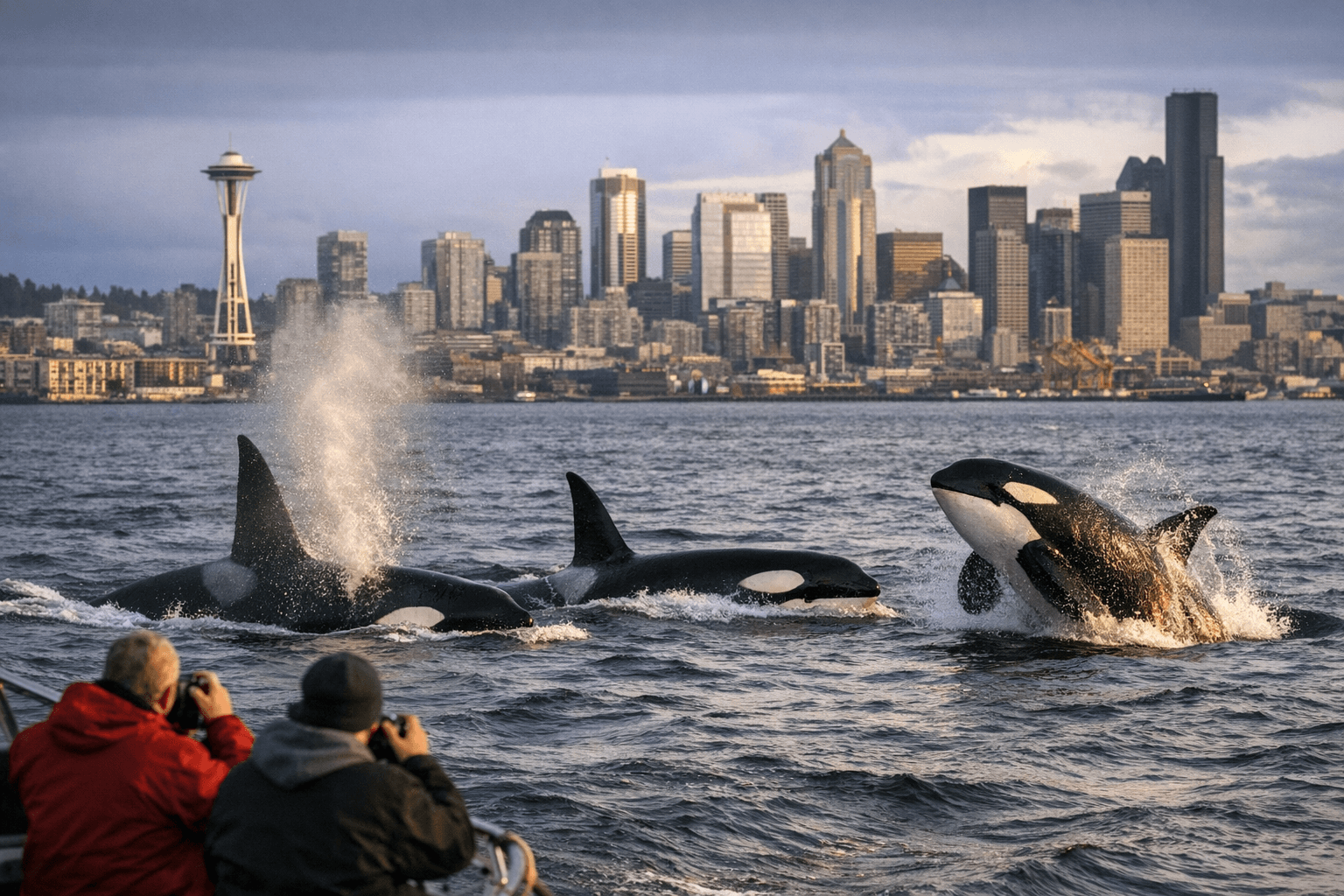
When three killer whales surfaced in Elliott Bay on April 1 with the Seattle skyline behind them, researchers monitoring the Salish Sea faced a problem they had not encountered in a quarter century: nobody recognized them.
The pod, formally designated T419, T420, and T421 by Bay Cetology, consists of an adult female and two offspring, including a large young adult male. The California-based Oceanic Research Alliance assigned the trio a competing set of names: OCX085, OCX086, and OCX087. The "T" in their official designations stands for "transient," the term for mammal-eating killer whales. T419, the adult female, is identified by a distinctive jagged cut on the inside edge of her dorsal fin. The three have also been spotted hunting seals at the Port of Olympia and made multiple visits to Seattle-area waters across the past month.
Their sudden appearance surprised researchers who have spent decades cataloging every killer whale that enters the Salish Sea, the waters between Washington state and British Columbia. The Center for Whale Research has monitored the regional population since 1976, identifying individual orcas by their dorsal fins and saddle patches, the grayish markings along their sides, each as unique as a fingerprint. Monika Wieland Shields, director of the Orca Behavior Institute, put the significance plainly: "I can't recall a time when we've had unknown adult whales turn up in the Salish Sea, at least in the last 25 years since I've been here."
The three were first photographed near Anchorage in March 2025 before reappearing in Vancouver Harbor in mid-March 2026, then moving south toward Seattle.
Their bodies carry physical evidence of a far longer journey. Unlike the resident orcas of the Salish Sea, the trio bears circular scars left by cookie-cutter sharks, small sharks that latch onto larger animals and carve out a plug of flesh. Those sharks inhabit the open ocean, not inland waters, and the scars point toward a life spent far offshore. Shari Tarantino of the Orca Conservancy cited the leading hypothesis: "We don't know their exact origin with 100% certainty yet, but the leading hypothesis is that they're from Alaska, possibly the Aleutian region, given their appearance and the fact that some Alaskan populations range widely across the North Pacific." One researcher described the trio as possibly "poorly documented Gulf of Alaska Bigg's killer whales or perhaps far-flung visitors from the Aleutian Islands or Bering Sea."
Tarantino also suggested the Salish Sea offered the visitors an obvious incentive, describing their southward push as a "culinary field trip" into waters rich with harbor seals, sea lions, and porpoises. As mammal-eating Bigg's killer whales, the trio is ecologically distinct from the critically endangered Southern Resident killer whales, salmon-eaters listed as endangered in both the United States and Canada. Roughly half of Southern Resident calves historically do not survive their first year; two new calves, K47 and L129, were documented with K Pod and L Pod in December 2025 and February 2026, respectively.
The mystery pod generated a sensation well beyond the whale-watching community. Hongming Zheng, who photographs whales as a hobby, drove 10 hours to find them. "It was epic," he said.
This article was produced by Prism’s automated news system from verified source data, official records, and press releases, then run through automated quality and moderation checks before publishing. The system is built and supervised by the people who set the standards it runs under. Read our full AI policy.
Did this article answer your question?