Artemis II Crew Nears Moon Ahead of Historic Lunar Flyby
Four astronauts entered lunar gravitational space at 12:41 a.m. Monday, the first humans pulled toward the Moon since Apollo 17 in 1972.
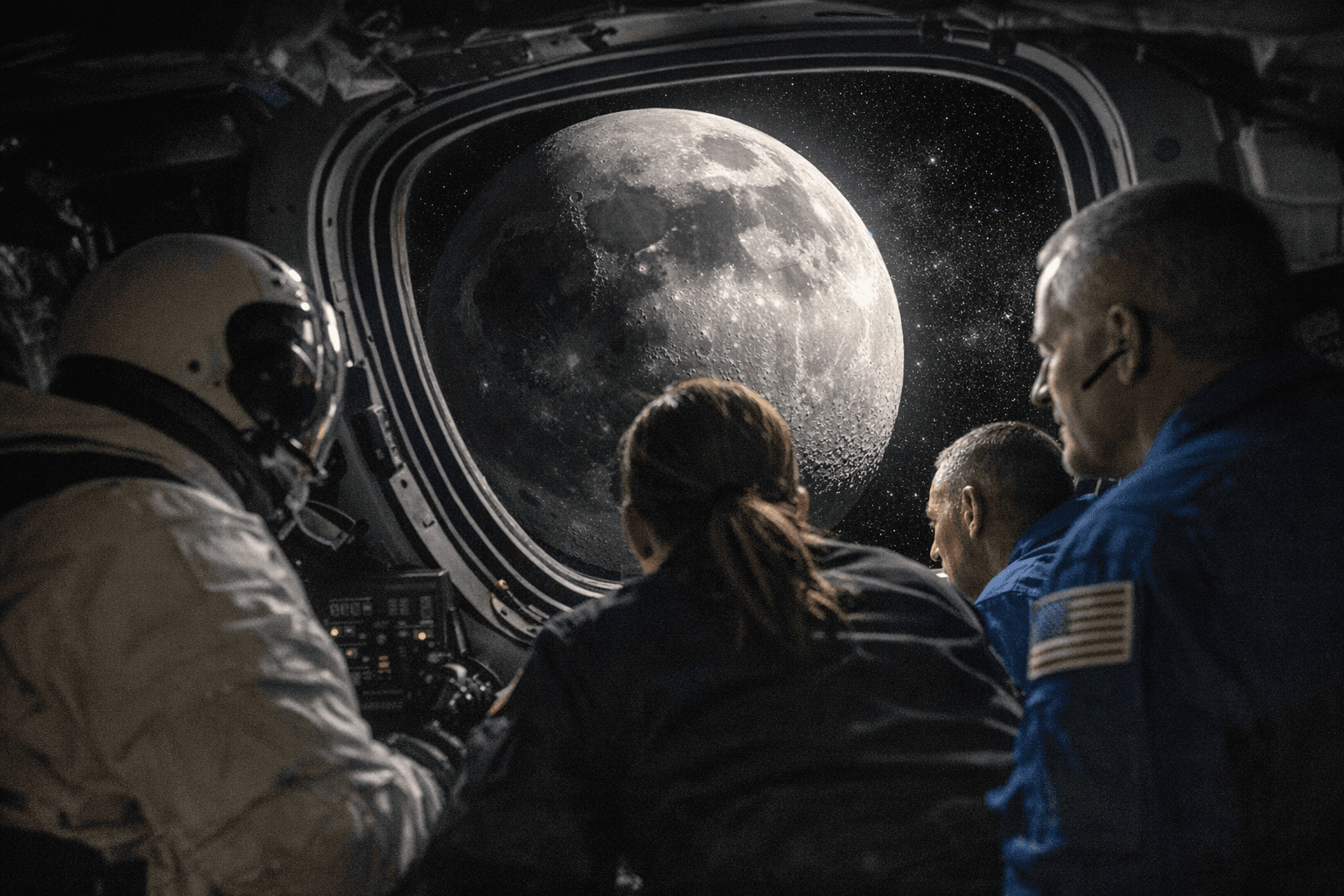
At 12:41 a.m. EDT Monday, the Orion spacecraft carrying four astronauts crossed into the lunar sphere of influence, the boundary in cislunar space where the Moon's gravitational pull exceeds Earth's. For NASA, that moment was more than symbolic: it marked the first time human beings have been subject to lunar gravity since the Apollo 17 crew left the Moon in December 1972, and it confirmed that the Orion capsule, the Space Launch System, and the agency's deep-space operations infrastructure could reliably deliver a crew to the edge of the Moon without incident.
Commander Reid Wiseman, pilot Victor Glover, and mission specialists Christina Koch and Jeremy Hansen launched from Kennedy Space Center's pad 39B at 6:35 p.m. EDT on April 1. The roughly 10-day mission, totaling a projected 695,081 miles from launch to splashdown off San Diego, is not a landing attempt; it is a systems validation flight designed to stress-test every layer of the deep-space stack before Artemis III tries to put boots on the lunar surface as early as 2028.
The trajectory performance has been striking. NASA flight director Rick Henfling confirmed Sunday that the first two of three planned outbound correction burns were canceled entirely because Orion's path was so precise. "We found that Orion was on such a pinpoint trajectory that we didn't need to do the first two correction maneuvers," Henfling said. A single 14-second burn executed at 11:03 p.m. EDT Sunday was all that was required to keep the capsule aligned for Monday's flyby, a result that flight controllers described as exceptional for a vehicle making only its second-ever flight.
The flyby window runs from 2:45 to 9:40 p.m. EDT Monday. At its closest point, the crew will loop about 4,066 miles from the lunar surface, and the spacecraft will reach a maximum distance of 252,757 miles from Earth, about 4,102 miles farther than Apollo 13. The Apollo 13 crew set that record at 12:21 UTC on April 15, 1970. The distance record is expected to fall at 1:46 p.m. ET Monday.
The roughly 40 minutes Orion spends behind the Moon represents the mission's most operationally consequential test. During that window, the Moon physically blocks all radio contact between the crew and mission control in Houston, cutting off the Deep Space Network's antenna stations in California, Spain, and Australia simultaneously. Navigation, communication blackouts, and loss-of-signal protocols are among the precise capabilities NASA must validate before any commander can be trusted to manage a lunar orbit insertion and descent on Artemis III.
During the flyby, the crew will conduct scientific observations including documenting craters, ancient lava flows, and cracks and ridges created as the Moon's outer layer shifted over time. One target on the observation list is a potential future landing area for an uncrewed payload mission; another is the lunar south pole, the same region NASA is targeting for the Artemis III landing. The crew will also witness a solar eclipse invisible from Earth, as the Sun passes behind the Moon from Orion's vantage point, creating an opportunity to observe the solar corona and watch for meteoroid impact flashes on the darkened lunar surface.
Beyond navigation and communications, Monday's flight carries institutional weight. With Glover, Koch, and Hansen aboard, the mission also represents the first time a Black astronaut, a woman, and a non-American astronaut, respectively, have ventured this far from Earth. Glover is also the first Black astronaut assigned to a lunar mission. Hansen, a Canadian Space Agency astronaut and former fighter pilot, is the first non-American set to travel to the Moon.
The crew also spent Flight Day 5 completing a full test sequence of the Orion Crew Survival System suits, running through pressurization, leak checks, simulated seat entry, and mobility assessments. That test matters for any future Artemis mission where rapid emergency suit donning could be the difference between crew survival and loss. With the correction burn complete, the suits certified, and the lunar sphere of influence now behind them, NASA has a narrowing checklist before it can declare Orion human-rated for the landing missions that follow.
Sources:
Know something we missed? Have a correction or additional information?
Submit a Tip