Asia Markets Surge as Trump Signals Iran War Could End in Weeks
Trump's hint that the U.S. could exit Iran in weeks sent $1.7 trillion back into U.S. stocks and drove South Korea's Kospi up 6.5% in a single session.

A single comment to the New York Post wiped out roughly a third of Wall Street's war-related losses in one session. President Donald Trump's suggestion that the U.S. could leave Iran in "two or three weeks," adding "We leave because there's no reason for us to do this," triggered a textbook risk-on rally: the S&P 500 gained 2.91% Tuesday to close at 6,528.52, recovering approximately $1.7 trillion in market value and about 30% of its total war-period drawdown. The Dow Jones Industrial Average surged 1,125.37 points to 46,341.51; the Nasdaq Composite advanced 3.83% to 21,590.63, clawing back nearly half of its losses since fighting began.
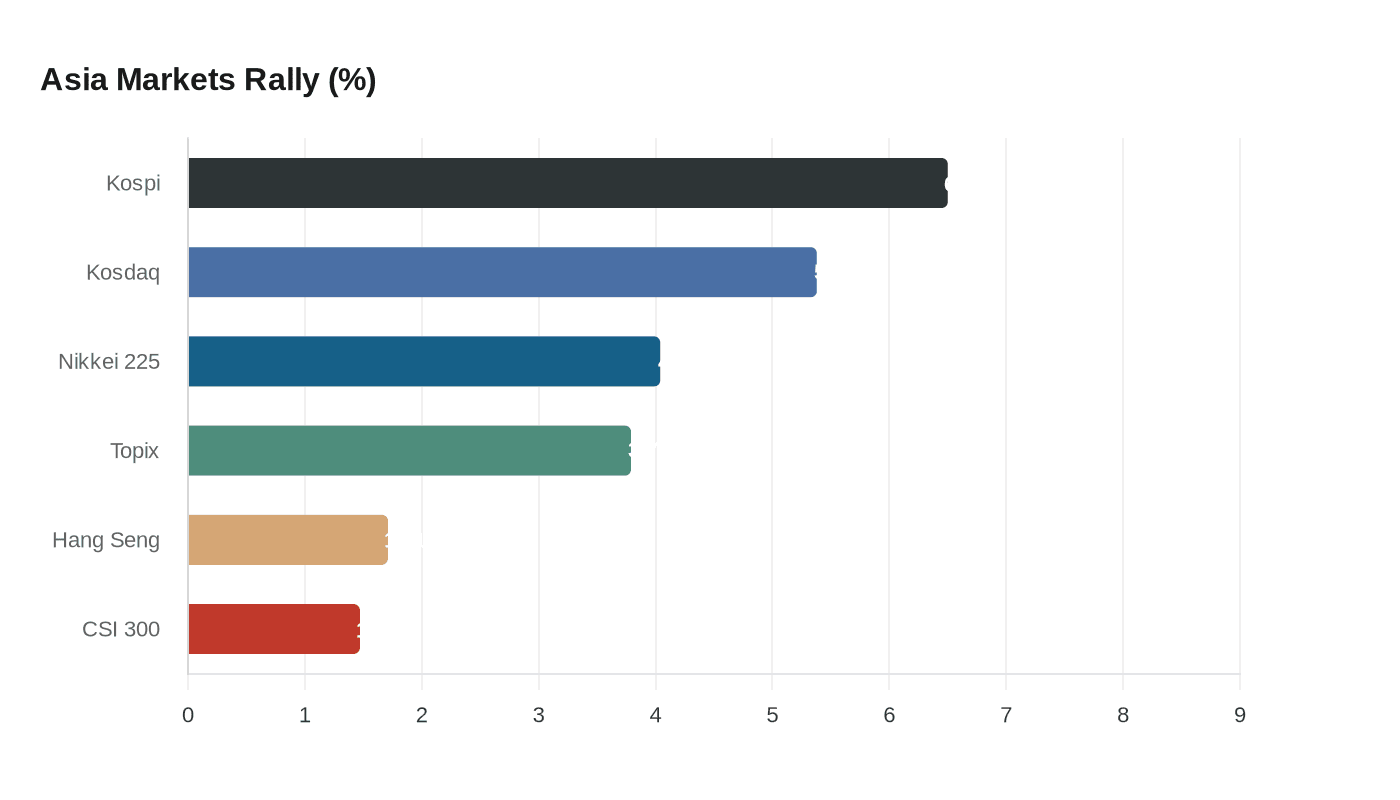
By Wednesday morning in Asia, the relief was sharper still. South Korea's Kospi, down roughly 14% since the war began, surged more than 6.5%; the small-cap Kosdaq added 5.38%. Japan's Nikkei 225 climbed 4.04%, with the Topix gaining 3.79%, both indexes having recorded their worst monthly performance in 18 years in March. Hong Kong's Hang Seng gained 1.71%, and mainland China's CSI 300 added 1.47%.
The outsized moves in Tokyo and Seoul reflect a specific structural vulnerability: Japan draws roughly 90% of its crude oil from the Middle East, South Korea about 70%. Iran's closure of the Strait of Hormuz in late February cut off roughly 20% of global oil supply, sending Brent crude surging a record 64% during March and briefly lifting WTI above $115 a barrel. By Wednesday, prices had eased modestly, with U.S. crude at $102.72 and Brent at $105.29, but the damage to household budgets had already registered. The national average gas price hit $4 per gallon, the 10-year Treasury yield spiked to 4.44% from roughly 3.97% in late February, and the S&P 500 posted a 7.33% quarterly loss, its worst since June 2022, before Tuesday's partial recovery.

The diplomatic picture is more ambiguous than one day's trading implies. Secretary of State Marco Rubio confirmed that "messages are being exchanged" with Iran, but Iranian Foreign Minister Abbas Araghchi was careful to draw a distinction: "What is happening now is not negotiations but an exchange of messages directly or through our friends in the region." Iranian President Masoud Pezeshkian said Tehran holds the "necessary will" to end the conflict, provided security guarantees against future aggression are met. Secretary of Defense Pete Hegseth offered a sharper read: "The upcoming days will be decisive. Iran knows that, and there's almost nothing they can militarily do about it."
The conflict began on February 28, 2026, when the U.S. and Israel launched coordinated strikes under the codename Operation Epic Fury, killing Supreme Leader Ali Khamenei and targeting nuclear facilities and military infrastructure. His son Mojtaba Khamenei was subsequently appointed as his successor. Iran retaliated with missile and drone attacks on U.S. bases, Israeli territory, and Gulf states before sealing the strait. Economists have described the disruption as the world's largest energy supply shock since the 1970s energy crisis.
Markets are now pricing two divergent paths over the next two weeks. In the bullish scenario, message exchanges produce a ceasefire framework within Trump's stated window, the Strait of Hormuz reopens, and oil retreats toward pre-war levels, delivering relief to pump prices, mortgage rates, and battered 401(k) accounts alike. In the bearish scenario, talks collapse, Hegseth's "decisive days" translate into further escalation, and Iran targets Gulf energy export infrastructure, driving oil well above its March highs and entrenching the Federal Reserve's paralysis on rate cuts.
The clearest early signal will be any announcement of direct U.S.-Iranian talks, as opposed to the message exchanges currently underway, alongside real-time tanker traffic through the strait itself. Until ships move freely through Hormuz again, the $4 gas price and elevated Treasury yields remain in place regardless of what is said on Truth Social.
Sources:
Know something we missed? Have a correction or additional information?
Submit a Tip