Blockchain Forensics Links Single Trader to $2 Million in Iran Bets
Blockchain forensics tied $2.14 million in Polymarket winnings to one suspected user across 38 accounts, all funneling profits to a single Coinbase address after near-perfect Iran bets.
Every dollar traced back to the same place. Blockchain analysis of a cluster of 38 Polymarket accounts, all believed to be controlled by a single individual, shows that the winnings from a remarkable string of correct bets on U.S. military strikes against Iran were routed to one deposit address on Coinbase, according to a blockchain forensics expert and a professional trader who verified the findings.
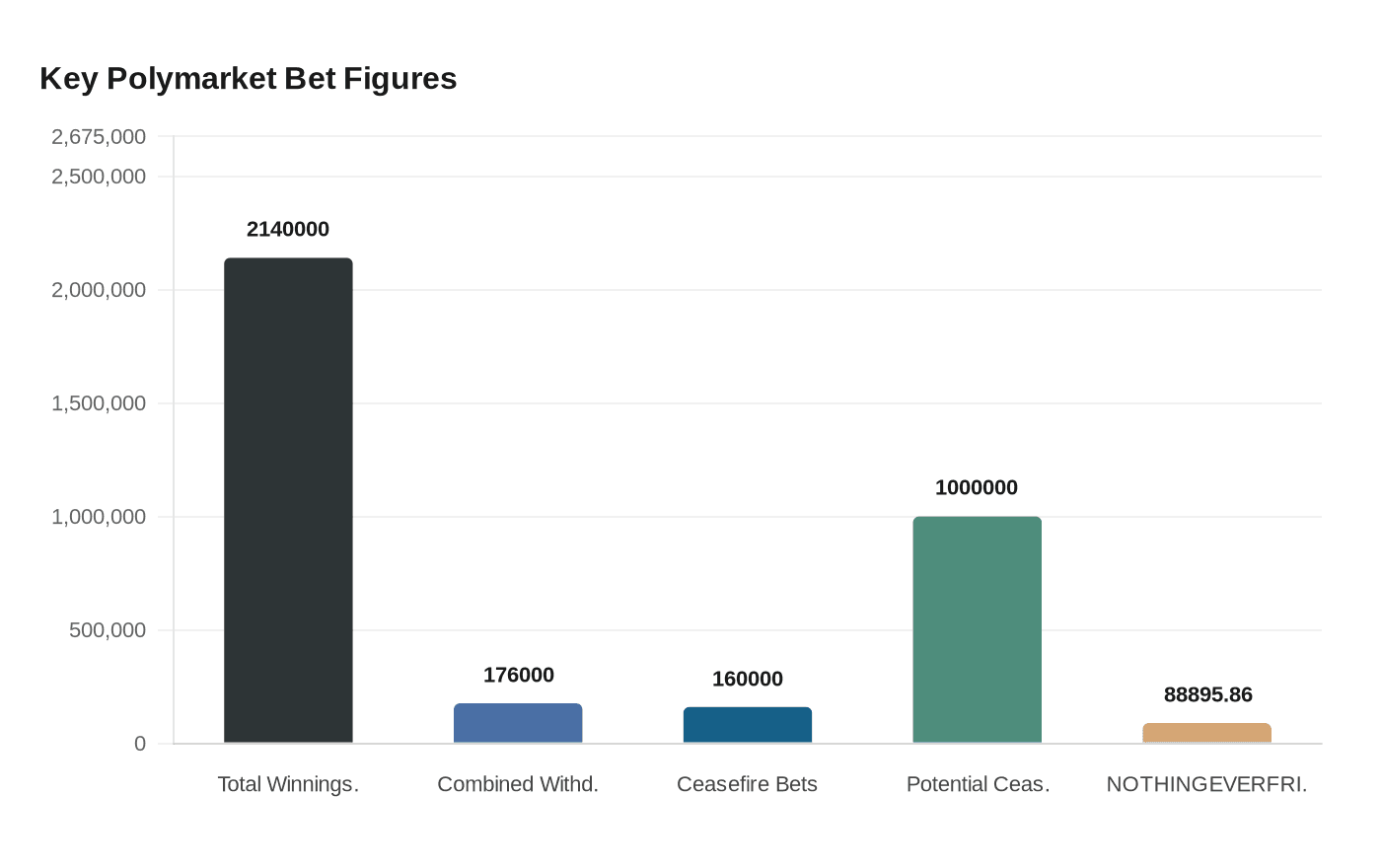
The independent on-chain analyst known as Andrew 10 GWEI identified 38 accounts he believes belong to one person, who netted more than $2 million by correctly betting on the February 28 strikes. The New York Post put a finer point on the figure, reporting the suspected user cleared $2.14 million. Each of the accounts placed between four and ten bets with a nearly 100 percent success rate, according to research shared publicly on X.
The user began preparing accounts with cryptocurrency transfers on February 22, before bets were placed on February 27, between 11:00 and 12:00 GMT, on the chance of a February 28 strike. That same day, the accounts that started the Iran wager trail came into sharp focus: two accounts, one identified by a Bitcoin wallet address and the other operating under the username Flipfloppity, withdrew a combined $176,000 to the same Coinbase deposit address. Ten additional Polymarket accounts were also created and funded that day, primarily through Robinhood or Coinbase transfers.
The coordination of those funding flows is central to investigators' case that a single actor was behind the scheme. The findings highlight rising concerns about the potential for insider trading on prediction markets, where users can wager on everything from sports to elections to warfare. Experts quoted in the New York Post's reporting said the suspected trader was "not covering their tracks very well."
One account identified by X user Lirrato, operating under the handle NOTHINGEVERFRICKINGHAPPENS, opened in late February and turned $18,883 in two early wagers into more than $85,000 in returns: $7,600 on a U.S. strike by February 28 and $11,283 on a strike by March 1. Screenshots cited in the reporting show that account carrying an $88,895.86 profit over the past month. The Post noted, however, that NOTHINGEVERFRICKINGHAPPENS does not appear to be connected to the broader cluster of accounts under suspicion.
The pattern did not stop at strike bets. Before President Donald Trump announced on Monday, March 23, that the U.S. and Iran had held "very good and productive conversations" to end the three-week-old war, ten brand-new Polymarket accounts had already wagered a combined $160,000 on an "US x Iran ceasefire," betting it would occur by March 31 or April 15. Those accounts stand to gain over $1 million collectively if the conflict halts by the end of the month.
While successful Polymarket bets could be based on everything from open-source intelligence to simple beginner's luck, researchers look for several red flags, including "wallet splitting," or dividing up bets among a series of accounts to avoid detection.
The broader regulatory landscape is shifting rapidly in response. Democratic Senator Chris Murphy, who has accused officials in the Trump administration of "insider trading" on Iran war news, introduced the Banning Event Trading on Sensitive Operations and Federal Functions Act, known as BETS OFF, in Congress. Polymarket updated its rules to clarify that trading on stolen confidential information, illegal tips, or by someone who could influence an outcome was prohibited as insider trading.
Investigators in Israel recently indicted two individuals, including a military reservist, for allegedly using classified material to bet on Polymarket during the country's war against Iran, according to local reports. The 38-account cluster under scrutiny has not resulted in any publicly announced charges, and no real-world identity has been confirmed for the suspected individual behind it. Over $529 million was traded on Polymarket contracts tied to the timing of U.S. strikes on Iran and the fate of Supreme Leader Ali Khamenei, a scale that underscores how the prediction market has become a live, liquid arena where advance knowledge of military decisions, if that is what drove these trades, carries an extraordinary price tag.
Know something we missed? Have a correction or additional information?
Submit a Tip