British Man Killed, 27 Injured as Tourist Bus Plunges into Canary Islands Ravine
A tourist bus plunged 10 metres into a La Gomera ravine on Easter Friday, killing a British man after the driver reported total brake failure on a steep mountain road.
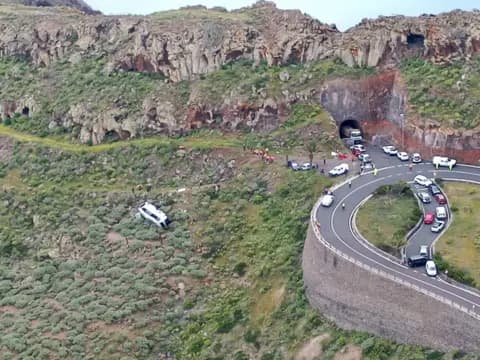
A tourist bus carrying 27 British holidaymakers plunged 10 metres into a ravine on La Gomera on Friday after the driver reported complete brake failure on one of the island's principal mountain roads, killing one passenger and leaving three others critically injured in an accident that raises pointed questions about tourist transport safety on Spain's smaller islands.
The vehicle, which bore the logo of Gomera Tours, a local excursion and transfer operator, was travelling the GM-2 road near San Sebastián de La Gomera at approximately 1:15 PM when the driver told police the brakes failed to respond as he headed downhill. He attempted to arrest the bus's descent by veering onto a dirt track, but could not prevent it from overturning and falling into the ravine below.
All 28 people on board had been staying at El Balcón de Santa Ana, a resort in Playa de Santiago, and the group, which included 24 adults and three minors, was bound for the San Sebastián ferry dock to catch a crossing to Tenerife. A receptionist at the resort confirmed: "They had left the hotel to head to Tenerife on the ferry. They were all British."
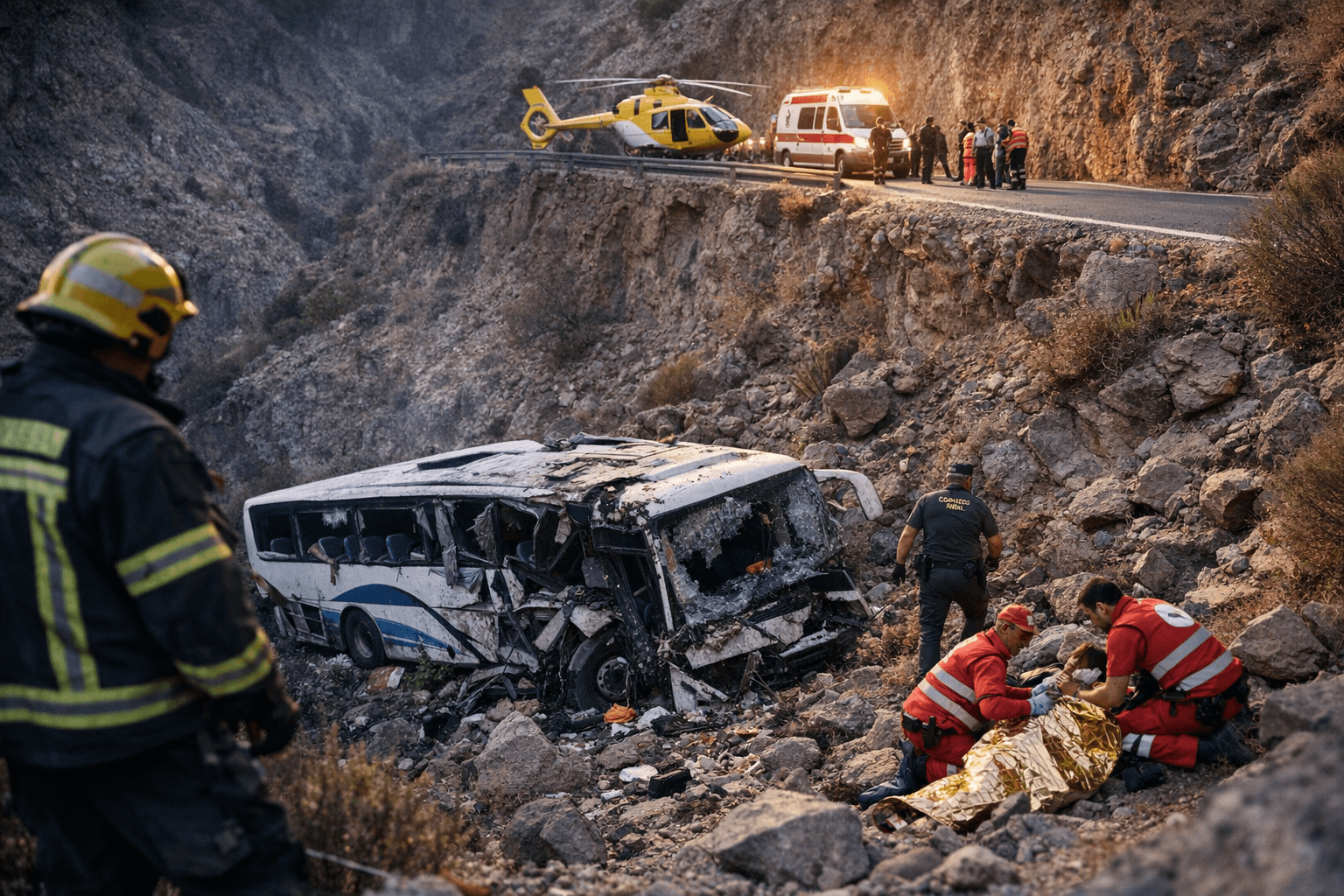
Twenty-five of the injured were treated at Hospital Nuestra Señora de Guadalupe on the east of the island. The two most critically injured passengers were airlifted by medicalised helicopter to hospitals in Tenerife, a detail that exposes a structural limitation of emergency care on smaller islands: specialist trauma capacity is simply not available locally. For British tourists who fall seriously ill or are injured in places as remote as La Gomera, medical evacuation to a larger island is not an edge case but a foreseeable outcome, making comprehensive travel insurance with helicopter transfer cover essential rather than optional.
The scale of the response reflected the PLATECA emergency protocol, the Canary Islands' Territorial Emergency Plan for Civil Protection, which was formally invoked at 2:00 PM, less than an hour after the crash. Five ambulances, Civil Protection units, Guardia Civil officers, and environment teams from the Cabildo de La Gomera attended the scene alongside the helicopter.
Canary Islands President Fernando Clavijo posted his "support to the victims and their families" on X. Spain's Minister for Territorial Policy and Democratic Memory, Ángel Víctor Torres, called it "tragic news in La Gomera," adding: "May there be no more victims." Héctor Cabrera, head of emergency operations in La Gomera, confirmed to TVE that the passengers "were staying at a resort" on the island.
The crash has placed sharp focus on the GM-2, the artery connecting San Sebastián with the island's northwest that cuts through La Gomera's characteristic volcanic terrain of steep gradients and tight bends. La Gomera, the second-smallest of the eight main Canary Islands with a population of approximately 22,361, sits about 50 minutes by ferry from Tenerife, and its road network carries well-documented risks for heavy vehicles on long downhill stretches.
Whether the Gomera Tours vehicle held current technical certification, when its brake systems were last inspected, and whether the operator carries appropriate commercial transport licences under Spanish regulations will all form part of the investigation. Spanish law requires licensed tour operators to maintain vehicles in roadworthy condition, and the Cabildo de La Gomera holds oversight responsibility for commercial transport on the island. When booking excursions or transfers on any of the smaller Canary Islands, ask the operator for proof of vehicle certification and confirm registration with the relevant island council before travelling. If booking through a resort, request the operator's name in advance rather than boarding an unmarked or unfamiliar vehicle at the hotel entrance.
The timing amplifies the significance. The crash happened during the Easter half-term holiday, one of the peak travel windows for British visitors to the Canaries. The UK is the archipelago's dominant tourism market: nearly 6.3 million British tourists visited in 2024, accounting for more than 40% of all international arrivals and more than double the figure from Germany, the second-largest source. With total arrivals across the islands reaching nearly 18 million that year, the pressure on tourist transport infrastructure is immense, and Friday's accident will likely accelerate scrutiny of how vehicle maintenance and operator licensing are enforced on islands where the roads are most unforgiving.
This article was produced by Prism’s automated news system from verified source data, official records, and press releases, then run through automated quality and moderation checks before publishing. The system is built and supervised by the people who set the standards it runs under. Read our full AI policy.
Did this article answer your question?


