Carney budget update deepens U.S. pivot, launches Canada Strong Fund
Carney’s update pairs a $25-billion sovereign wealth fund with a sharper U.S. pivot, while the last deficit lands at $66.9 billion, below forecast.

Ottawa turned its spring economic update into a test of Mark Carney’s central promise: Canada can lean less on the United States without giving up growth or fiscal discipline. The package, tabled April 28, 2026, set up the Canada Strong Fund with an initial $25-billion capitalization, described it as the country’s first national sovereign wealth fund, and added a retail investment product so Canadians can buy in.
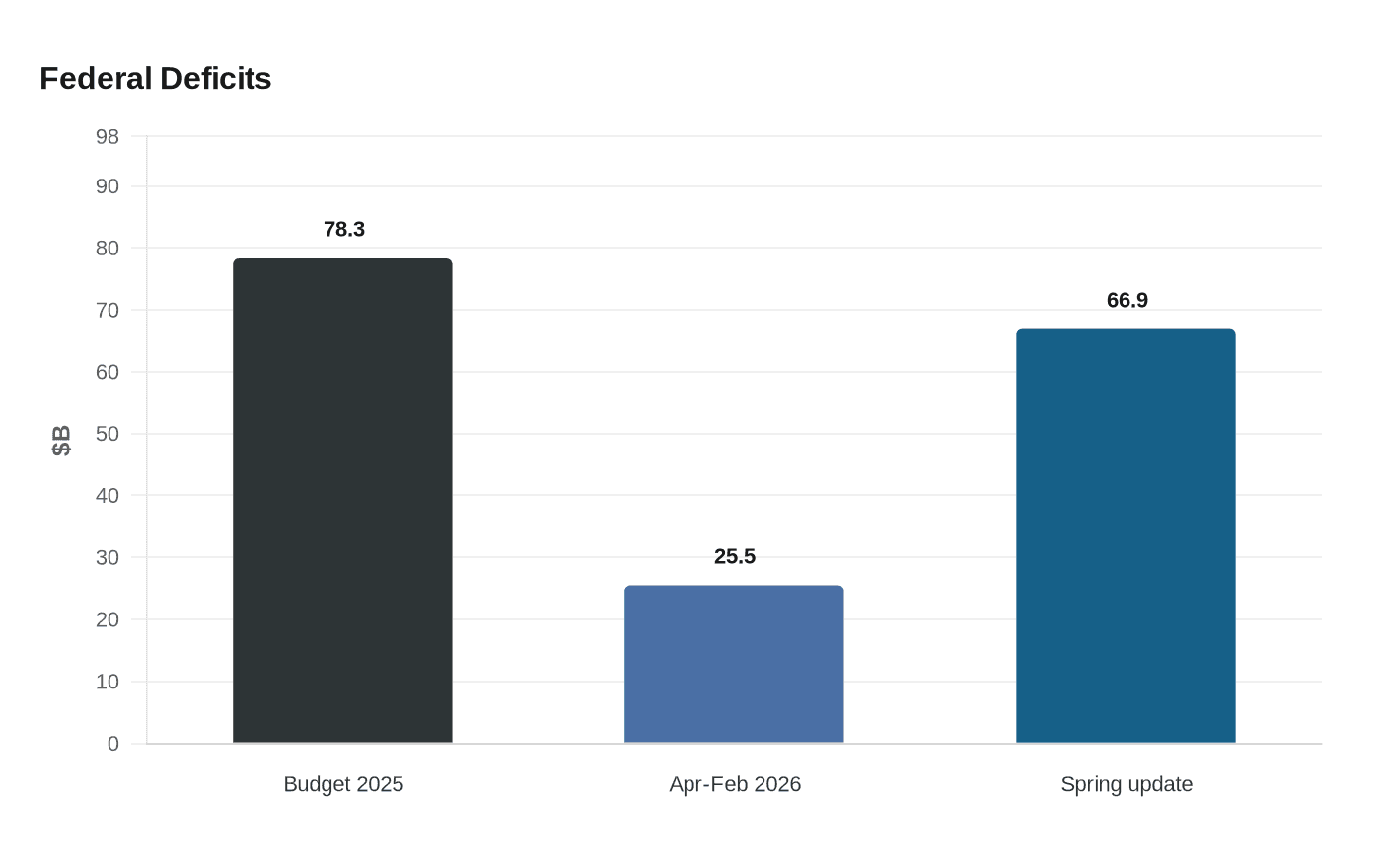
The numbers Carney is asking voters and markets to trust are better than the fall outlook, but not painless. Budget 2025 had projected a $78.3-billion deficit for the last fiscal year. The federal fiscal monitor for April 2025 through February 2026 showed a $25.5-billion deficit over the first 11 months, and the spring update said the final deficit came in at $66.9 billion, helped by stronger-than-expected economic performance and higher personal and corporate income tax revenues. Ottawa says projected deficits are lower over the fiscal horizon and that Canada remains on track to meet its fiscal anchors.
That improvement comes with a harder question: what has to go right next? Carney’s economic strategy rests on diversifying trade partners abroad, drawing in private capital for strategic Canadian projects, and building more capacity at home as the United States turns more unpredictable under Donald Trump’s tariff regime. Finance officials are also betting on stronger defence spending, major projects and a deeper domestic industrial base. But the update also acknowledged pressure points, including weak consumer spending and the fact that gains from higher oil prices were largely offset by new spending.
Those spending measures matter because they will be felt quickly. The update includes a boost to the GST benefit for lower-income households and a pause on the federal fuel excise tax until Labour Day, alongside new spending on a skilled worker program and infrastructure. It also expands federal capital investment, including $225 million over five years for the Union Training and Innovation Program and support for Indigenous housing providers. Team Canada Strong aims to recruit, train and hire 80,000 to 100,000 new skilled trade workers by 2030-31, a scale that signals how much Ottawa wants labour supply to do the work of an industrial policy reset.
The politics around the update are already sharp. Conservative Leader Pierre Poilievre has demanded a $31-billion deficit cap and accused the government of “credit card budgeting,” warning of higher inflation and interest costs. Former parliamentary budget officer Kevin Page said the Liberals will be expected to show real results and face pressure for more transparency on how NATO spending, nation-building projects and other commitments affect the outlook. Carney has answered that the government is making difficult choices and focused on the numbers. The next test is whether those numbers can hold while Canada rewires its economy away from the U.S. market.
This article was produced by Prism’s automated news system from verified source data, official records, and press releases, then run through automated quality and moderation checks before publishing. The system is built and supervised by the people who set the standards it runs under. Read our full AI policy.
Did this article answer your question?