Chernobyl wildlife rebounds, Przewalski’s horses thrive in exclusion zone
Przewalski’s horses now roam Chernobyl’s exclusion zone, a place where wildlife has rebounded even as radiation still makes the land unsafe for people.
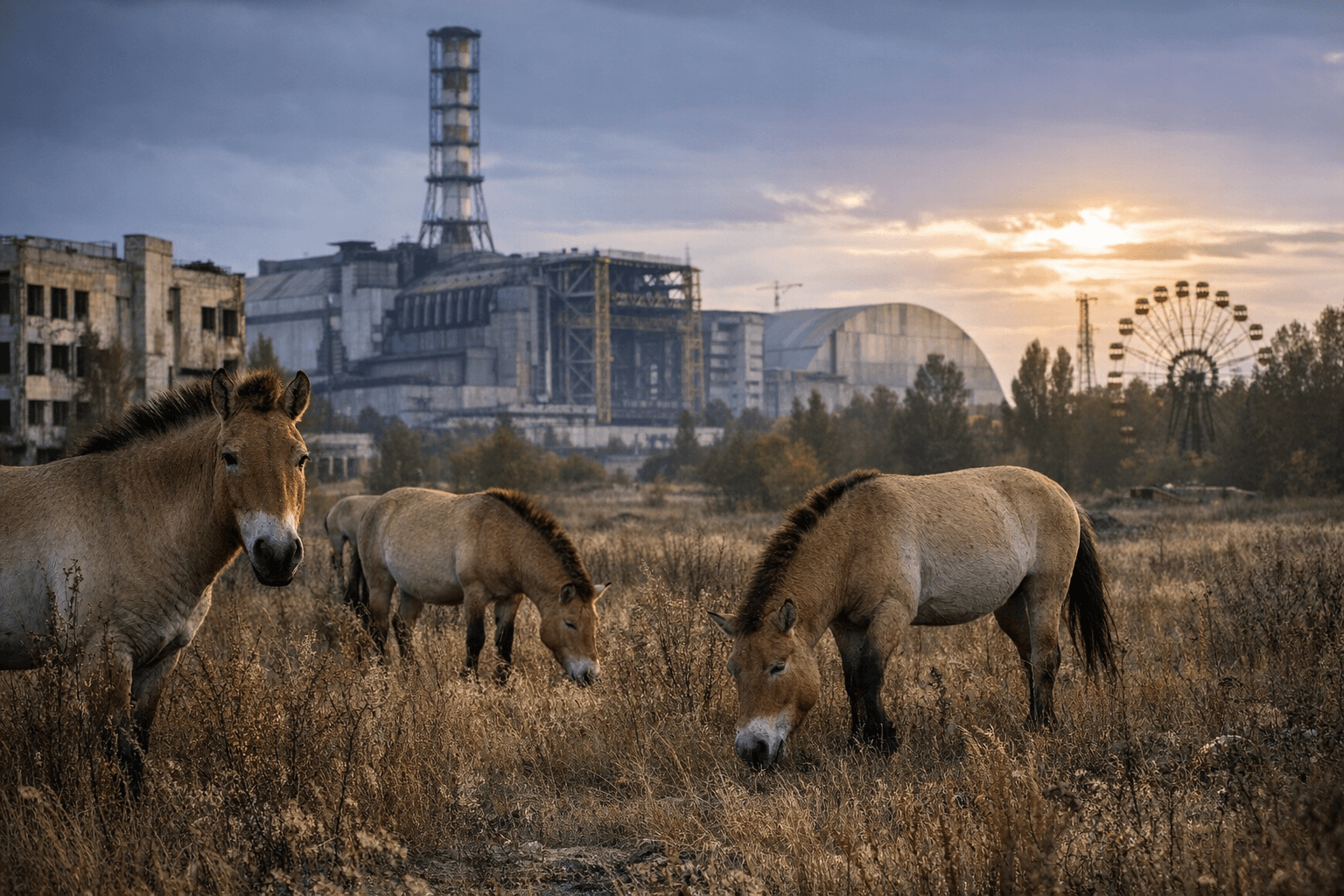
Four decades after the reactor exploded at Chernobyl, the zone around the ruined plant has become a paradox in motion: wolves, bears and horses have returned to a landscape still shaped by one of nuclear power’s worst catastrophes.
The April 26, 1986, disaster at the Chernobyl nuclear power station forced the evacuation of entire towns and sent radiation across Europe. Britannica describes it as the worst disaster in the history of nuclear power generation. The exclusion zone was first carved out as a roughly 30-kilometer-radius area of about 2,634 square kilometers, then expanded to about 4,143 square kilometers, or roughly 1,600 square miles. Reporting on the accident says about 115,000 to 135,000 people were evacuated in the initial phase and first year.
What followed was not a return to safety, but a return of wildlife. Associated Press reported that the exclusion zone, which spans territory in Ukraine and Belarus and is larger than Luxembourg, has become a striking example of ecological rebound after people were abruptly removed. Wolves have prowled the no-man’s-land, brown bears have returned after more than a century, and populations of lynx, moose, red deer and feral dogs have rebounded across the reserve.
At the center of that story are Przewalski’s horses, stocky sand-colored animals native to Mongolia and known locally as takhi, or “spirit.” They were introduced into the Chernobyl Exclusion Zone in 1998 as an experiment. A peer-reviewed review and related studies said 36 horses were released between 1998 and 2004, and long-term monitoring found the free-ranging population spread north through the zone and into the Belarusian Polesie State Radiation Ecological Reserve. Denys Vyshnevskyi of the Chornobyl Radiation and Ecological Biosphere Reserve called the herd “something of a small miracle” and said nature “recovers relatively quickly and effectively.”
Scientists say that rebound does not prove radiation is harmless. Rather, it suggests that when human pressure disappears over a vast territory for decades, many mammals can expand into the space left behind. Research published in Current Biology found no evidence that radiation reduced mammal abundance in the zone and reported that wolf abundance there was more than seven times higher than in nearby uncontaminated reserves. The same research found the relative abundances of elk, roe deer, red deer and wild boar were similar to those in four regional nature reserves.
Since Russia’s full-scale invasion of Ukraine in 2022, researchers have also warned that the zone’s ecological value and scientific importance face new risks from fires, military activity and disrupted monitoring. Chernobyl remains both a warning and a laboratory, where the long shadow of contamination meets one of the clearest demonstrations of how quickly ecosystems can reclaim ground when humans step back.
This article was produced by Prism’s automated news system from verified source data, official records, and press releases, then run through automated quality and moderation checks before publishing. The system is built and supervised by the people who set the standards it runs under. Read our full AI policy.
Did this article answer your question?


