China Offers Vietnam Loans, Technology to Expand Railway Cooperation
China offered Vietnam loans, technology and training for rail projects as Hanoi weighs faster trade links against deeper dependence on Beijing.
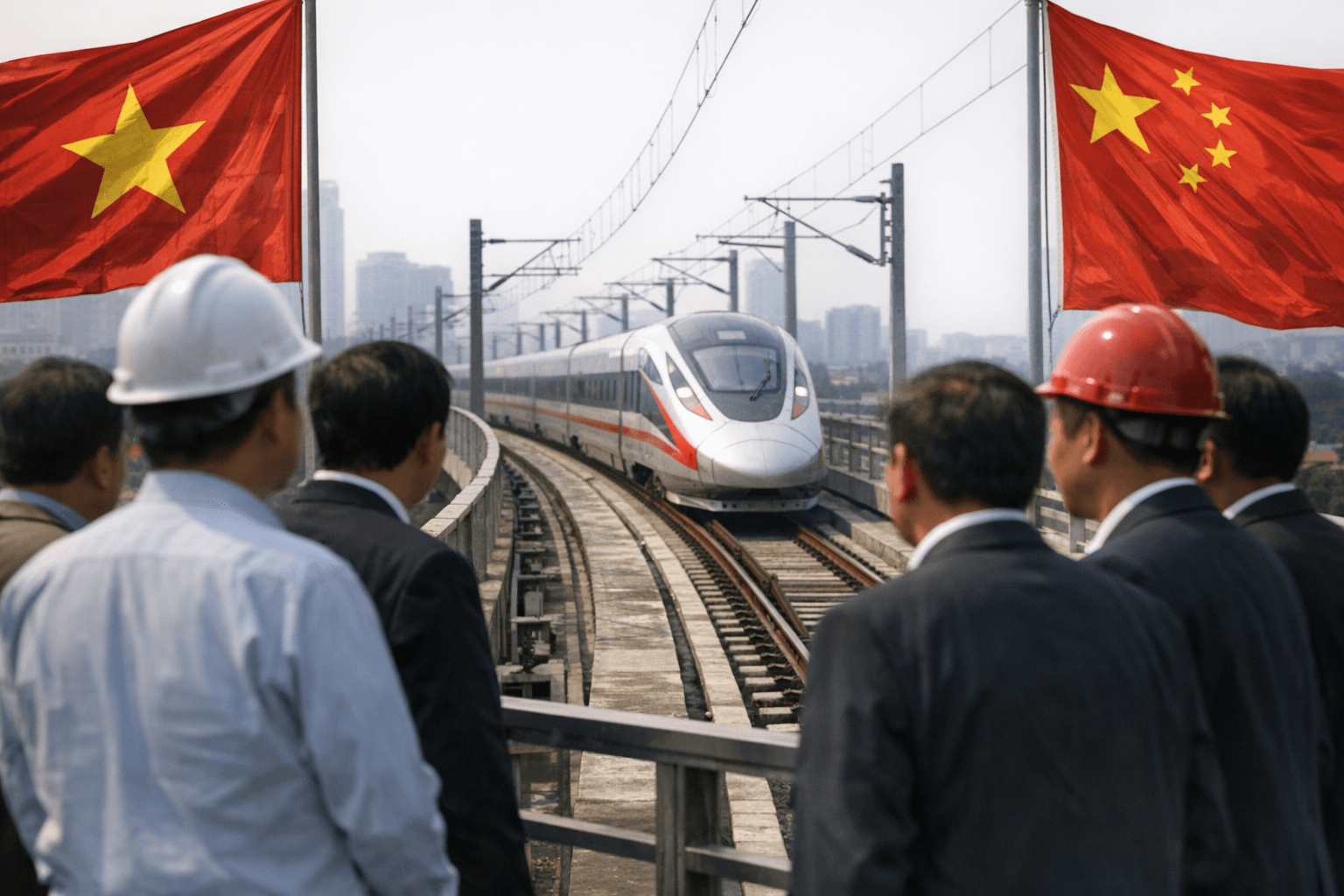
China said it would provide Vietnam loans, technology, training and industrial-capacity support to deepen railway cooperation, a move that would tie the two neighbors more closely through the machinery of infrastructure as much as diplomacy.
The offer came in a joint statement from China’s foreign ministry after Vietnamese leader To Lam’s visit to China, where he traveled on high-speed trains in northern and southwestern China. Beijing also said it would guide enterprises to take part in railway construction projects in Vietnam, signaling that rail remains one of the sharpest tools in the relationship.
The timing matters because Vietnam’s rail system still carries the burden of old infrastructure. Much of the network remains metre-gauge and single-track, with only a smaller share built to standard-gauge or mixed-gauge specifications. One existing route between Nanning and Hanoi still requires passengers and freight to change trains at the border because Vietnam’s colonial-era gauge does not match China’s modern high-speed system. Vietnam’s railway law defines high-speed rail as electrified double-track national railway running at 200 km/h or more on 1,435 mm gauge.
The latest offer built on a framework already under way. In April 2025, China and Vietnam agreed to feasibility studies for two planned rail lines, one linking Guangxi to Hanoi and another connecting Shenzhen to Haiphong. Those studies were set to run for 12 months after a contractor is selected, showing that both governments have been trying to turn political goodwill into transport projects that can move goods more efficiently and tighten supply-chain links across the border.
Vietnam has also been moving fast on its side. During Xi Jinping’s April 2025 state visit, the two governments signed two intergovernmental treaties, two ODA agreements and three ministerial-level accords on railway and road cooperation. In the same period, Prime Minister Pham Minh Chinh ordered faster work on the Lao Cai-Hanoi-Hai Phong railway, a standard-gauge line described in Vietnamese reporting as about 460 km long. Xinhua later said the main track exceeded 390 km, crossed six provinces and cities, and was designed for both passenger and freight traffic at speeds of up to 160 km/h on main sections.
China’s latest statement did not give a financing amount or a start date, but it kept rail cooperation at the center of a relationship shaped by trade, geography and strategic caution. For Vietnam, the appeal is obvious: faster logistics, better port access and a more integrated north-south transport network. The risk is just as clear: loans, technology and training can build capacity, but they can also deepen dependence on Chinese standards, contractors and financing at a moment when Hanoi is trying to expand connectivity without surrendering room to maneuver.
This article was produced by Prism’s automated news system from verified source data, official records, and press releases, then run through automated quality and moderation checks before publishing. The system is built and supervised by the people who set the standards it runs under. Read our full AI policy.
Did this article answer your question?


