China Recasts Lu Xun, Fierce Critic, as Sanitized Communist Mascot
Lu Xun, the writer who excoriated social rot, now appears as big‑headed mascots and ¥1 fridge magnets as Shaoxing pushes a "cute economy" around his name.
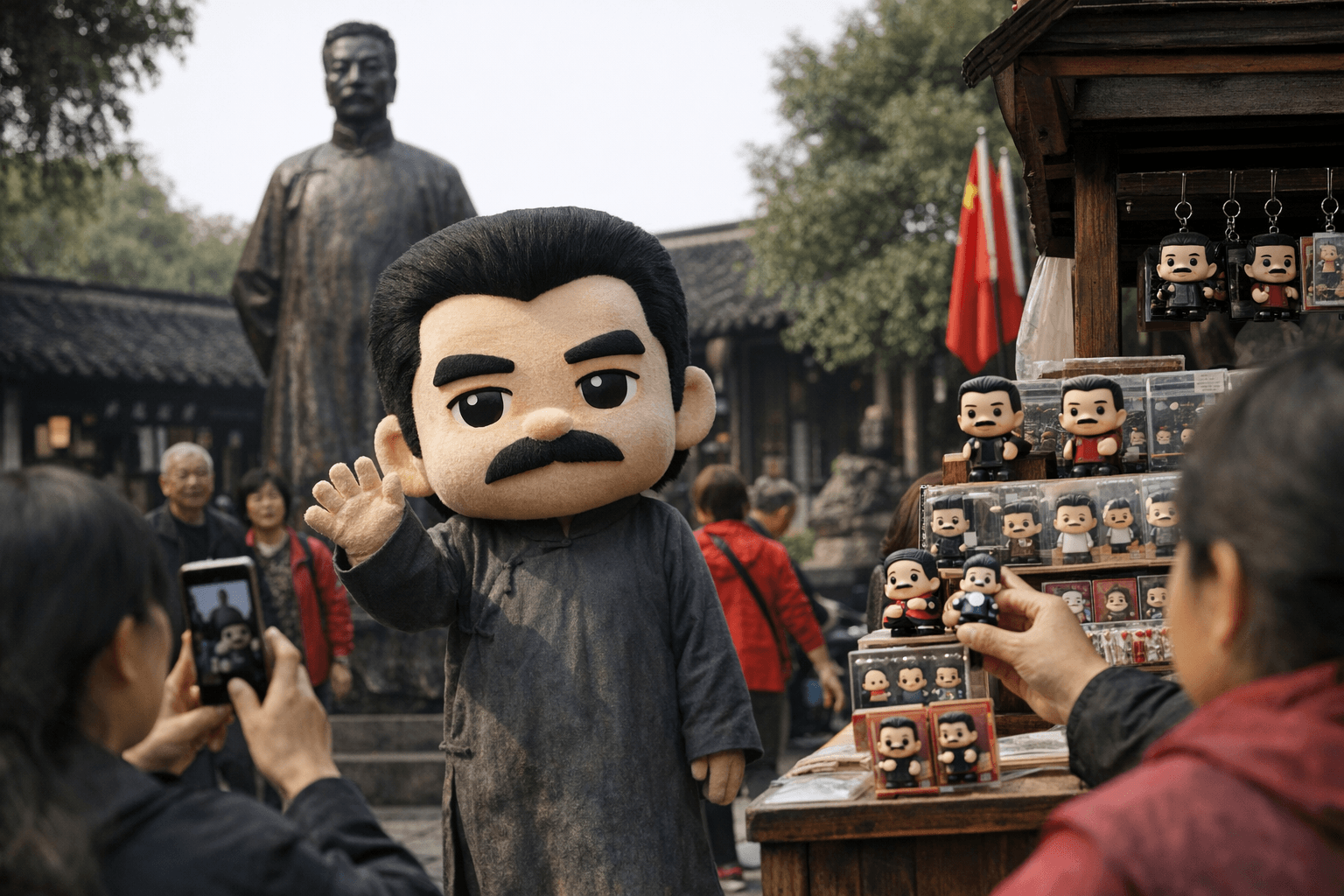
In Shaoxing, Zhejiang province, merchandising has reshaped Lu Xun from an embittered critic into an affable mascot: costumed characters, Q‑version figurines and refrigerator magnets selling for under ¥1 appear alongside official Lu Xun‑themed cultural badges promoted by city cultural authorities since 2024 and visible in a China Daily feature dated July 14, 2025. The Lu Xun Memorial Museum, whose publicly cited holdings list 6,507 items and 222 catalogued precious relics, reported about 971,650 visitors at the end of 2022, making the writer’s hometown a major tourism node that cultural managers are packaging for youth audiences.
Lu Xun, born Zhou Shuren on September 25, 1881 and died October 19, 1936, wrote "Diary of a Madman" and "The True Story of Ah Q" in vernacular Chinese and used satire to attack social complacency; he never formally joined the Chinese Communist Party. His uncompromising prose made him a target of appropriation: Mao Zedong in the Yan'an speeches around 1940 elevated Lu Xun, calling him the 'commander of China's cultural revolution,' language that helped convert a complex critic into a usable revolutionary symbol.
The Party’s long pattern of instrumentalizing Lu Xun reached a peak of spectacle in 1966, the thirtieth anniversary of his death, when official commemorations in Beijing reportedly drew more than 70,000 people. The current wave of repackaging intersects with recent policy shifts: the National People's Congress Standing Committee passed the Patriotic Education Law on October 24, 2023, which took effect January 1, 2024 and strengthens incentives for local governments to present heritage figures as noncontroversial role models for patriotic education and tourism.
Recent examples show how those incentives operate in practice. Photographs of a Lu Xun mascot in Shaoxing circulated in 2024, and souvenir listings across e‑commerce platforms show fridge magnets priced under ¥1 and figurines in the tens of yuan, indicating a mass retail market. Local museum officials defended historical depictions when an anti‑smoking activist identified as Ms. Sun filed a complaint on August 22, 2025 requesting the removal of a 2003 mural that shows Lu Xun holding a cigarette; Lu Xun Memorial Hall staff said they had no plans to alter the image, emphasizing historical authenticity over public‑health concerns.
Scholars such as Gloria Davies and commentators in Critical Inquiry and other journals map this domestication from Yan'an through the Cultural Revolution to the present, arguing that turning Lu Xun into a "cute" commodity neutralizes his questioning edge. The practice also echoes a broader CCP trend: mascots at national events, including the 15th National Games in late 2025, show how viral, family‑friendly imagery now forms part of official narratives.
The stakes are civic as well as cultural. With the Lu Xun scenic area and museum drawing millions to Shaoxing annually and souvenir price points under ¥50 making branded items broadly accessible, the transformation shapes what younger visitors encounter in public memory: a domesticated symbol compatible with patriotic education rather than a living model of dissent. That shift narrows the public vocabulary for critique at a moment when state cultural policy, tourism revenue and public‑health debates intersect in local museums and streets.
This article was produced by Prism’s automated news system from verified source data, official records, and press releases, then run through automated quality and moderation checks before publishing. The system is built and supervised by the people who set the standards it runs under. Read our full AI policy.
Did this article answer your question?


