China's Space Pioneer Rocket Tianlong-3 Fails on Maiden Flight
An explosion in Tianlong-3's engine bay 33 seconds after liftoff ended China's most ambitious commercial rocket debut, the country's third orbital launch failure of 2026.
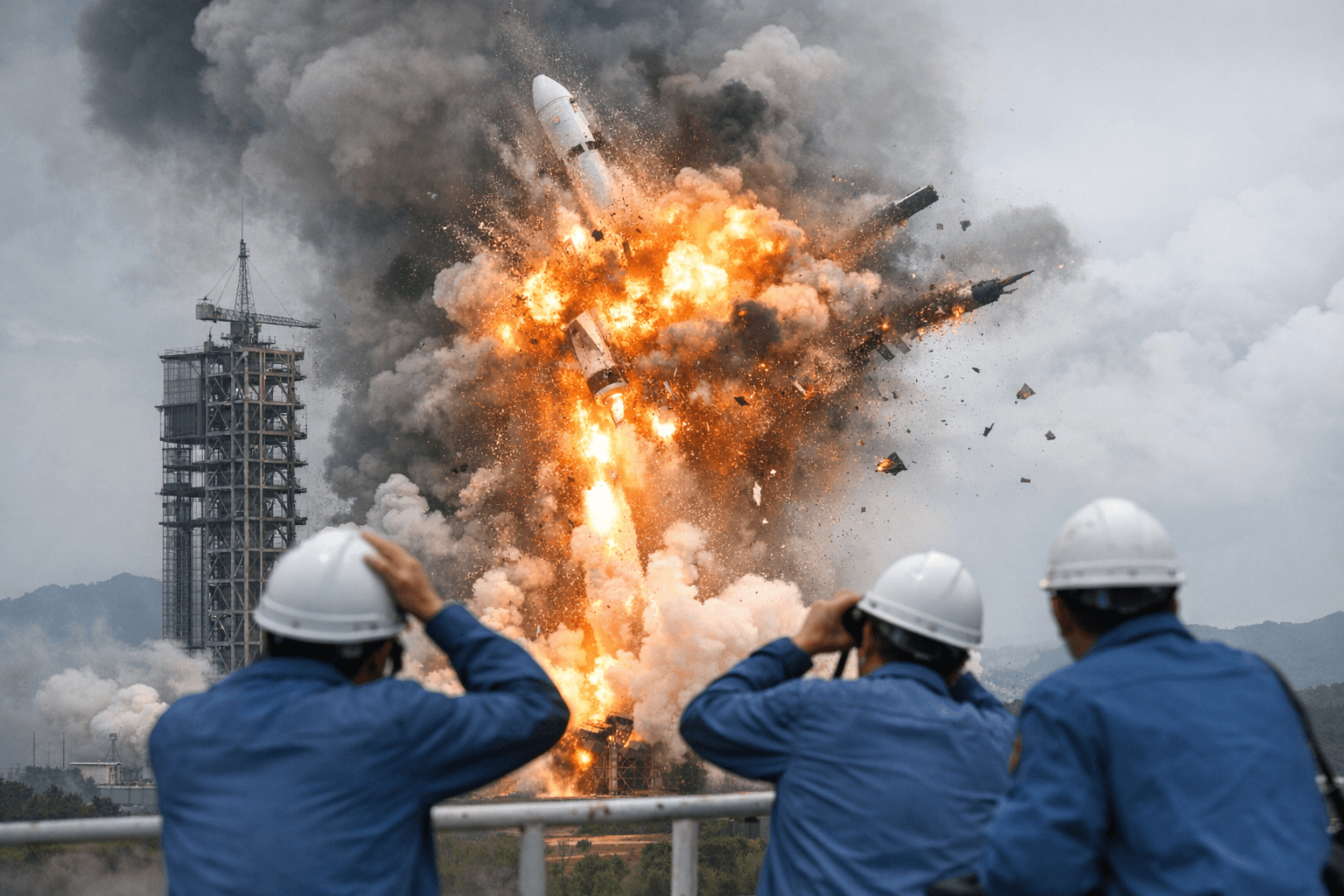
Thirty-three seconds into its inaugural flight, a small explosion tore through the engine bay of Space Pioneer's Tianlong-3 rocket, ending China's most ambitious commercial launch attempt over the Jiuquan Satellite Launch Center. The April 3 failure marked the third orbital launch loss for China in 2026 and dealt a significant blow to the country's push to field homegrown reusable heavy-lift vehicles.
Video circulated on social media captured the sequence clearly: the 72-meter-tall, two-stage kerosene/liquid oxygen rocket lifted off from its commercial pad at Jiuquan before the anomaly struck the engine section, and the vehicle continued briefly before flight termination. Space Pioneer, formally known as Beijing Tianbing Technology Co., confirmed the failure on its official WeChat account, stating the "specific cause is currently under analysis and investigation." The company subsequently issued an apology to its partners and "all sectors of society who care about the development of commercial spaceflight," and pledged to ensure the success of future missions.
Tianlong-3 was designed as a direct competitor to SpaceX's Falcon 9. Its first stage carries nine Tianhuo-12 engines producing a combined liftoff thrust of approximately 820 to 900 tonnes-force. In expendable mode, the rocket can lift 22,000 kg to low Earth orbit and was engineered to launch up to 36 satellites in a single flight. The first stage is designed for up to 10 recovery cycles via autonomous vertical landing, though no recovery attempt was planned for the maiden flight. No official payload manifest was released; unconfirmed reports in spaceflight circles suggest demonstration satellites for the Qianfan (千帆) internet megaconstellation may have been aboard.
Friday's failure was the second major setback for the Tianlong-3 program. On June 30, 2024, a first-stage prototype unexpectedly detached from its hold-down structure during a static fire test at the Gongyi Engine Test Facility in Gongyi, Henan Province, a city of approximately 800,000 residents. The stage lifted off accidentally, crashed, and exploded in the mountains roughly 1.5 km southwest of the test stand, with no casualties. Investigators found the nine-engine stage had reached 820 tonnes-force of thrust, far exceeding the stand's maximum designed load-bearing capacity of 600 tonnes-force. Space Pioneer responded with 127 corrective measures, including doubling the number of hold-down arms, and completed a successful redesigned static fire on September 15, 2025, on a floating platform near Haiyang, Shandong Province, where all nine engines fired for approximately 35 seconds and produced nearly 1,100 metric tonnes of combined thrust.
The company has now initiated a "zeroing procedure," the rigorous fault-investigation and rectification process standard in Chinese aerospace, to systematically identify root causes before the next flight attempt.
The setback arrives at a consequential moment for China's commercial space sector. April 3 was the country's 19th orbital launch attempt of 2026, coming just four days after CAS Space successfully debuted its Kinetica-2 kerolox rocket on March 30. No Chinese firm has yet demonstrated the ability to recover and reuse a rocket's first stage, a gap this incident underscores. Competitor LandSpace is planning a second flight of its reusable Zhuque-3 rocket in the first half of 2026.
Space Pioneer has raised approximately $764 million in total funding, including an additional $350 million announced in October 2025 specifically to support Tianlong-3 and next-generation engine development. The company reached a landmark in April 2023 when Tianlong-2 became the first liquid-fueled rocket from a Chinese private company to reach orbit. Tianlong-3 was supposed to be the program's defining next step; instead, its future now rests with the engineers working through the flight telemetry.
This article was produced by Prism’s automated news system from verified source data, official records, and press releases, then run through automated quality and moderation checks before publishing. The system is built and supervised by the people who set the standards it runs under. Read our full AI policy.
Did this article answer your question?


