Saturn's Magnetosphere Is Lopsided, Driven by Enceladus and Rapid Rotation
Cassini data reveals Saturn's magnetic shield is persistently skewed post-dawn, driven by Enceladus' geysers and the planet's 10.7-hour rotation.
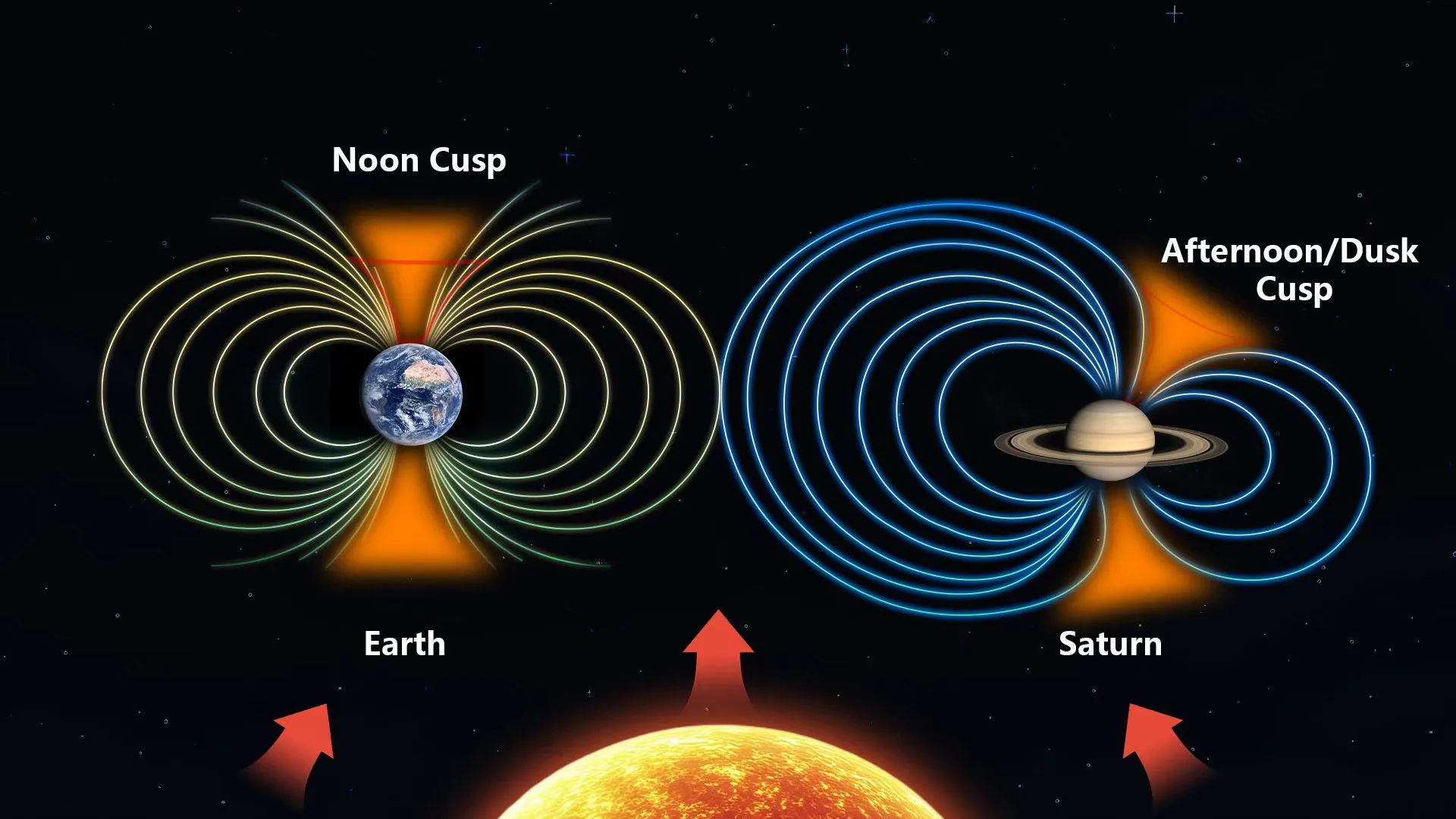
Saturn's magnetosphere, the vast magnetic bubble that shields the planet and its moons from the solar wind, is not the symmetric structure scientists long assumed. A study drawing on six years of NASA's Cassini spacecraft observations found the magnetospheric "cusp," the funnel-shaped region where solar particles slip past the field and enter the system, sits consistently skewed toward the planet's post-dawn side, hovering between 13:00 and 15:00 on the solar local clock rather than at the noon position expected for a more Earth-like system.
The finding, published in Nature Communications and led by researchers including a team from University College London, redraws the map of Saturn's space environment in ways that carry direct operational weight for any spacecraft navigating that region.
Understanding a magnetospheric cusp requires imagining a planetary magnetic field as a hollow shield. On Earth, the cusp sits close to solar noon, where the solar wind's pressure is greatest and particles can most easily funnel in. Saturn's cusp does not sit at noon. It drifts roughly two hours past into the post-dawn afternoon sector, and the UCL-led analysis shows this drift is not random noise. It is a persistent, statistically significant feature.
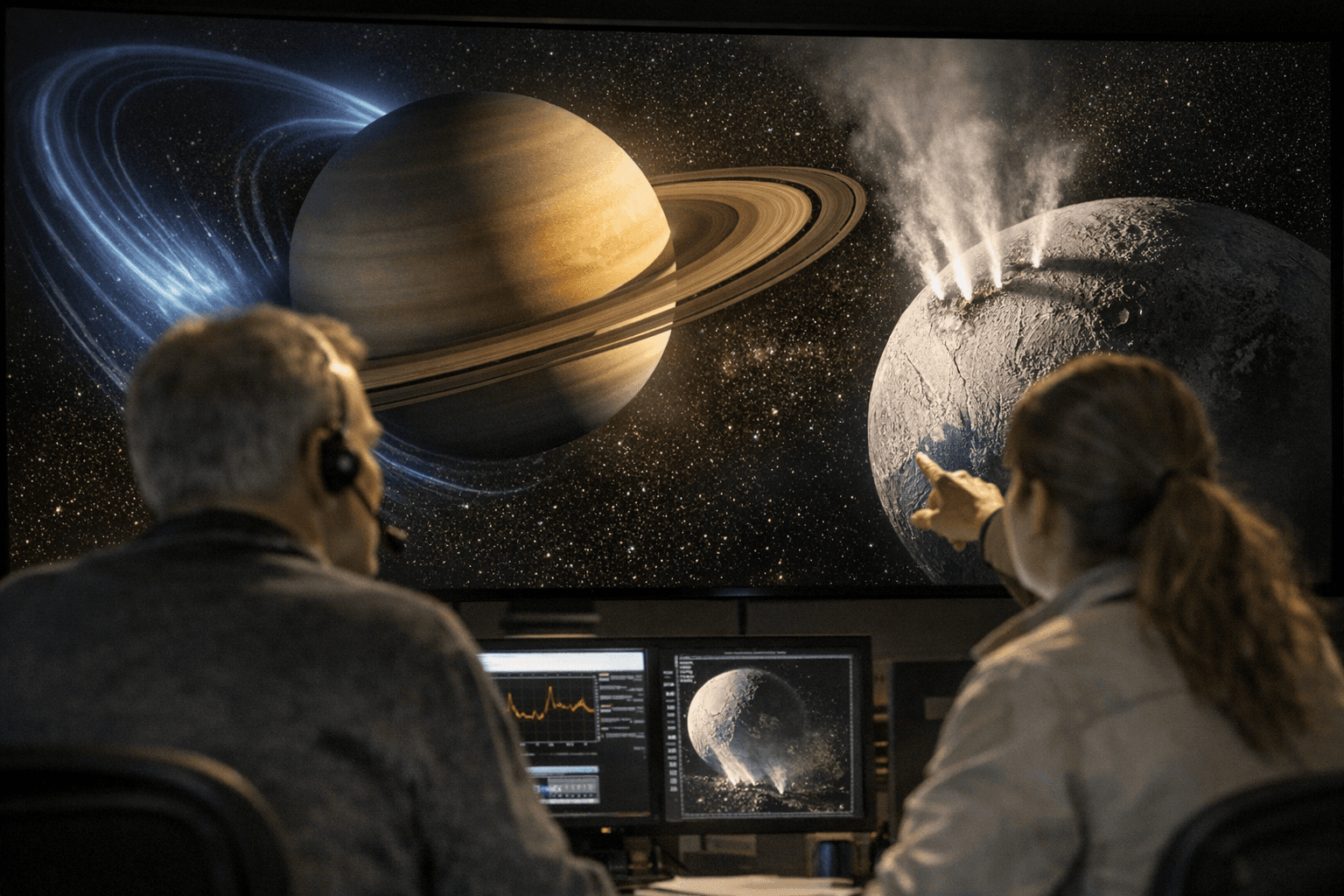
Two forces account for it. Saturn completes a full rotation in approximately 10.7 hours, one of the fastest spins among the solar system's planets. That speed generates significant rotational momentum in the magnetosphere itself. The second force is more exotic: Enceladus, one of Saturn's icy moons, continuously ejects water vapor and ice grains through geysers erupting from its south pole. Once that material is ionized by radiation, it becomes electrically charged plasma, trapped in Saturn's magnetic field and dragged along with the planet's spin. That rotating plasma "soup," combined with the 10.7-hour rotation, effectively hauls the entire magnetospheric structure off center, pulling the cusp away from its expected solar noon position.
Professor Andrew Coates of UCL, a co-author on the paper, said knowing the cusp's location "can help us better understand and map the whole magnetic bubble," with rapid rotation and the Enceladus-fed plasma providing a natural explanation for the asymmetry.
The study expanded the catalog of directly observed cusp events from roughly a dozen cases identified in earlier Cassini-era analyses to dozens, a jump in sample size that crossed the threshold needed for statistically reliable conclusions about global geometry. Cassini orbited Saturn from 2004 to 2017; the magnetospheric observations used in this work span 2004 through 2010, representing a late but significant scientific dividend from the mission's archived data.
The implications extend beyond orbital mechanics. The cusp is where high-energy charged particles enter the magnetosphere and precipitate into Saturn's upper atmosphere, driving auroral displays and depositing energy. A displaced cusp means models built on symmetric assumptions have been miscalibrating radiation exposure across Saturn's flanks. For spacecraft designers planning future missions to Enceladus, whose subsurface ocean makes it a primary target in the search for extraterrestrial habitability, that asymmetry translates directly into revised shielding requirements and trajectory planning.
The broader principle may reach further still. Saturn's magnetospheric architecture is dominated not by the solar wind but by plasma injected from its own moon system and amplified by rapid rotation. If that configuration holds at other fast-rotating giant planets, it points toward a general framework: for worlds like Saturn, the moons feeding their magnetospheres may shape space weather more decisively than anything arriving from the Sun.
This article was produced by Prism’s automated news system from verified source data, official records, and press releases, then run through automated quality and moderation checks before publishing. The system is built and supervised by the people who set the standards it runs under. Read our full AI policy.
Did this article answer your question?