How Cutting-Edge Technology Is Helping Restore Blenheim Palace
A 300-year-old UNESCO World Heritage Site is using digital twins, IoT sensors, and machine learning to outwit damp, beetles, and crumbling stone.
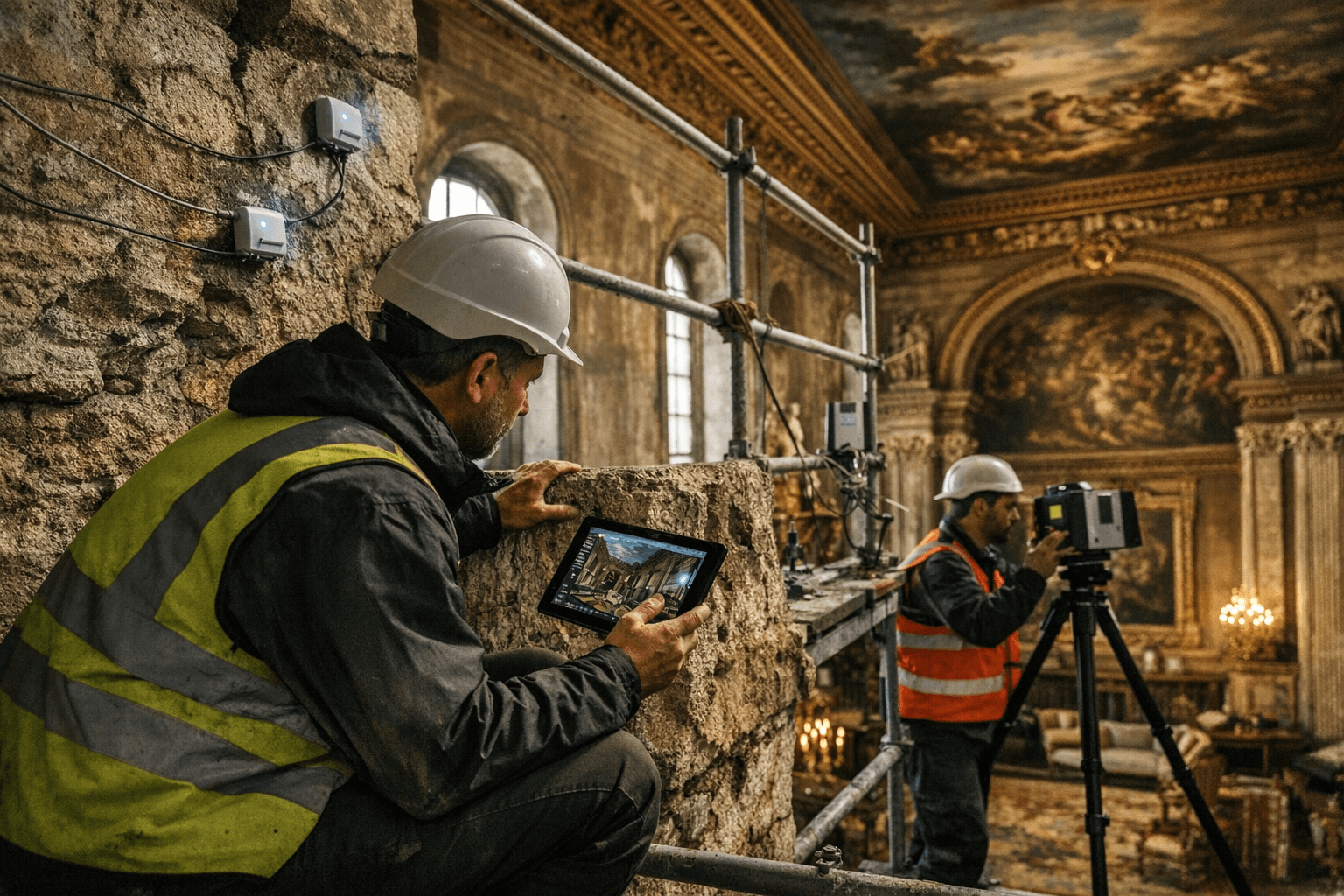
Blenheim Palace has stood for more than three centuries, but the threats it faces today, moisture seeping through a Baroque roofline, Death Watch Beetle gnawing through timber, and the slow exfoliation of 300-year-old stonework, are as relentless as ever. What has changed is the arsenal available to fight back. Blenheim Palace is mid-way through a 10-year conservation project costing £40 million, funded entirely through visitor admission charges. Keeping it standing costs approximately £4 million a year, and the palace is now deploying some of the most sophisticated building technology in the heritage sector to make every pound of that work harder.
The Roof Crisis That Started It All
Blenheim's most pressing current challenge is the £10.4 million roof restoration, the most significant in the palace's history, which commenced in January 2025 and is expected to complete by 2026. Dubbed "Above and Beyond," the project was triggered by water penetration in the Great Hall, in the Heights (formerly the servants' quarters), and in the Saloon, where saturated timbers had become infested with Death Watch Beetle, threatening a priceless ceiling fresco. The work is being carried out by DBR Ltd, specialists in historic building conservation, and includes the renewal of slate and lead roofs, as well as essential upgrades to lead gutters, rooflights, and rainwater drainage systems.
DBR is also conducting sensitive cleaning trials, including poulticing and laser cleaning, to carefully remove sulphation crusts and contaminants while preserving Blenheim's distinctive patina. The installation of safety decks for roof repairs has created a rare opportunity to conduct in-depth conservation work on the iconic ceiling and wall paintings of the Great Hall and Saloon. Alongside the active construction, a Heritage Learning Lab has been opened on-site, allowing visitors to observe restoration techniques firsthand in what is already the palace's most ambitious repair programme in its history.
An IoT Backbone Across 30 Platforms
At the heart of Blenheim's digital transformation is a state-of-the-art IoT sensor network that monitors temperature, humidity, CO2 levels, and footfall in real time. The data pours in from over 30 platforms and had long been siloed, often buried in folders, making it nearly impossible for maintenance teams to get a comprehensive picture of the palace's condition. That fragmentation is now being addressed by centralising everything through the IONA Controller, the IoT digital backbone that ties the network together.
The result is a growing database that currently exceeds 150 million rows of environmental and building data. David Green, Head of Innovation at Blenheim Palace, has driven this transformation, overseeing a system that now sends automated alerts when environmental thresholds are breached anywhere in the building. The practical effect is significant: heating is reduced automatically in unused rooms, lights switch off in empty spaces, and the palace has reportedly cut its energy consumption by 20 to 30 per cent. Blenheim's formal target is at least a 20% reduction in energy consumption, with a broader goal of reaching carbon net zero by 2027.
Building a Digital Twin With Oxford
In partnership with the Heritage Innovation Laboratory Oxford at Oxford University and Oxford Brookes University, Blenheim has built a Cesium-powered digital twin of the palace, a precise, interactive 3D model built from scanned point-cloud data, corrected by architects, and tied to floor plans. The team used the Cesium Design Tiler and Add-In for Autodesk Revit to convert a large Revit building information model into 3D Tiles, enabling smooth streaming via CesiumJS despite the model's size and complexity.
The twin currently contains around 14,000 individual building elements, with plans to expand that figure to more than 50,000 as the model gains greater architectural granularity and eventually incorporates household items such as tapestries and furniture. Regular drone surveys of the structure are also planned, feeding updated condition data directly into the model. Users, both technical and non-technical staff, can filter views of the site by urgency, prioritising sections flagged as most at risk in a recent conservation assessment. By centralising data with Cesium and automating alerts, Blenheim has reduced manual oversight and enabled proactive maintenance, potentially lowering restoration costs by up to 10%.
Turning 140-Year-Old Archives Into Machine Learning Fuel
One of the digital twin's most distinctive features came from an unexpected source. Blenheim Palace maintains extensive archival records of building maintenance dating back to 1881, but these handwritten and typed documents existed only as scanned images, rich in information but impossible to analyse systematically. Clara Saliba, an AI and Data Insights Analyst at the Blenheim Palace Heritage Foundation with a linguistics master's degree from the University of Oxford, developed a workflow to transform those unstructured historical records into a structured dataset suitable for machine learning.
The resulting dataset enabled Blenheim to predict which building elements require attention, optimising conservation strategy and resource allocation. Machine learning models trained on this combined historical and real-time data can now identify patterns in stonefall, water ingress, and surface exfoliation, flagging sections of wall at imminent risk of losing stone before a single piece drops. It is a shift from reactive repair to predictive conservation, and one that carries considerable implications for how stretched heritage budgets are allocated. This work has been cited as an example of smart conservation technology and is being considered for application at other heritage institutions, including the British Museum.
Sustainability Beyond the Building
The technology reaches well beyond the palace walls. Sensors and data analytics have been deployed across the wider 2,100-acre estate to identify which land management practices reduce or increase local fauna. Blenheim also operates a solar farm, with AI helping to optimise panel layout to reduce ground compaction and increase warmth and light beneath the panels, a design choice that has simultaneously boosted biodiversity on land previously described as exhausted from intensive farming.
In recent years, biodiversity studies on the estate have revealed the presence of hundreds of different species, including over 40 colonies of wild bees, some of which were believed to have disappeared from the UK entirely before their discovery at Blenheim. Among the most striking finds is a species of bee unique to the estate, living approximately 30 metres up in 400-year-old oak trees, in cavities carved out by woodpeckers. The estate is also a designated Site of Special Scientific Interest, and the same data-driven approach applied to the palace is informing stewardship decisions across the entire landscape.
A Blueprint for the Heritage Sector
The scale of Blenheim's digital investment raises questions that matter beyond Oxfordshire. Technology of this kind does not eliminate costs, but it can change where those costs are concentrated, moving money away from emergency reactive repairs and toward scheduled, targeted interventions. Blenheim's team has designed the digital twin to scale, recognising that few heritage sites around the world have cultivated the internal technical expertise Blenheim now possesses.
That expertise comes with its own workforce dimension. Saliba has delivered AI education workshops across more than 600 employees at Blenheim, from frontline staff to executive briefings on governance, confronting scepticism about whether technology is relevant to heritage work. The answer emerging from Blenheim is that it is not only relevant; it may be essential. The project reflects a commitment to blending traditional craftsmanship with innovative conservation techniques to protect Blenheim Palace for generations to come. What Blenheim is demonstrating, in real time, is that the question is not whether historic buildings can afford this technology. It is whether, without it, they can afford not to use it.
This article was produced by Prism’s automated news system from verified source data, official records, and press releases, then run through automated quality and moderation checks before publishing. The system is built and supervised by the people who set the standards it runs under. Read our full AI policy.
Did this article answer your question?