China's Space Program Is Growing Fast, and These Photos Show How
China hit 92 rocket launches in 2025 and just low-altitude tested the rocket it plans to use to land astronauts on the moon by 2030, as NASA's Artemis 2 finally circles the moon.
The Numbers That Tell the Story
While NASA's Artemis 2 completed its long-awaited lunar flyby on April 2, 2026, carrying four astronauts around the far side of the moon for the first time since Apollo, a strikingly different space program has been quietly compounding momentum on the other side of the world. China carried out a record 92 space launches in 2025, the highest annual total in its history. That cadence, combined with a series of hardware milestones that have arrived on schedule, has shifted how analysts in Washington and at NASA headquarters now talk about the 2030 lunar landing competition: not as a hypothetical contest, but as a live race with measurable benchmarks ticking down.
The contrast with Artemis is stark on the timeline alone. Artemis II slipped from 2024 to April 2026, and Artemis III to mid-2027. China, meanwhile, reports steady progress, and with Artemis historically missing every major goal by years and China adhering to schedules, momentum is favoring Beijing.
The Heavy Lift Question: Long March 10 vs. SLS
Every crewed moon landing depends on a rocket powerful enough to get people and hardware out of Earth's gravity well. China's answer is the Long March 10. The full, three-stage, 92.5-meter-tall Long March 10 for lunar flights uses three 5.0-meter-diameter first stages bundled together, each powered by seven YF-100K variable-thrust engines, generating a total liftoff thrust of 2,678 tonnes. For comparison, the Space Launch System rocket used for Artemis II is more powerful, at 3,992 tonnes of thrust.
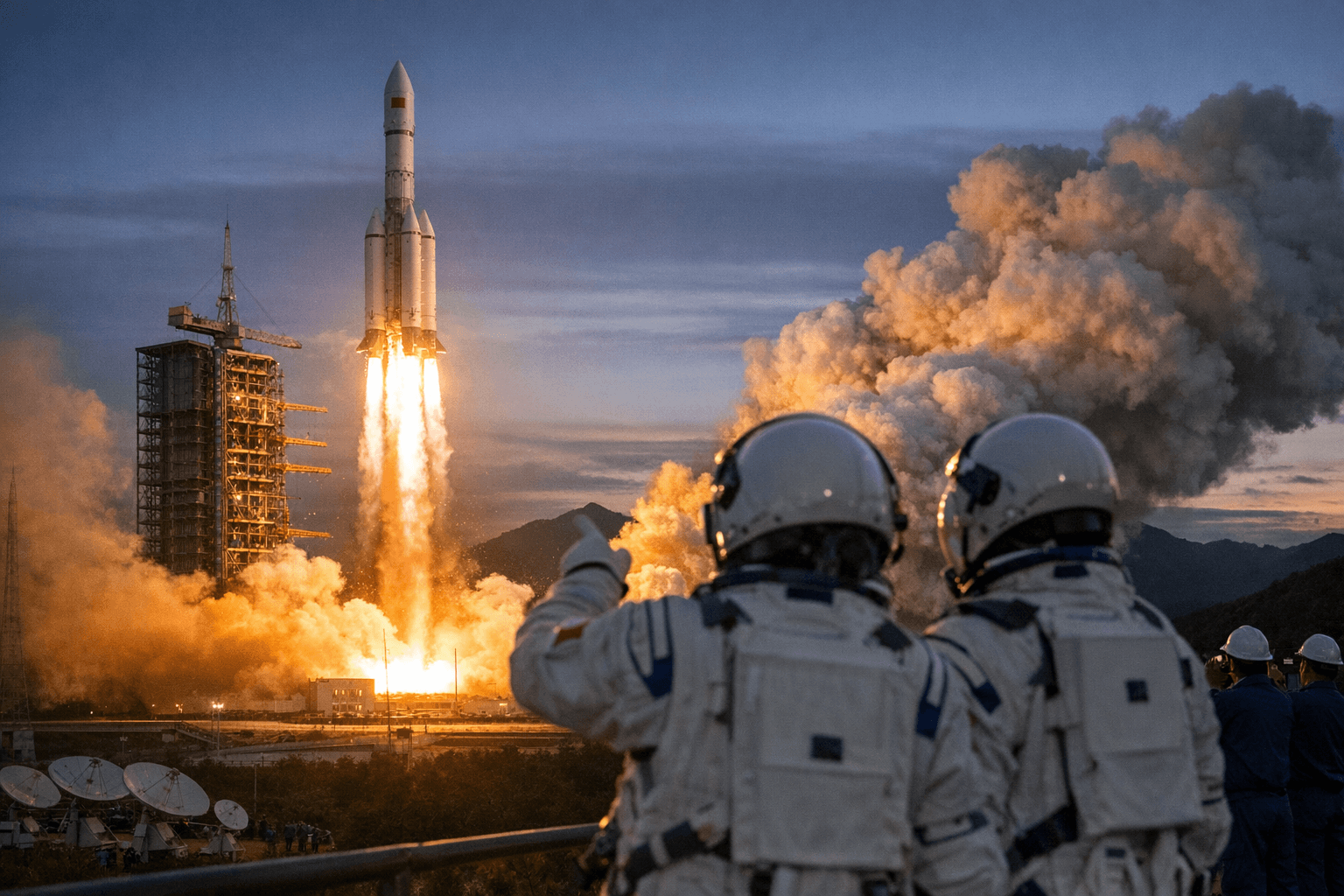
The Long March 10 passed a critical developmental test on February 11, 2026. China conducted a low-altitude demonstration and validation flight test of the Long March 10 at the Wenchang Space Launch Site in Hainan Province, marking a major developmental milestone in China's crewed lunar exploration program. The test featured multiple firsts, including a new rocket model, a new spacecraft model, a new launch pad, and new missions involving the maritime recovery of both the rocket and spacecraft. A separate, partially reusable variant, the Long March 10A, is a two-stage rocket with a diameter of 5 meters and a maximum height of 67 meters, capable of lifting at least 14 tonnes into low Earth orbit, intended for future crew and cargo transport to the Tiangong space station.
Mengzhou and Lanyue: The Spacecraft China Is Building to Land on the Moon
China's lunar mission architecture closely mirrors the Artemis approach. Two successive Long March 10s would lift off, one carrying the astronauts in their Mengzhou spacecraft, the other hoisting the Lanyue lander. The two vehicles would rendezvous in lunar orbit so the crew can transfer to the lander for the descent.
Both vehicles have now cleared major tests. In June 2025, China's Mengzhou spacecraft completed a pad abort test, demonstrating the ability to separate the capsule rapidly from the rocket during an off-nominal situation near the pad. The February 2026 low-altitude test pushed that further: the maximum dynamic pressure abort flight test simulated an emergency occurring when the rocket reaches the point of maximum dynamic pressure at an altitude of about 11 kilometers during ascent, conditions under which the spacecraft must overcome extremely harsh aerodynamic environments to ensure a safe abort and crew rescue.
On the lander side, the lunar lander named Lanyue completed a comprehensive landing and liftoff verification test at a dedicated extraterrestrial landing test site in Hebei Province on August 6, 2025. In that test, China used a full-scale mockup of Lanyue for a terrestrially simulated autonomous lunar landing and takeoff test, with the China Manned Space Agency using exogravity simulation equipment to evaluate the control systems. A senior Chinese space official confirmed in April 2024 that program development for all major mission components, including the Long March 10 rocket, Mengzhou crewed spacecraft, Lanyue lunar lander, and lunar landing space suits, was already complete.
Tiangong: The Operational Platform Behind China's Confidence
China's lunar ambitions are not abstract aspirations; they are backed by an operational space station that has been continuously crewed for nearly five years. China launched its tenth crew to the Tiangong space station with Shenzhou 21, marking the 16th crewed spaceflight for China's Shenzhou program overall, which has continually occupied the orbiting outpost since June 2021. Five crews, comprising 15 taikonauts in total, have conducted long-duration stays in orbit, and to date there have been 11 extravehicular activities and multiple extravehicular payload deployments.
The station also produced a record in 2025: the Shenzhou 20 crew spent 204 days in space, breaking the record for the longest single mission duration by Chinese taikonauts. Looking ahead, China's 2026 crewed spaceflight plans include two crewed missions and one cargo resupply mission, with astronauts from the Hong Kong and Macao special administrative regions expected to fly.
Chang'e 7 and the Push for the Lunar South Pole
China's robotic lunar program is running on a parallel track that will soon intersect directly with NASA's own south pole priorities. Chang'e 7, expected to launch in the second half of 2026, will explore the Moon's south pole to study water ice and other volatile resources. The mission will include an orbiter, a lander, and a mini-flying probe. Chang'e 8, expected in 2028, will verify in-situ resource development and utilization technologies, building on Chang'e 7's international cooperation. Both missions are aimed at the same terrain that NASA and its Artemis Accords partners have identified as essential for a sustained human lunar presence, making the south pole not just scientifically coveted but strategically contested.
What Policymakers Can Actually Influence
The competitive picture that emerges from these benchmarks is not inevitable. Artemis II slipping from 2024 to 2026 reflects deeper problems: fragmented funding, regulatory bottlenecks, and a lack of streamlined acquisition processes. If Artemis II succeeds in 2026 and Artemis III manages a landing in 2028 or 2029, China will be forced to tell a different story: not about being first, but about being more methodical.
The Artemis Accords framework, which now includes more than 40 signatory nations, gives Washington a coalition-building tool that China lacks. Beijing has cultivated its own international partnerships for Chang'e 7 and Chang'e 8, but its program remains more closed to outside verification. What U.S. policymakers can realistically move is straightforward: multi-year budget predictability for NASA suppliers, continued diplomatic investment in Accords partnerships, and congressional pressure to stabilize the commercial lunar lander contracts that underpin Artemis III.
NASA's next clear signal to watch for from Beijing is the first orbital flight test of the Long March 10 and the uncrewed Mengzhou-1 mission, both targeted for 2026. If those fly on schedule, China will have demonstrated the complete transportation stack for a crewed lunar landing with years to spare before 2030. The photos of a rocket rising from Wenchang and a lander touching down in Hebei are already striking. The images from an actual lunar surface would redefine the competitive landscape entirely.
Sources:
Know something we missed? Have a correction or additional information?
Submit a Tip