DESI completes largest 3D map of the universe, expands survey further
DESI finished its planned sky map with more than 47 million galaxies and quasars, but the real test is whether its dark-energy hints hold up.
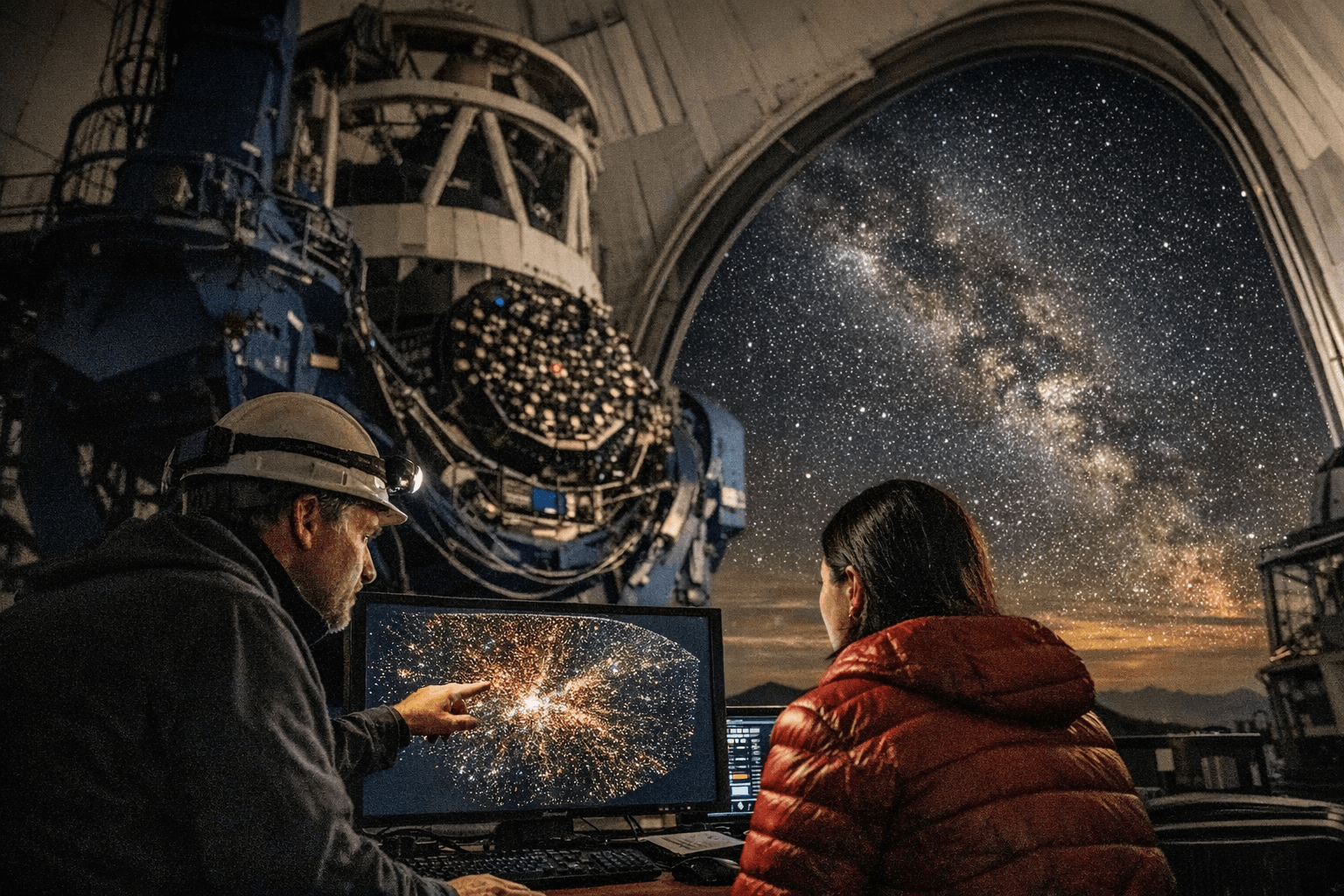
The Dark Energy Spectroscopic Instrument has finished the survey it set out to do, but the scientific argument that gave the project urgency is still very much alive. DESI has built the largest high-resolution 3D map of the universe ever made, charting more than 47 million galaxies and quasars and more than 20 million nearby stars, yet the map’s real value lies in what it may still reveal about dark energy and the fate of cosmic expansion.
The milestone came on April 15, 2026, when collaborators completed the originally planned five-year survey from the NSF Nicholas U. Mayall 4-meter Telescope at Kitt Peak National Observatory in Arizona. The project was designed to collect spectra from 34 million galaxies and quasars across about two-thirds of the northern sky, but it surpassed that target and finished ahead of schedule. Lawrence Berkeley National Laboratory manages DESI, with funding from the U.S. Department of Energy Office of Science, and the collaboration now includes more than 900 researchers, among them 300 PhD students, from over 70 institutions.
DESI’s scale is matched by its speed. The instrument can measure one set of 5,000 objects in about two minutes before moving on, while its observing plan adjusts exposure times in real time as atmospheric conditions and sky brightness change. That efficiency helped produce a survey that went beyond raw mapping. It created a cosmic record scientists will use to compare how galaxies clustered in the past with how they are distributed today, tracing dark energy’s influence over 11 billion years of history.
That question is where the story becomes more than a completed map. Dark energy makes up about 70% of the universe and is driving its accelerating expansion, but DESI’s first three years of data, spanning nearly 15 million galaxies and quasars, raised the possibility that dark energy may not be a fixed cosmological constant after all. Instead, it may evolve over time. That suggestion, first sharpened in an April 2025 analysis, has drawn intense attention because it could force a revision of the standard cosmological model if the full dataset supports it.
The collaboration expects the first dark-energy results from the complete five-year survey in 2027. DESI will keep observing through 2028, expanding its survey area by about 20%, from 14,000 square degrees to 17,000 square degrees, and aiming for a total of 63 million extragalactic redshifts. The next phase will probe harder-to-observe regions near the Milky Way’s plane and farther south, revisit the current survey area to capture fainter and more distant luminous red galaxies, and study dwarf galaxies and stellar streams in the Milky Way and the Andromeda galaxy. The map is complete. The verdict on dark energy is not.
This article was produced by Prism’s automated news system from verified source data, official records, and press releases, then run through automated quality and moderation checks before publishing. The system is built and supervised by the people who set the standards it runs under. Read our full AI policy.
Did this article answer your question?


