NASA turns off Voyager 1 instrument to extend interstellar mission
NASA cut power to Voyager 1’s particle detector so the 49-year-old probe can keep sending data from interstellar space, even as only two instruments still work.
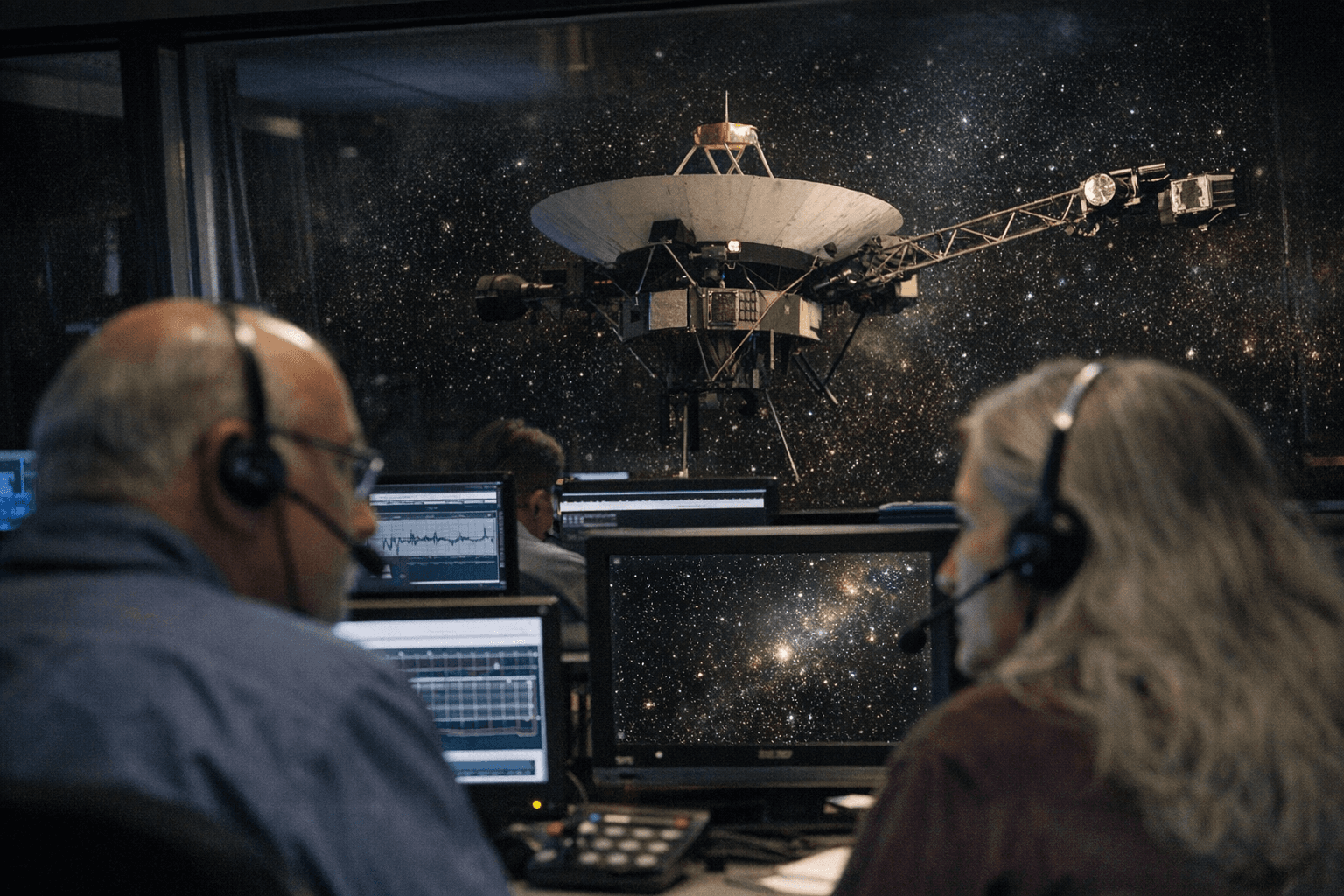
NASA turned off one of Voyager 1’s longest-running instruments not because the mission is ending, but because the spacecraft still has work to do. Engineers at NASA’s Jet Propulsion Laboratory in Southern California shut down the Low-energy Charged Particles experiment on April 17, 2026, to conserve power and keep the probe alive longer as it continues sending back data from interstellar space.
That sacrifice carries a cost. The LECP had run almost continuously since Voyager 1 launched from Cape Canaveral on September 5, 1977, aboard a Titan-Centaur rocket. For nearly 49 years, it measured low-energy charged particles, including ions, electrons and cosmic rays, and helped scientists map the interstellar medium, including pressure fronts and regions of changing particle density. NASA had already set the order for which instruments would go dark as power dwindled, and the LECP was next on the list.
Voyager 1 is now the most distant human-made object in existence and the first to cross the heliosphere, which NASA says it did in August 2012. Voyager 2 reached that interstellar boundary in 2018. The two spacecraft, built at NASA’s Jet Propulsion Laboratory, remain the only probes ever to operate outside the Sun’s heliosphere, a rare feat made possible by a planetary alignment that occurs only once every 176 years.
The engineering math is stark. Of the 10 identical instrument sets on each spacecraft, seven have already been shut off. Voyager 1 still has two science instruments operating, and NASA says four science investigation teams are still using the surviving instruments aboard Voyager 1 and Voyager 2 to study the frontier beyond the Sun’s influence. The same LECP instrument on Voyager 2 was turned off in March 2025.
Keeping the mission alive also means accepting an almost absurdly thin trickle of data. Voyager science reaches Earth at just 160 bits per second, and the Deep Space Network, with complexes in California, Spain and Australia, gives each spacecraft only six to eight hours of real-time tracking data a day. Even so, NASA has continued to nurse the aging probes through deep space, including a brief communications pause for Voyager 1 in October 2024 and a successful backup-thruster revival that same year.
What began as a five-year mission has become a decades-long lesson in public science: carefully rationed power, steady engineering and a federally funded spacecraft still returning discoveries from beyond the heliosphere.
Know something we missed? Have a correction or additional information?
Submit a Tip