ECB Expected to Hold Rates Through 2026, but War-Driven Energy Shock Boosts Hike Odds
Oil prices up 40% and a war-driven energy shock pushed more than a third of economists to forecast an ECB rate hike in 2026, even as most still expect rates to hold.
The European Central Bank is still expected to hold interest rates steady in 2026, a Reuters poll of economists showed, although over a third now forecast at least one hike this year as a war-driven energy shock has pushed up inflation forecasts.
Just over a third of respondents, 21 of 60, now expect at least one hike this year, compared with three of 72 who held that view in a survey two weeks ago. Respondents expecting rate hikes this year were mostly split between one and two increases, and some rate forecasts were lifted between 25 to 125 basis points since the previous poll.
The shift reflects a rapidly evolving geopolitical backdrop. The broadly steady consensus view contrasts with financial market bets on around three hikes by year-end after the U.S.-Israeli war with Iran and blockade of a key transport corridor sent oil prices surging about 40%, forcing major inflation upgrades.
The ECB's Governing Council decided on March 19 to keep its three key interest rates unchanged, reaffirming it is determined to ensure that inflation stabilises at the 2% target in the medium term. The ECB stated that the war in the Middle East has made the outlook significantly more uncertain, creating upside risks for inflation and downside risks for economic growth, and that it will have a material impact on near-term inflation through higher energy prices, with medium-term implications depending on the intensity and duration of the conflict.
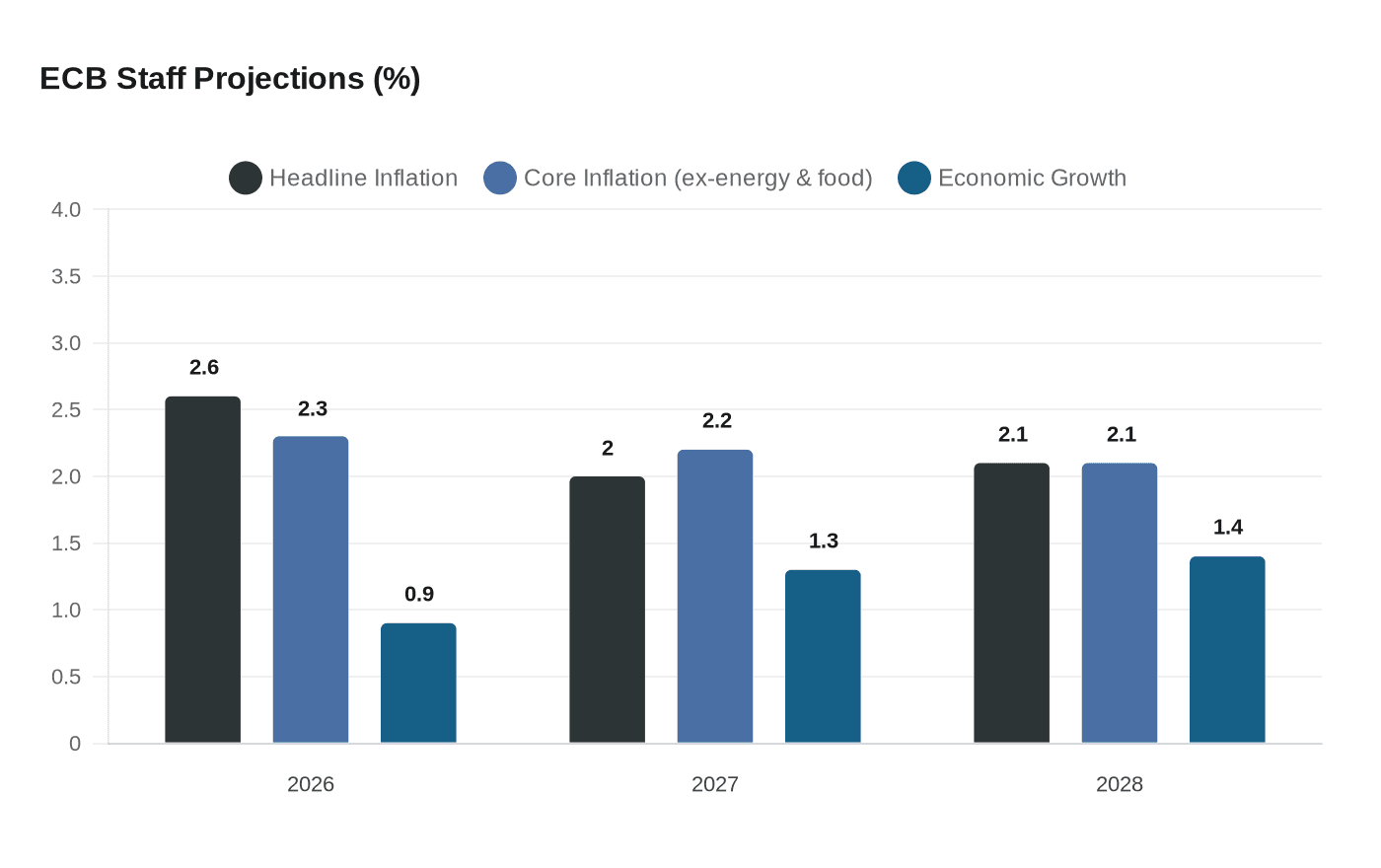
The ECB's new staff projections, which exceptionally incorporated information up to March 11, show headline inflation averaging 2.6% in 2026, 2.0% in 2027, and 2.1% in 2028. Inflation was revised up compared with the December projections, especially for 2026, because energy prices will be higher owing to the war in the Middle East. For inflation excluding energy and food, staff project an average of 2.3% in 2026, 2.2% in 2027, and 2.1% in 2028. Staff expect economic growth to average 0.9% in 2026, 1.3% in 2027, and 1.4% in 2028, a downward revision especially for 2026 reflecting the global effects of the war on commodity markets, real incomes, and confidence.

The ECB's hold came just days after major banks pivoted sharply. Barclays and J.P. Morgan expect as many as three rate hikes of 25 basis points each this year, with the banks penciling in increases in April, June, and July, a marked shift away from forecasts of unchanged rates for 2026 that would bring the deposit rate to 2.75% by year-end. Morgan Stanley expects ECB hikes at the bank's June and September meetings, taking the rate to 2.5%. UBS economists, however, expect the ECB to keep rates unchanged rather than tighten policy, which they described as "contrary to market expectations."
After holding rates last week, ECB policymakers have since sounded slightly more hawkish. On Wednesday, President Christine Lagarde said "some measured adjustment of policy could be warranted" to tackle "a large though not-too-persistent" inflation overshoot. Bundesbank President Joachim Nagel's interview with Bloomberg pointed to a potential April rate hike if the war continues and inflation reappears.
Carsten Brzeski of ING, whose earlier March poll commentary called for a "panic room" within a stable policy stance, offered a more nuanced read in the latest survey. "We changed our baseline scenario but not in an extreme case. In this scenario, by June we will all call the war and the energy price shock temporary and therefore would allow the ECB to stay on hold. If this is not the case in June, yes, we're in for rate hikes," said Brzeski, global head of macro research at ING. He was equally blunt on April: "The chances for April are extremely low. We cannot entirely exclude anything thanks to President Donald Trump. But if I had to add probabilities, it is less than 5%."
The contrast with analyst survey consensus two weeks prior is stark. Over 90%, or 67 of 72 economists, expected the ECB to hold its deposit rate at 2% through 2026 in the March 9-13 poll, an outlook Reuters described as unchanged since October, with only three predicting a hike and two expecting at least one cut.
Memories of the inflation spike after Russia's invasion of Ukraine in 2022 and the ECB's slow response remain raw. Fabio Balboni, senior economist at HSBC, argued the current situation is structurally different. "In 2022, the ECB started very late hiking from a negative rate. It's like putting a matchstick into a tank of fuel," he said. "This time it's different because we've taken rates back towards neutral, we've been doing quantitative tightening for two years and inflation is back at 2%. Maybe the need to introduce a significant amount of tightening should be less than what was the case in 2022."
Deutsche Bank chief economist Mark Wall had flagged the persistence risk in the earlier March poll: "The ECB is ready and willing to act to avoid a repeat of the 2022-2023 inflation shock. Saying this loudly and clearly might be the best way of ensuring that inflation expectations remain well anchored. 2026 is not 2022, but the risk of persistence is not negligible."
Richard Carter, head of fixed interest research at Quilter Cheviot, cautioned against overreaction: "Any inflation spike will naturally act as a brake on economic growth, so it is important the ECB does not overtighten and keeps focus on the economic outlook."
The growth outlook remains modest. The euro zone economy, which grew 0.2% in the final quarter of 2025, is expected to expand between 0.3% and 0.4% through 2026, according to the Reuters poll. Traders are betting on about 72 basis points worth of hikes from the ECB in 2026, according to data compiled by LSEG. Whether that pricing survives into summer will hinge almost entirely on how long the conflict endures and how durably energy prices remain elevated.
This article was produced by Prism’s automated news system from verified source data, official records, and press releases, then run through automated quality and moderation checks before publishing. The system is built and supervised by the people who set the standards it runs under. Read our full AI policy.
Did this article answer your question?


