Essential Catamaran Handling and Docking Guide for Skippers
This practical guide explains core handling differences between catamarans and monohulls and provides step-by-step techniques for safe, repeatable maneuvers in close quarters. Follow these procedures to improve precision when docking, reduce stress on crew, and protect your boat and marina neighbors.
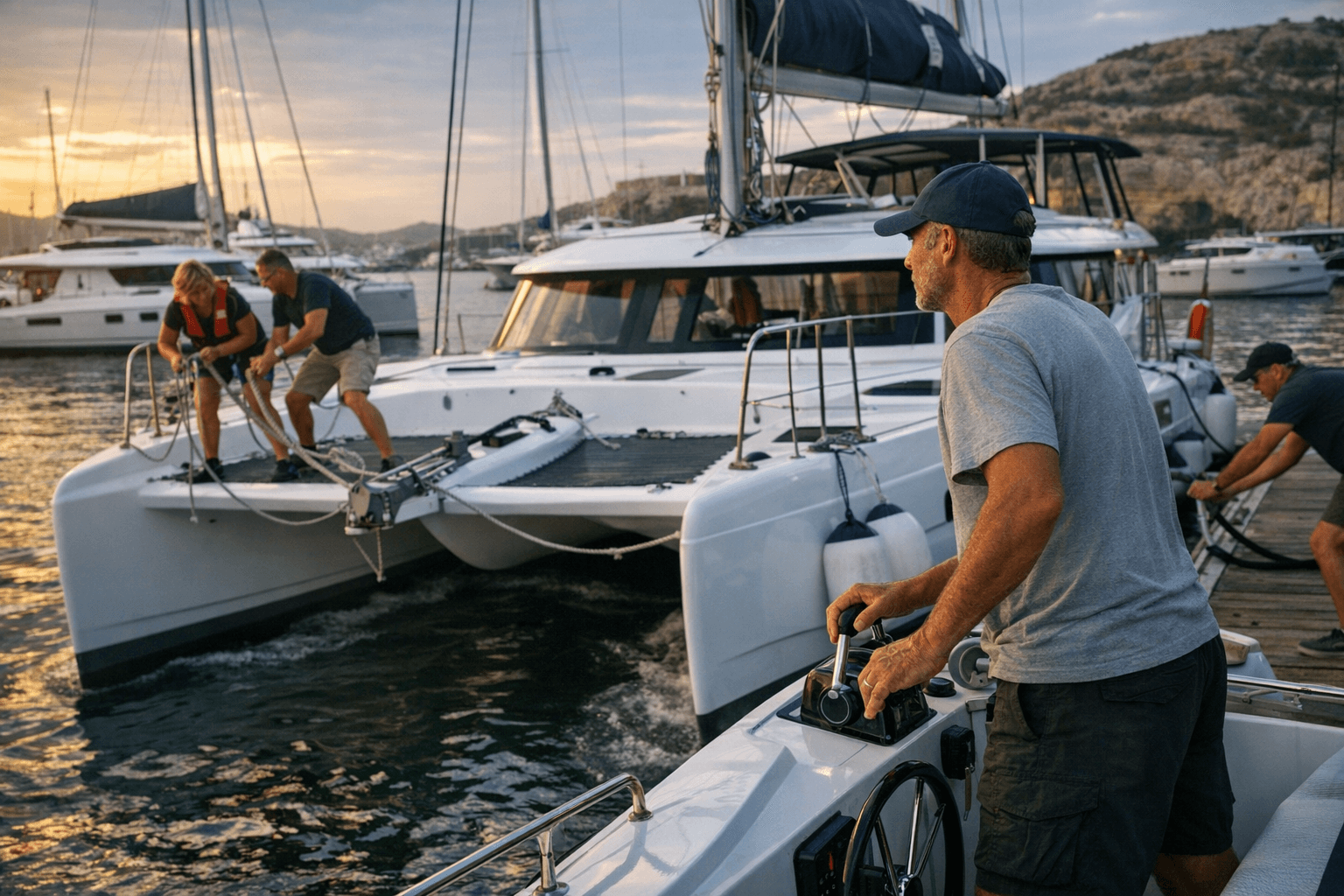
Catamarans respond differently to power and steering than monohulls, and mastering those differences is the fastest way to safer, more confident arrivals and departures. The single most important technique is pivoting with differential engine power: use one engine ahead and the other astern to rotate the boat around its center, then fine-tune position with short bursts of throttle.
Plan your approach before you reach the slip. Assess wind and current, pick which side of the boat you will tie up to, and assign crew roles well ahead of arrival so lines and fenders are ready. Approach at a shallow angle that gives space to correct for wind or gusts; keep speed low to preserve control and allow time for adjustments.
Fender placement and line order matter. Deploy fenders along the side that will take the initial contact, and have dock lines staged by function. Secure the windward bow line first to halt lateral movement, then add stern lines or springs depending on conditions. Use short, deliberate bursts of throttle for positioning rather than prolonged power; this provides pinpoint control and reduces the risk of overcorrection.
Handling reverse on a catamaran requires restraint. These boats respond quickly when backing; small throttle changes translate to significant movement. Practice backing with minimal throttle in calm conditions to build muscle memory. When you need more control in tight marinas, use a mid-ship line or springs to hold position while you sort remaining lines and fenders, and consider backing with differential power to pivot rather than relying on rudders alone.
Communicate clearly with crew throughout. A brief, specific pre-arrival briefing covering who handles which line, who manages fenders, and how you will use engines removes confusion at the critical moment. Have dock lines of appropriate length and strength ready and double-check cleats and attachment points before committing to the slip.
When unfamiliar with a marina, call ahead for local guidance on preferred approaches, hazards, and any traffic patterns. Local knowledge can save time and prevent damage to finger piers or adjacent boats.
This set of practices is tailored for charter skippers and new owners as a simple, repeatable framework for close-quarters handling. Practice these techniques in calm conditions, build familiarity with how your particular catamaran responds, and revisit the routine before each docking to keep crew aligned and operations smooth.
Know something we missed? Have a correction or additional information?
Submit a Tip