EU migrant population hits record 64.2 million, Germany remains top destination
Europe’s foreign-born population hit 64.2 million, with Germany hosting nearly 18 million and 72% of them working age.

Europe’s migrant population reached a record 64.2 million in 2025, turning immigration into a direct test of the continent’s labor markets, housing supply and political coalitions. The foreign-born population has jumped by about 2.1 million in a year and has grown from around 40 million in 2010, a surge that is reshaping who fills jobs, who needs shelter and which governments are absorbing the strain.
Germany remained the bloc’s biggest destination, with nearly 18 million foreign-born residents and about 2.7 million refugees overall. Tommaso Frattini, one of the report’s authors, said: “Germany remains the main destination for migrants in Europe,” both in absolute terms and relative to its population. About 72% of Germany’s foreign-born residents were of working age, a crucial detail in a country, and a continent, where employers are short of labor and the population is aging.

Spain posted the fastest recent growth, adding about 700,000 foreign-born residents to reach 9.5 million. The concentration is not even across the bloc. Luxembourg, Malta and Cyprus stand out for especially high immigrant shares relative to their population size, while the pressure on asylum systems falls most heavily on a small group of countries.
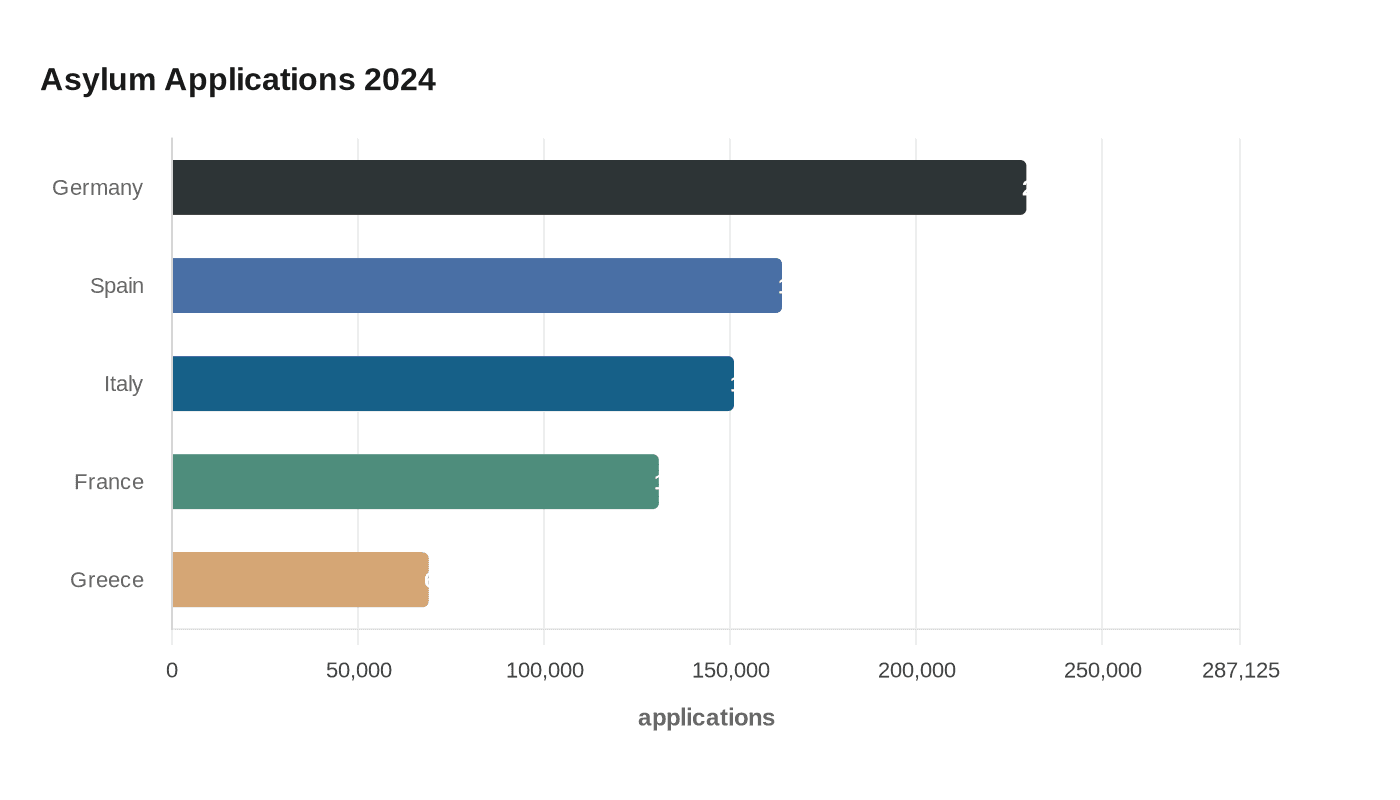
That burden is visible in the asylum data. Spain, Italy, France and Germany accounted for nearly three-quarters of all first-instance asylum applications in the EU, and Germany alone received 229,700 first-time applications in 2024. Spain took 164,000, Italy 151,100, France 130,900 and Greece 69,000. The pattern shows that migration is not simply a European story, but a country-by-country stress test, with a handful of national systems carrying most of the load.
The demographic backdrop explains why the numbers matter so much. The EU population stood at about 449.2 million on January 1, 2024, while the share of people aged 80 and over rose from 3.8% in 2004 to 6.1% in 2024. A 2025 European Parliament briefing said 42% of EU citizens identify population aging as a key concern, while 40% cite a shrinking working-age population and labor shortages. Against that backdrop, migration is both an economic necessity and a political flashpoint, especially as wars, inequality and climate pressure continue to push people toward the bloc.
This article was produced by Prism’s automated news system from verified source data, official records, and press releases, then run through automated quality and moderation checks before publishing. The system is built and supervised by the people who set the standards it runs under. Read our full AI policy.
Did this article answer your question?