European Ministers Visit Bucha on Fourth Anniversary of Russian Atrocities
Twelve European ministers traveled to Bucha, where 400 civilians were killed, pledging accountability while U.S. attention remains fixed on the Middle East.
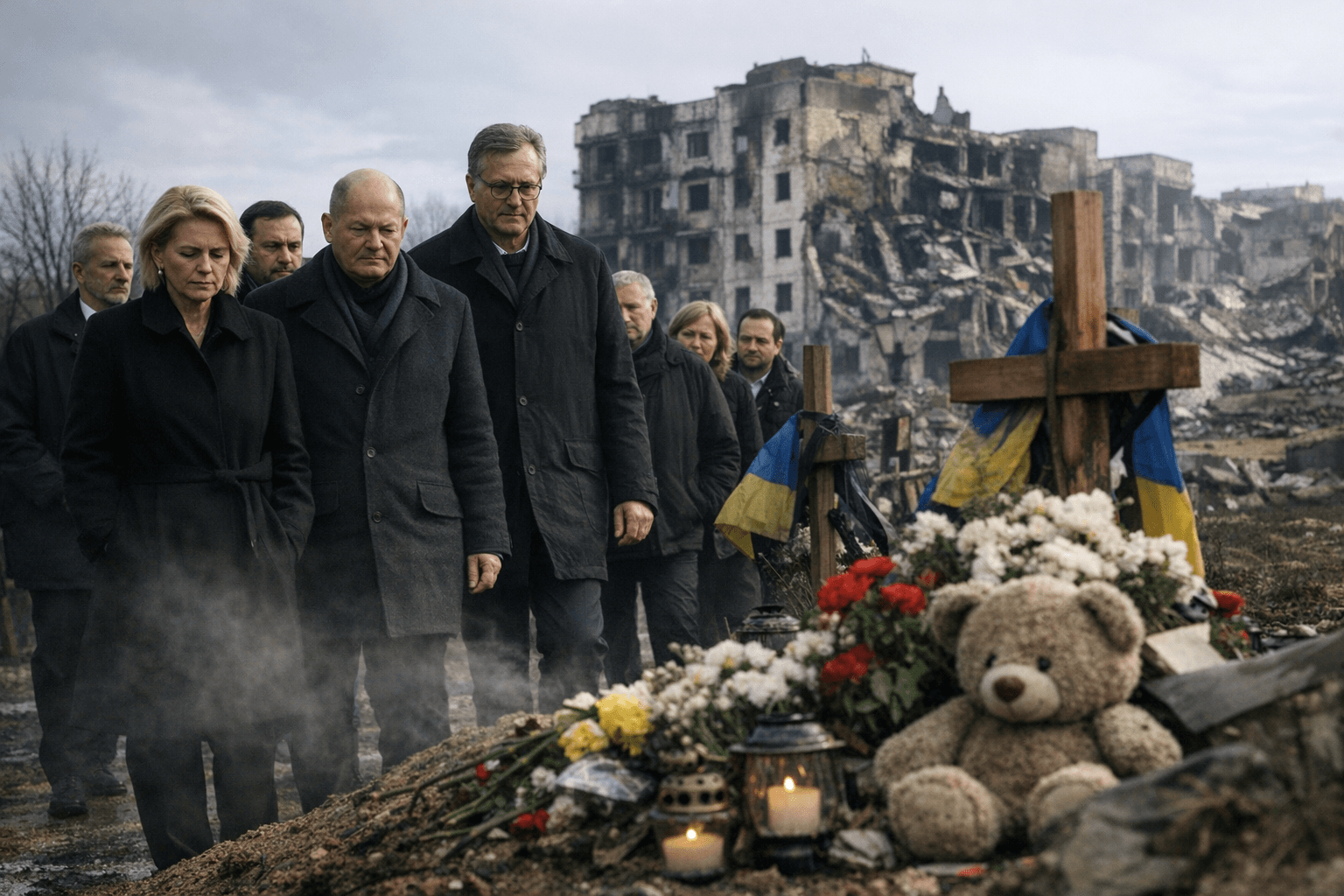
Twelve European foreign ministers arrived in Kyiv by train Tuesday, making their way to the town of Bucha to mark four years since Russian forces killed more than 400 civilians there during the opening phase of Moscow's full-scale invasion. The commemoration carried deliberate diplomatic weight: with U.S.-mediated peace negotiations stalled and Washington's political bandwidth consumed by the conflict in the Middle East, Europe's top diplomats chose the site of the war's most documented atrocities to insist they will not let Ukraine's cause fade from the global agenda.
At the Church of Saint Andrew in Bucha, EU foreign policy chief Kaja Kallas and Polish Foreign Minister Radek Sikorski stood alongside Ukrainian Foreign Minister Andrii Sybiha to view dozens of graphic photographs and video footage of the 2022 massacres. Authorities say many of the victims were gunned down in the street; some had their hands tied behind their backs, and others showed signs of torture or rape. The United Nations has documented more than 70 summary executions in the town, located roughly 25 kilometers northwest of the capital.
Sikorski's reaction after the viewing was blunt. "Anybody who claims that Vladimir Putin is not a war criminal should come and see for themselves," he told reporters at the site.
Kallas framed the visit around accountability as a strategic imperative rather than a moral formality. "One of the things that is really necessary is accountability," she said. "If you don't see people doing this to your family held accountable, you will want revenge." Traveling to Kyiv, she underlined the importance of prosecuting not only those who carried out killings in places like Bucha, but those who gave the orders. The logic was pointed: impunity breeds cycles of violence; justice is a precondition for any durable peace.
The question the delegation left partially unanswered is whether memory diplomacy translates into material commitments. Tuesday's agenda centered on reassuring Kyiv of continued European support for military resupply, economic aid, and the legal infrastructure needed to document and prosecute alleged war crimes. Kallas acknowledged the structural risk openly: "We can't let it slip off the table. We are the ones who have to keep this up because nobody else does."
Sybiha, welcoming the group at Kyiv's central railway station, posted on Telegram that a strong European presence on the anniversary signaled that justice was "inevitable." "Comprehensive accountability for Russian crimes is vital to restore justice in Europe," he wrote. "And today, we will advance accountability efforts."
The visit unfolded as Ukraine simultaneously stepped up drone strikes on Russian energy infrastructure, with fresh damage reported at the Baltic port of Ust-Luga and 38 drones shot down overnight in the Leningrad region, underscoring that the war remains kinetic even as diplomats convened in solemn reflection. U.S.-mediated talks, meanwhile, have shown no clear path to resumption, with Washington still navigating the broader regional fallout from the Middle East conflict.
For European governments, the calculus is increasingly straightforward: if the continent's largest land war since World War II is to remain on the international agenda in its fifth year, Europe itself must carry the political and financial burden of keeping it there. Bucha, four years on, is both the moral argument and the strategic reminder.
Know something we missed? Have a correction or additional information?
Submit a Tip