Foxconn Q1 Revenue Surges 29.7% on Record AI Server Demand
Foxconn's March revenue hit a record T$803.7 billion, up 45.6%, as Q1 sales surged 29.7% to US$66.6B on booming AI server demand.
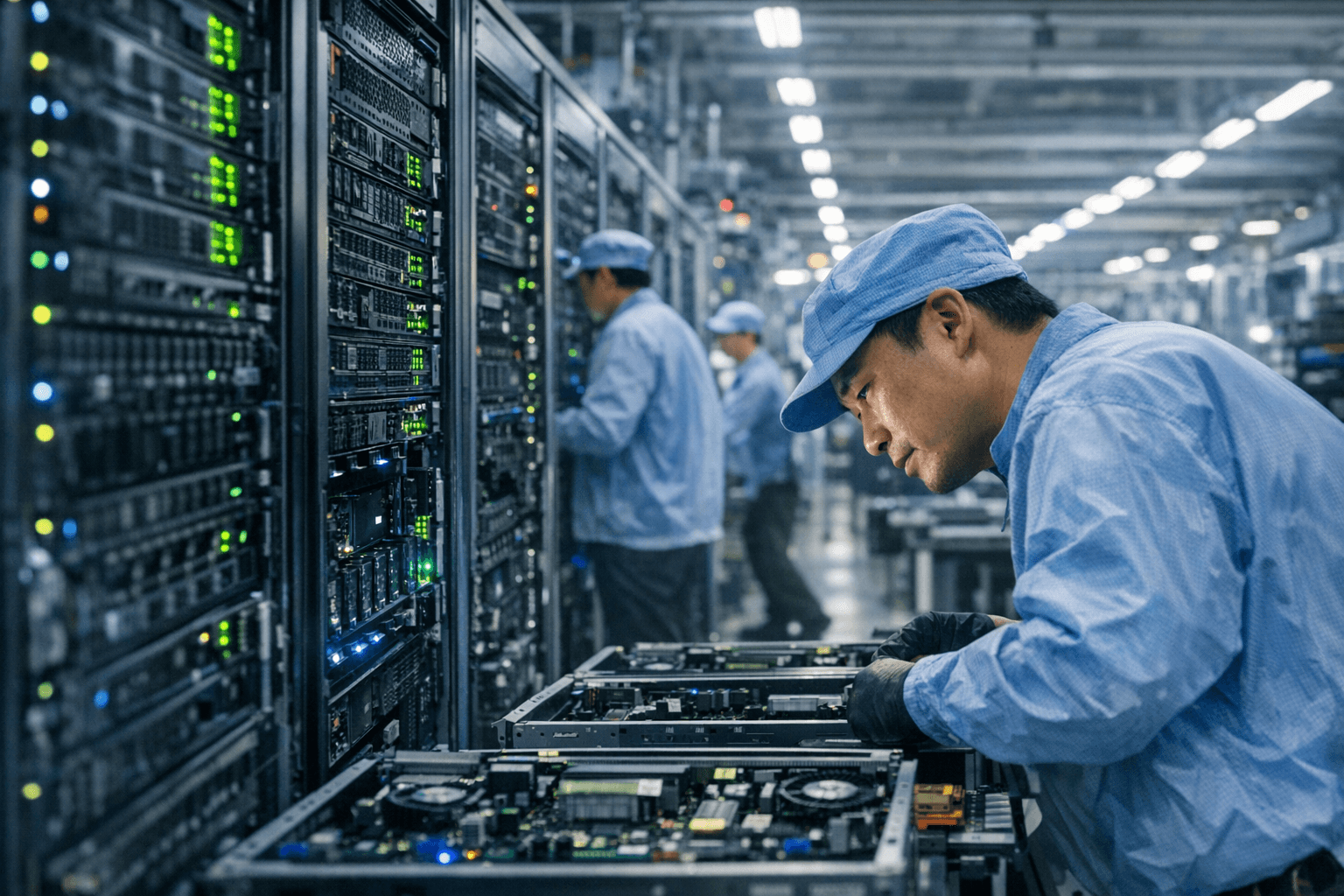
Foxconn reported first-quarter revenue of T$2.13 trillion (approximately US$66.6 billion), a 29.7% year-on-year increase fueled by surging demand for AI infrastructure hardware, with March alone delivering a record T$803.7 billion in monthly sales, up 45.6% from a year earlier and the highest March reading in the company's history.
The quarterly figure narrowly missed the T$2.148 trillion LSEG SmartEstimate, which assigns greater weight to analysts with stronger forecasting track records. Full earnings, including margins and profitability, are scheduled for May 14.
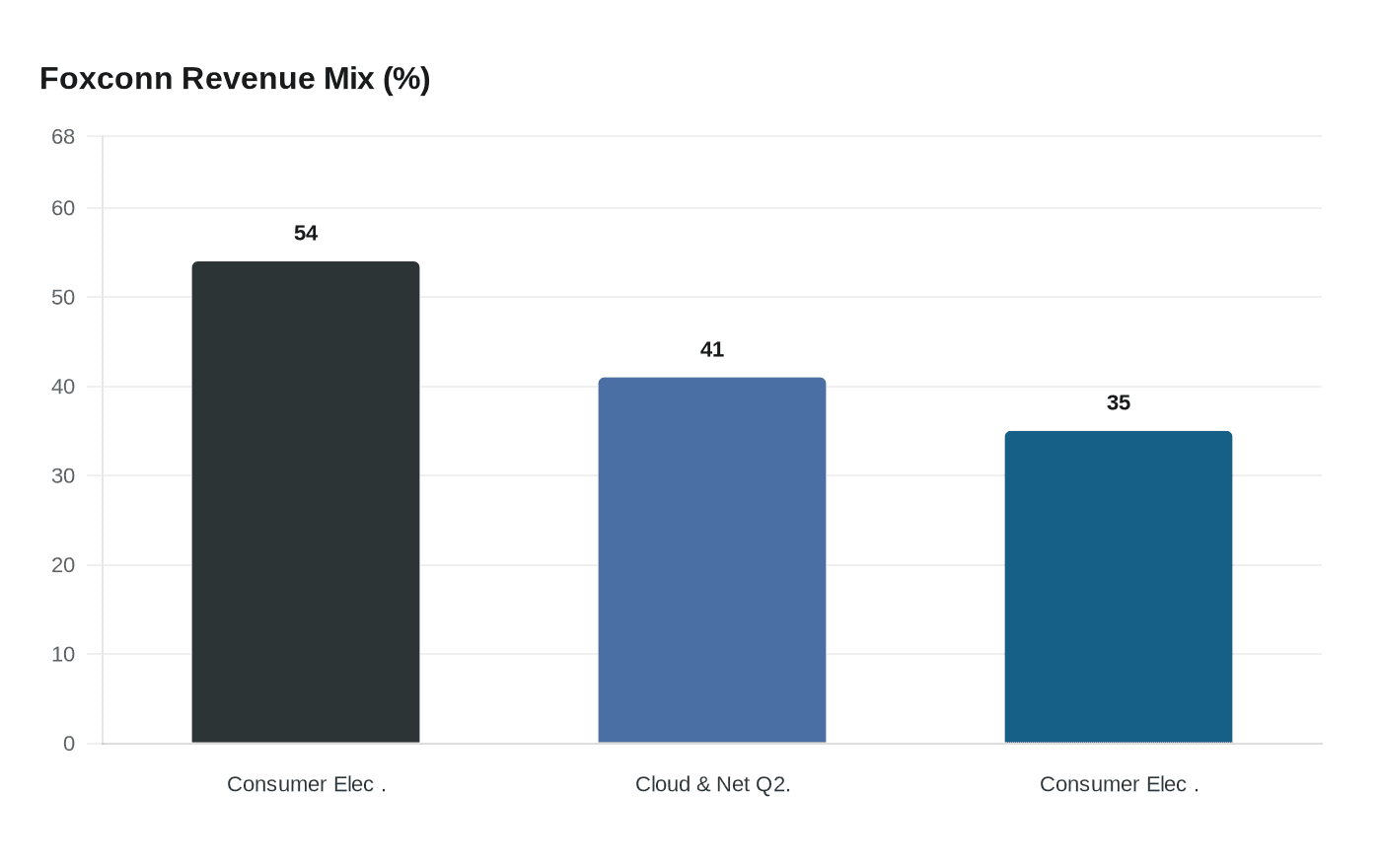
The standout was Foxconn's cloud and networking division, which has been the company's largest revenue segment since Q2 2025, when it first displaced consumer electronics in a structural reversal that would have seemed implausible in 2021, when consumer electronics represented 54% of total revenue. By Q2 2025, cloud and networking had climbed to 41% of revenue versus 35% for consumer electronics, and it held that lead even through Q4 2025's traditionally dominant ICT season. Bloomberg Intelligence analyst Steven Tseng put it plainly: "Hon Hai's cloud business, mostly driven by AI server growth, has become the largest revenue contributor, and should continue to outgrow the iPhone business over the next few years."
Anchoring that shift is Foxconn's role as Nvidia's largest server manufacturing partner and the sole assembler of Nvidia's Blackwell-powered GB200 servers, which carry roughly a 40% price premium over conventional server models. The company's smart consumer electronics segment, which encompasses iPhone assembly for Apple, also posted significant growth on new product launches, though it now plays a secondary role in Foxconn's revenue mix.
For Q2 2026, Foxconn projected AI rack demand to continue expanding, with operations expected to rise both quarter-on-quarter and year-on-year. The company assigned 2026 its highest internal designation of "strong growth" for the full year, the first time it has used that category, signaling management's conviction that the AI infrastructure build-out is structural rather than cyclical.
That conviction is underpinned by 2025's record results. Full-year revenue reached NT$8.1 trillion (approximately US$257 billion), an 18% increase and the first time the company has crossed NT$8 trillion. Earnings per share hit NT$13.61, a record since Foxconn's 1991 listing, and the company declared a cash dividend of NT$7.2 per share, keeping its payout ratio above 50% for the seventh consecutive year. Chairman Young Liu has publicly targeted above NT$9 trillion in revenue for 2026, projecting double-digit growth from that base.
The manufacturing geography behind those targets spans three continents. In Guadalajara, Mexico, Foxconn is building what has been described as the world's largest facility for Nvidia GB200 superchips, with capacity for approximately 20,000 AI servers annually. Its Ohio plant produces AI servers for SoftBank's Stargate project, targeting nearly 2,000 racks per week in 2026. A $3.7 billion semiconductor joint venture with India's HCL Group adds further supply-chain depth. Even so, Foxconn flagged what it called a "volatile global political and economic situation," with Chairman Liu specifically citing the Middle East conflict as a 2026 pressure point due to disrupted airspace and elevated logistics costs.
Investors have been skeptical of the top-line momentum. Hon Hai shares fell approximately 16% year-to-date through April 5, sharply underperforming the broader Taiwan benchmark's roughly 12% gain. Analysts attribute the divergence to a "geopolitical discount" rooted in margin concerns: Q4 2025 net profit of NT$45.21 billion fell well short of the NT$60.88 billion analyst consensus compiled by FactSet, underscoring that converting record revenues into proportional profit remains unfinished work. On the market-share front, Liu has stated that "a 40% market share is our most conservative target," and by early 2026, Foxconn was already approaching that threshold in both general-purpose and AI server categories globally.
This article was produced by Prism’s automated news system from verified source data, official records, and press releases, then run through automated quality and moderation checks before publishing. The system is built and supervised by the people who set the standards it runs under. Read our full AI policy.
Did this article answer your question?