From blast off to splashdown: My days following Nasa's historic mission to the Moon
Standing three miles from liftoff, I felt 8.8 million pounds of thrust ripple through my body as Artemis II sent humans to the Moon for the first time in 53 years.
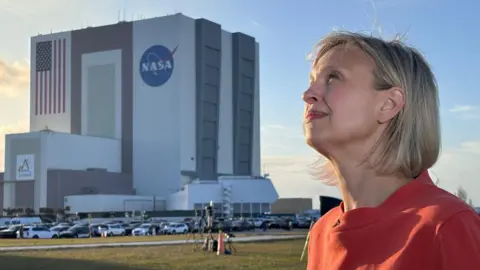
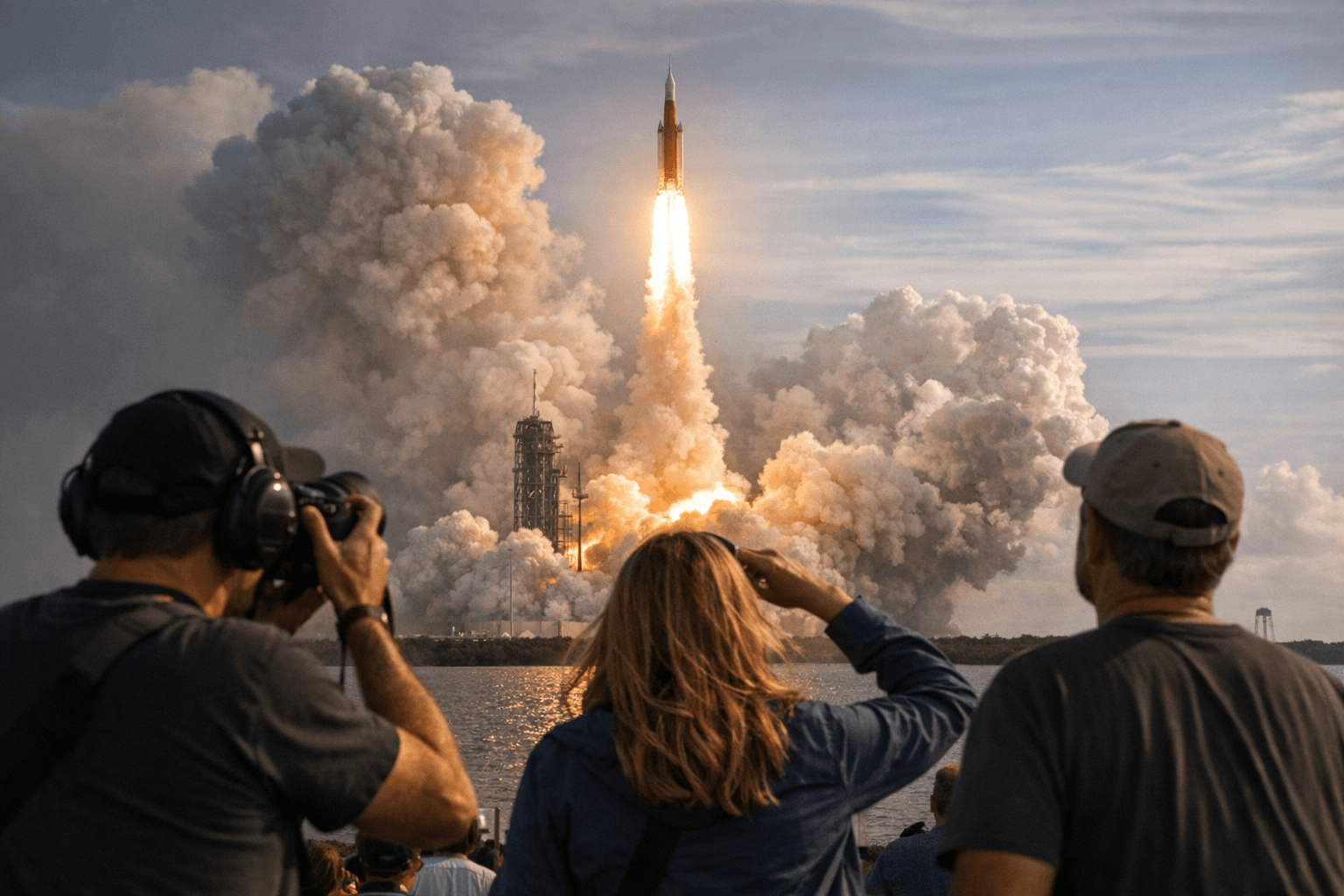
The ground shook first. Three miles from Launch Complex 39B at Kennedy Space Center, I felt the concussive wave before I could fully process what I was seeing: NASA's Space Launch System, generating 8.8 million pounds of thrust, tearing skyward on 1 April 2026 at 6:35 p.m. ET. I was already in tears. "Oh my goodness that is spectacular," I managed, into my microphone. Later, calmer, I tried to explain it properly: "It's not just what you see and you hear as the rocket lifts off. You can feel the force of it through your body. This is the most powerful rocket that NASA has ever built."
Inside the Orion spacecraft, four astronauts were beginning a journey not attempted in more than 53 years. Commander Reid Wiseman led the crew. Pilot Victor Glover, 49, became the first Black astronaut to fly beyond low Earth orbit and the first Black man to complete a lunar orbit. Mission Specialist Christina Koch, 47, who already held the record for the longest single spaceflight by a woman (328 days aboard the International Space Station), became the first woman ever to travel to the Moon. Mission Specialist Jeremy Hansen of the Canadian Space Agency became the first non-American to make that journey. Every seat carried a historic first.
What Artemis II carried beyond those four seats is harder to see from a press-site bleacher. The heat shield on the Orion capsule had been modified after NASA identified a problem during the uncrewed Artemis I test flight, when charred material in the Avcoat ablator wore away unevenly. More than 100 tests at facilities across the country preceded NASA Administrator Jared Isaacman's January 2026 decision to proceed. The life support systems and Launch Abort System were being activated with a live crew for the first time. Every one of those systems had to perform.
They did. On Flight Day 6, 6 April, the Orion spacecraft surpassed 248,655 miles from Earth at 12:56 p.m. CDT, eclipsing the distance record set by the Apollo 13 crew in April 1970 and held for more than 56 years. The crew continued to a maximum of 252,756 miles, or 406,771 kilometres, from home. Later that day, they witnessed a total solar eclipse from deep space as the Moon blocked the Sun and exposed its corona. The crew also held a live call with President Donald J. Trump following the lunar flyby.
On 10 April, the Orion capsule splashed down in the Pacific Ocean off San Diego at 5:07 p.m. PDT. Crews aboard the USS John P. Murtha extracted all four astronauts by helicopter, and every member of the crew walked with little assistance to the ship's medical bay. Isaacman was aboard to greet each of them with a hug. Across the country, stadium Jumbotrons had broadcast the moment live.
The spectacle, however, obscures the strategic arithmetic. China's National Space Administration is targeting a Chang'e 7 mission to the lunar south pole in the second half of 2026 as part of a sustained campaign to establish a presence in the same resource-rich region where NASA's own budget documents call for a "lunar base camp." More than 2,700 suppliers across 47 states feed the Artemis supply chain; California alone generates $18.6 billion in economic output from $5.8 billion in NASA procurement, with Boeing handling SLS core stage work in Los Angeles County and Lockheed Martin serving as Orion's prime contractor.
Associate NASA Administrator Amit Kshatriya put it plainly: "The path to the lunar surface is open." Isaacman called the mission the "opening act."
The sequel is Artemis III, which targets a crewed lunar surface landing for the first time since 1972, with NASA aiming to return astronauts to the Moon's surface by the end of 2028. To get there, SpaceX's Starship Human Landing System must be certified, suit development must be completed, and the agency must demonstrate that Artemis II's validated life support systems can sustain a crew long enough to walk on the surface. Proving humans could survive the journey was the test. Proving they can stay is what comes next.
This article was produced by Prism’s automated news system from verified source data, official records, and press releases, then run through automated quality and moderation checks before publishing. The system is built and supervised by the people who set the standards it runs under. Read our full AI policy.
Did this article answer your question?