Gaza Christians Celebrate First Easter in Peace After Brutal War
Gaza's 500 remaining Christians celebrated Easter at the Holy Family Church, bombed months before the ceasefire, in joy shadowed by grief and shortages.

Catholics young and old filed into the Holy Family Church in Gaza City on Easter Sunday, forming a queue in the aisle to kiss a sketch of Jesus held by clergy, singing as they went. It was the first Easter in nearly three years without active bombardment, and for a community that has lived on this land for more than 2,000 years, the moment carried profound weight.
"There is great joy, especially after the ceasefire and after nearly three years of suffering and being unable to celebrate all the holy holidays," said George Anton, a Gaza City resident. "People are somewhat relieved and more stable."
The relief was real but shadowed. Of the approximately 1,000 Christians who lived in Gaza before October 7, 2023, roughly 500 remain. At least 23 Palestinian Christians were killed during the conflict, according to Holy Family Church data, and many more fled. The community, less than 1% of Gaza's population, gathers across only three churches, all in Gaza City: the Holy Family Church, the Greek Orthodox Church of Saint Porphyrius, and a Protestant church.
The ceasefire that made this Easter possible took effect on October 10, 2025, brokered by the United States under President Trump with mediation from Turkey, Qatar, and Egypt. But peace did not restore what was lost. Easter Sunday passed without eggs, without meat, without children's laughter in church courtyards. Electricity, water, and food remained in short supply. Amal al-Masri, 74, displaced three times during the conflict, from az-Zahra to Rafah to Khan Younis, said: "For two years in the south, there was no holiday at all. Even on Christmas, there was no celebration of any kind."
Elias, a 60-year-old member of the Orthodox Church council who sheltered in the Holy Family Church throughout the war, described a holiday stripped of its texture. Easter once meant families sharing coloured eggs, kahk, maamoul, and Eidiya, traditional gifts for children. "For children, there is nowhere to entertain: no amusement parks, no playgrounds, no gardens," he said. "Traditional customs are incomplete."
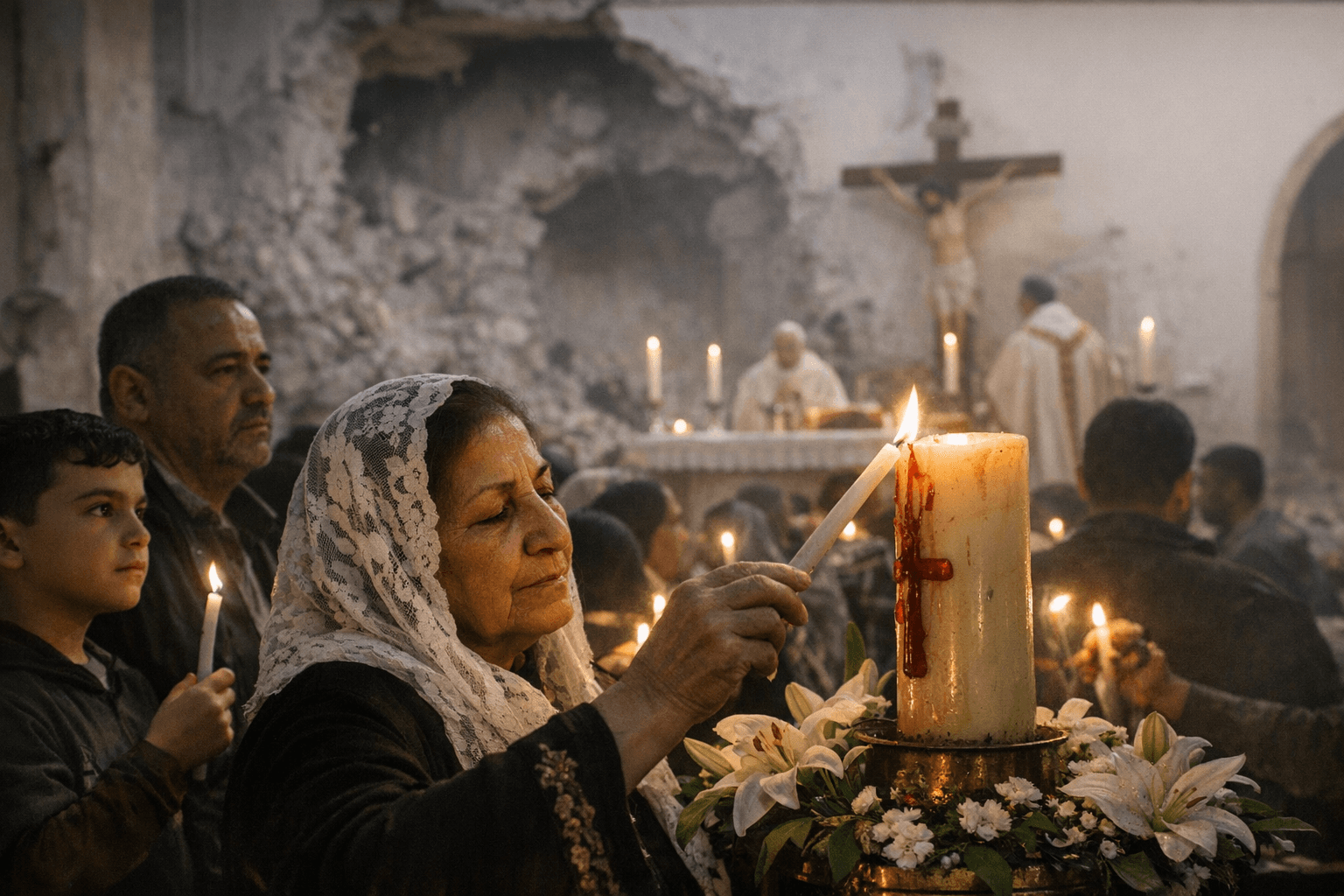
Freedom of movement remained constrained. For the second consecutive year, Gazan Christians could not travel to the Church of the Holy Sepulchre in occupied East Jerusalem for Easter. The Holy Family Church itself bore visible wounds: an Israeli airstrike on July 17, 2025, killed two people there.
Tensions extended further on Palm Sunday, March 29, when Israeli police blocked Cardinal Pierbattista Pizzaballa, the Latin Patriarch of Jerusalem, from entering the Church of the Holy Sepulchre, in what the Latin Patriarchate and Custody of the Holy Land called "the first time in centuries" church leaders had been prevented from doing so. Fr. Francesco Ielpo, official Guardian of the Church, was also blocked. Italian Foreign Minister Antonio Tajani formally protested; the US Ambassador voiced concern. Netanyahu ordered the site reopened, and limited Holy Thursday prayers were held April 2 without public attendance.
At the Vatican, Pope Leo XIV, the first U.S.-born pope, delivered his first Easter Urbi et Orbi address without naming individual conflicts. "Let those who have weapons lay them down! Let those who have the power to unleash wars choose peace!" he said. "Not a peace imposed by force, but through dialogue!"
For Fouad, a Gaza Christian, the core truth remained constant: "We, the Christians, are part of this land and suffered along with everyone in Gaza." Over 72,000 Palestinians have been killed since October 7, 2023. The Christians among them, fewer than a thousand people in a land their ancestors have called home for millennia, buried their dead, sheltered in their churches, and gathered again on Easter Sunday.
This article was produced by Prism’s automated news system from verified source data, official records, and press releases, then run through automated quality and moderation checks before publishing. The system is built and supervised by the people who set the standards it runs under. Read our full AI policy.
Did this article answer your question?


