Global survey finds U.S. image sinks below Russia, alarms allies
A new 98-country democracy survey put the U.S. at -16% net perception, below Russia, as allies digest a widening soft-power crisis.
If the United States now ranks below Russia in global image, the problem reaches far beyond embarrassment. It raises a harder question for Washington: what happens to U.S. influence when allies and rivals alike see American power as less predictable, less democratic and less trustworthy?
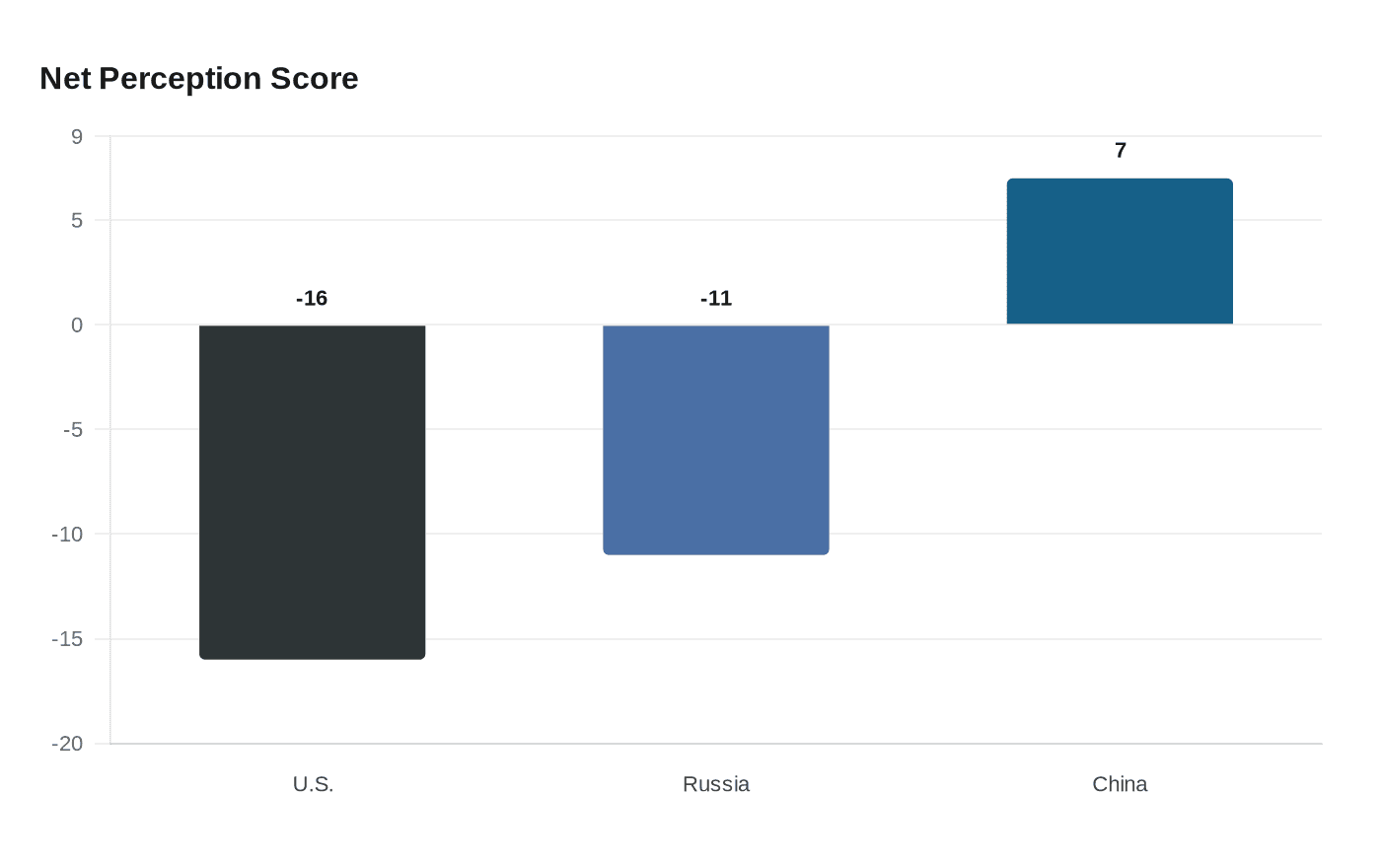
The Democracy Perception Index, the annual flagship survey of the Alliance of Democracies Foundation and polling firm Nira Data, found the U.S. net perception score had fallen to -16%, compared with Russia at -11% and China at +7%. The study was fielded from March 19 to April 21 and drew on more than 94,000 respondents across 98 countries overall, with the country-perception figures based on 46,600 respondents in 85 countries. The findings were released on May 8, ahead of the Copenhagen Democracy Summit on May 12 in Copenhagen.
The numbers marked a sharp deterioration for America’s standing. In the prior year, the U.S. had already slipped to -5% from +22% two years earlier, and it was viewed negatively in 55% of the countries surveyed. This year’s survey went further, naming the United States as the country most frequently identified as the greatest threat to the world, trailing only Russia and Israel. For a country that has long sold itself as a guarantor of democratic stability, that is a striking reversal.
The decline was tied to Donald Trump’s foreign-policy choices, including tariffs, threats involving Greenland, reduced support for Ukraine and tensions connected to the U.S.-Israeli war against Iran. Those moves appear to have done more than irritate capitals in Europe; they seem to have altered how many respondents judge the United States itself, casting Washington as less anchored to democratic norms and less reliable as a partner.
That matters because soft power is not abstract. Public attitudes shape the room leaders have to maneuver on trade, security and multilateral cooperation. If partners grow more skeptical of American motives, the costs show up in NATO cohesion, sanctions enforcement, defense coordination and the willingness of governments to follow Washington’s lead during crises. A state can still be militarily dominant and diplomatically weaker at the same time.
The result lands with particular force because the Alliance of Democracies, founded in 2017 by former NATO chief Anders Fogh Rasmussen, is built around defending democracy, supporting Ukraine and Taiwan and resisting authoritarian coercion. Rasmussen said the collapse in America’s image was saddening but not surprising. In that context, the survey is more than a poll. It is a warning that the democratic camp’s central power may be losing the moral authority it once treated as automatic.
This article was produced by Prism’s automated news system from verified source data, official records, and press releases, then run through automated quality and moderation checks before publishing. The system is built and supervised by the people who set the standards it runs under. Read our full AI policy.
Did this article answer your question?