Hundreds of Geometric Tattoo Designs With Composition, Placement, and Style Guidance
An evergreen gallery collects hundreds of geometric tattoo examples—from single‑line triangles to mandalas and sacred‑geometry sleeves—paired with short notes on composition, placement, and style adap.
1. evergreen gallery and design primer
This project presents itself as a comprehensive reference: "This evergreen gallery and design primer collects hundreds of geometric tattoo examples — from minimalist single‑line triangles to large mandalas and complex sacred‑geometry sleeves — and pairs images with short notes on composition, placement, and style adap" — a useful promise for anyone building a reference board or briefing a tattooer. The "hundreds" claim is the piece's share hook: it signals scale and variety, from tiny linework experiments to full sleeves.
2. minimalist single-line triangles
The collection explicitly includes minimalist single‑line triangles as a recurring basic vocabulary for geometric work. These pieces illustrate the core idea that "Geometric tattoos are designs that primarily use shapes and patterns featuring straight lines and curves to create a visually appealing and often symmetrical piece of art on the body," showing how a single triangle can read as an accent, talisman, or building block for more complex layouts.
3. large mandalas
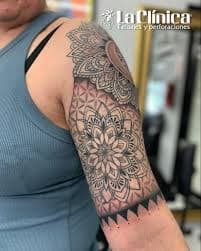
Mandalas are listed among the gallery's headline examples and are tied to explicit symbolism: "mandalas symbolizing unity and completeness." Expect full‑scale circular compositions in the gallery that demonstrate radial symmetry and high-contrast line density—ideal patterns for central chest, back, or thigh placements where their geometry can breathe.
4. complex sacred-geometry sleeves
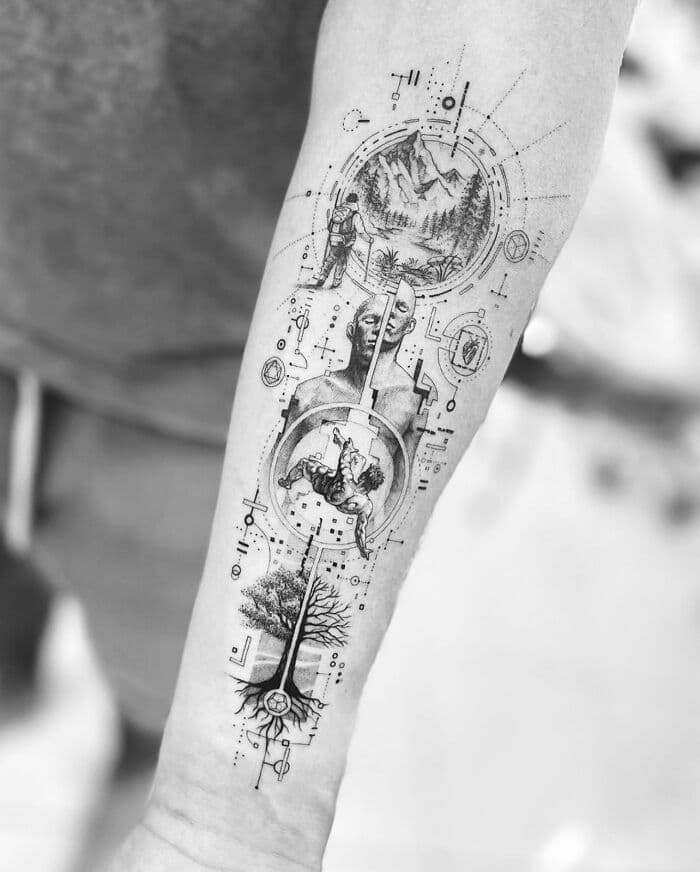
The primer calls out "complex sacred‑geometry sleeves" as a major category, demonstrating how interlocking motifs scale across an arm or leg. TattooSmart material reinforces this direction: "Geometric sleeve incorporating the Flower of Life, a sacred geometry motif. Done by Luis Hinestroza." Use those sleeve examples to study repeat spacing, line weight consistency, and how micro‑motifs build macro‑patterns.
5. flower of life sleeve — done by luis hinestroza
This is a named exemplar in the notes: "Geometric sleeve incorporating the Flower of Life, a sacred geometry motif. Done by Luis Hinestroza." That specific credit gives a visual benchmark for sacred-geometry sleeves and helps readers locate an artist's approach to repeating lattices and negative space on a full limb.
6. geometric sleeve and abstract work by corey ferguson
TattooSmart credits two Corey Ferguson pieces: "Geometric sleeve by Corey Ferguson." and "Abstract geometric tattoo by Corey Ferguson." These two short references point to both structured sleeve work and more interpretive abstract pieces from the same hand—useful when comparing strict tessellations versus freer geometric abstraction in placement and flow.
7. old world geo collection — classical architecture influence
"For designs that incorporate elements of classical art and architecture, explore Tattoo Smart's Old World Geo collection. This series features designs inspired by the intricate tile work and stonemasonry of ancient civilizations, perfect for those who appreciate a historical narrative." That line names a stylistic lane: geometric work borrowing from tile motifs, interlaced stone patterns, and architectural repeat systems—especially useful for chest panels or paneling across a shoulder.
8. vibrant eagle head designs with geometric backgrounds
The Dreamstime excerpts include several eagle motifs in slightly different phrasings: "Vibrant eagle head tattoo design with a bold geometric background." / "A vivid tattoo of an eagle's head set against a bold geometric pattern." / "A dynamic eagle head tattoo paired with an intense geometric design." These repeated entries show the marketplace appetite for animal portraiture framed by geometric scaffolding—combine realistic feathering with angular backgrounds for contrast.
9. geometric magical mountains tattoo design (duplicate entries)
"Geometric magical mountains tattoo design." appears multiple times in the asset list, indicating both a common motif and multiple variations available. Mountain silhouettes rendered with stacked geometry or crystalline facets make strong vertical pieces suited to forearm, calf, or rib placements where the composition can read as a landscape strip.
10. black-and-white mountain landscape, line-art simplicity
One Dreamstime entry reads: "Black and white mountain landscape with evergreen forest, reflected lake, simple line art, minimalist outdoor nature scene, AI" — a compact visual that proves geometric language works in minimalist line scenes as well as in dense patterning. The reflected-lake composition demonstrates symmetry used as an explicit design device.
11. abstract geometric deer head with orange accents
"Abstract geometric deer head with vibrant orange elements. This abstract illustration features a geometric deer head with striking antlers, set against a background splashed with vibrant orange and gray hues." Use color sparingly as an accent in geometric pieces—the excerpt demonstrates how a single saturated hue can define focal points within otherwise structural linework.

12. minimalist tree of life with celtic knot roots
"Minimalist Tree of Life with stylized Celtic knot roots, refined gold accents and geometric balance" combines organic iconography with knotwork and geometric balancing. This hybrid is a clear template for centerline placements—spine, sternum, or rib—where knot-roots and vertical trunk geometry can be mirrored on either side.
13. ocean waves and tribal dragon fused with geometry
"Ocean Waves and Tribal Dragon Tattoo Design: Where Vibrant Nature-Inspired Elements Merge with Bold Geometric Patterns" shows motif fusion—marine waves and a tribal dragon wrapped in geometric frames. These hybrid pieces are useful for sleeve transitions and wraparound placements where organic motion meets strict geometry.
14. traditional asia line wave pattern
"Traditional asia line wave pattern" appears as a short, lowercase asset label—an explicit motif to draw from. Traditional wave linework translated into geometric grids or repeats can serve as borders, cuff pieces, or negative-space backdrops for larger motifs.
15. detailed black-and-white lion sketch with geometric shapes (truncated)
"A detailed black and white sketch of a lion's face featuring geometric shapes, showcasing its majestic power in." The fragmentary line is preserved as written and points to portraiture treated with faceting and planar geometry. Treat such sketches as study pieces for facial planes, contrast, and how geometry can emphasize expression.
16. repeated dreamstime licensing cue: free with trial
Many Dreamstime assets in the notes carry the repeated licensing label "Free with trial." That explicit phrase is the only pricing/licensing detail in the supplied materials and flags that some image assets may be available under trial terms—verify usage rights before reproduction or referencing exact artwork in commercial contexts.
17. concise definition: what are geometric tattoos?
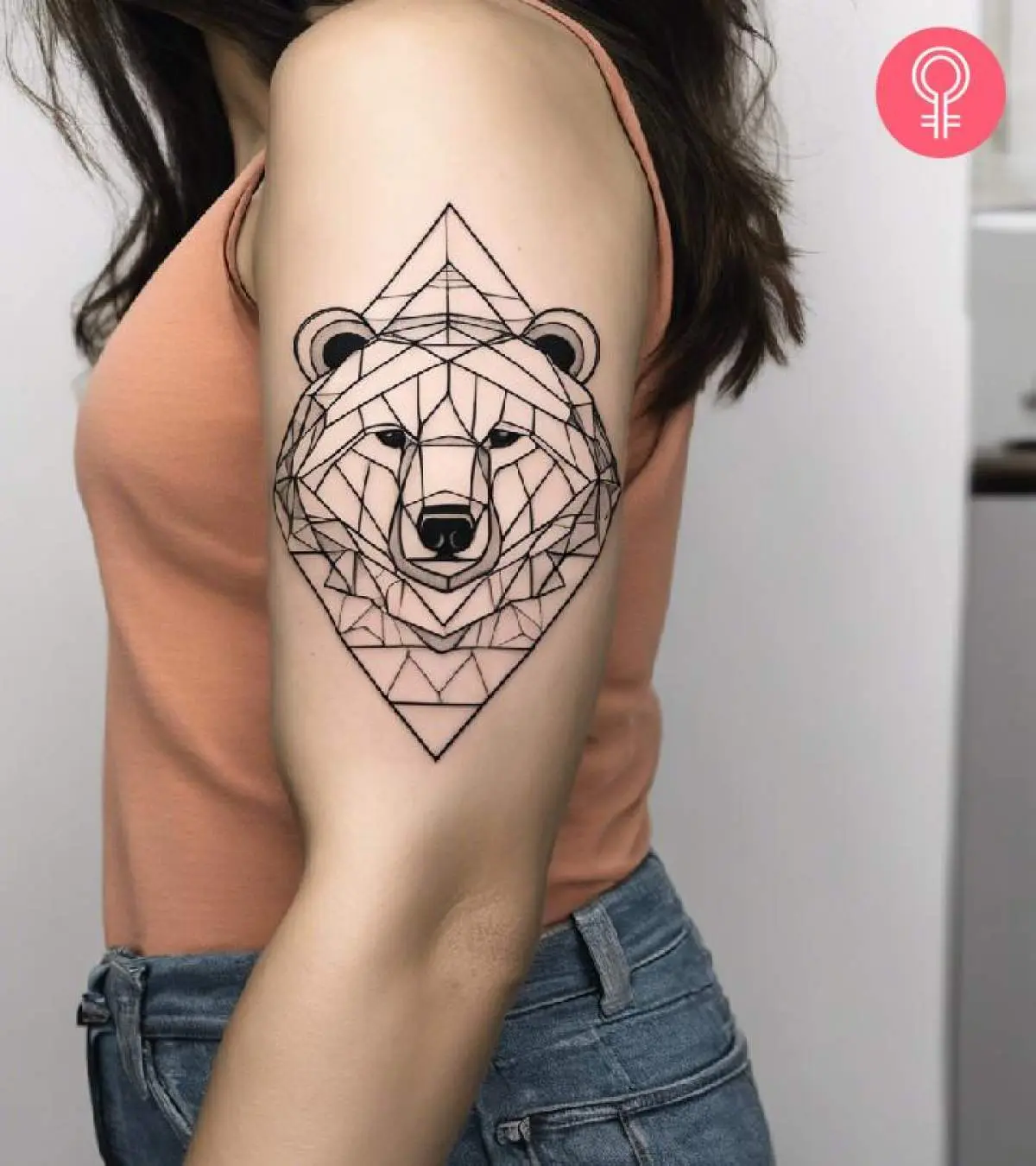
"Geometric tattoo designs are distinguished by their precise lines and shapes that form patterns often inspired by nature, mathematics, and different cultures." The notes also include the direct question "What are geometric tattoos?" followed by clarifying lines: "They can range from simple shapes like circles and triangles to complex compositions involving multiple interlocking patterns." Use these sentences to explain genre boundaries when you're briefing a flash sheet or custom consultation.
18. symbolism and interpretations
"What do geometric tattoos symbolize?" is posed and answered in the sources: "Geometric tattoos can carry a variety of symbolic meanings depending on the shapes and patterns used." Common interpretations are summarized as: "balance, symmetry, stability, and harmony. Specific shapes may also have unique cultural or spiritual significance, like mandalas symbolizing unity and completeness." Those lines anchor the emotional intent when selecting motifs.
19. how the gallery pairs images with notes and available design tools
The primer promises paired commentary: images plus "short notes on composition, placement, and style adap"—that truncated phrase is part of the source verbatim. Complementing that, TattooSmart site fragments signal a toolbox ecosystem—"Design Tools", "Brush Sets", "3D Models", "Tool Kits", "Workshops"—that map to hands‑on techniques for adapting motifs. If you use the gallery, reference the short notes for composition cues and turn to these listed tools to test scale, line weight, and mockups.
20. credits, sourcing, and next steps
The research explicitly names two contributing artists—Corey Ferguson and Luis Hinestroza—so use those credits when comparing sleeve and abstract work: "Geometric sleeve by Corey Ferguson." / "Geometric sleeve incorporating the Flower of Life... Done by Luis Hinestroza." It also documents multiple Dreamstime descriptors but no artist credits for those assets; many of those items are followed by "Free with trial." Treat the gallery as a starting library—verify image authorship and licensing before reuse, then apply the primer's composition and placement notes to adapt motifs to client anatomy.
Conclusion: This resource gathers motif-by-motif examples—from single‑line triangles and mandalas to animal head portraiture and Old World tile geometries—paired with authored examples (Corey Ferguson, Luis Hinestroza) and marketplace image variants (Dreamstime entries labeled "Free with trial"). Use the gallery's short notes on composition, placement, and style adap alongside the listed design tools to translate those hundreds of examples into practical, site-specific tattoos that balance mathematical rigor with personal meaning.
Know something we missed? Have a correction or additional information?
Submit a Tip