Hungary's Roma Voters Could Decide Orban's Fate in Tight Election
With up to 800,000 Roma voters concentrated in Hungary's northeast, a single offensive remark by Fidesz's second-most powerful figure may have fractured a coalition Orban spent 15 years building.

Five days before Hungary's April 12 parliamentary vote, the battle for the country's largest minority has turned into one of the most consequential fights of the campaign. An estimated 600,000 to 800,000 Roma, representing more than 8 percent of Hungary's 10 million people, have been a critical, if often overlooked, pillar of Prime Minister Viktor Orban's Fidesz majority since 2010. Whether that holds on election day may determine whether Orban wins a fifth consecutive term or becomes the first Hungarian leader in 15 years to lose power.
The fracture began on January 22, when Janos Lazar, the minister for construction and transport and Fidesz's second-most prominent campaign figure, made a remark widely described as offensive to Roma people at a public forum in Balatonalmadi. The fallout was swift and lasting, generating weeks of political controversy at the worst possible moment for a party already trailing in the polls.
That trail is significant. A 21 Kutatokozpont survey published in April showed Peter Magyar's Tisza party at 56 percent support among decided voters against 37 percent for Fidesz. Magyar, a 44-year-old former Fidesz insider turned opposition leader, has drawn Roma activists directly into the Tisza coalition, a deliberate break from the fractured opposition alliances that repeatedly failed against Orban in previous cycles.
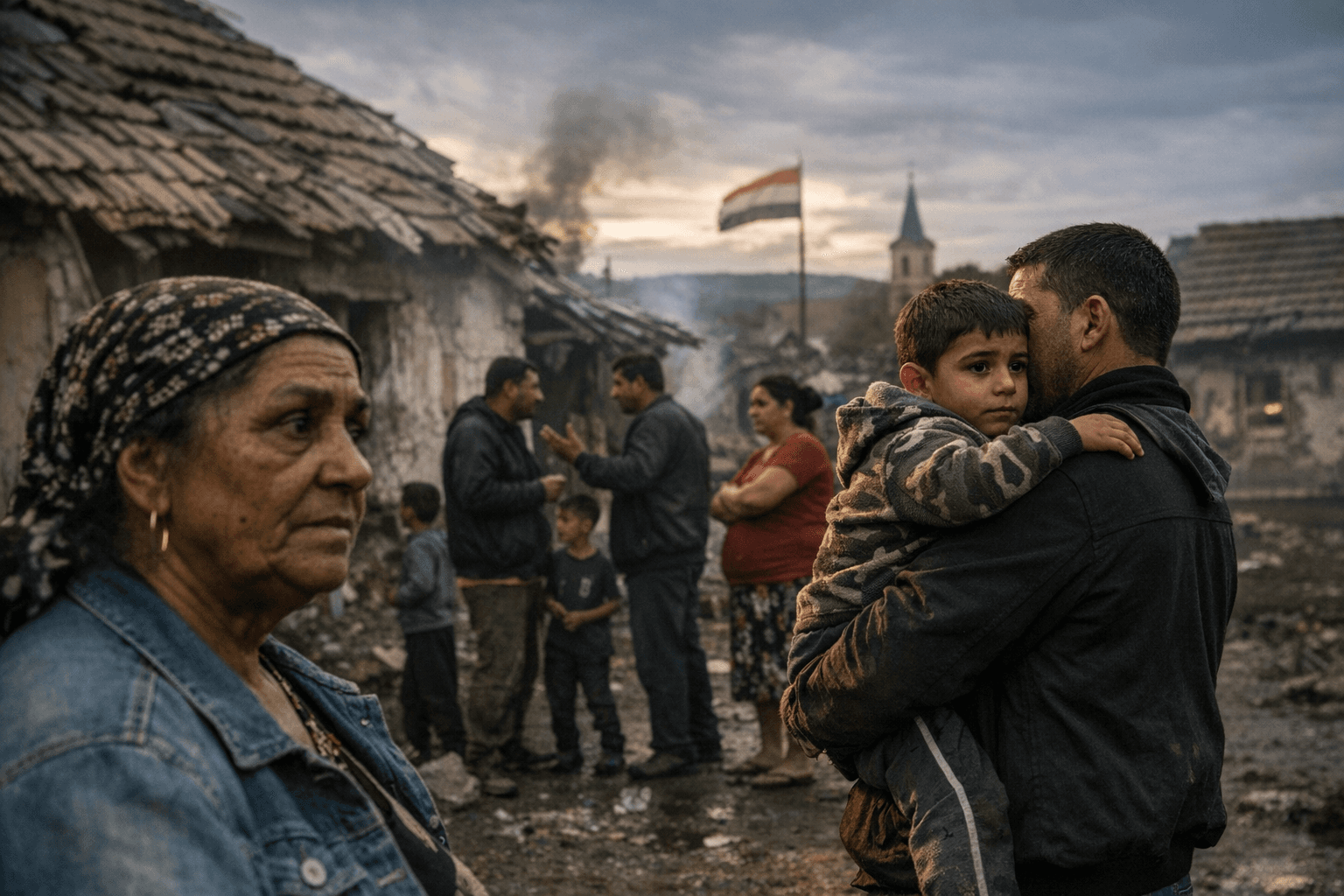
What is actually moving Roma votes is not abstract ethnic grievance but the concrete texture of daily life: access to work, school enrollment rates, the condition of housing in northeastern villages, and especially the public workfare schemes that Fidesz has used for years as the primary economic lifeline for impoverished rural communities. Civil society monitoring of Hungary's Roma integration strategy has found that broad-based public employment is the one policy measure that meaningfully improved Roma livelihoods, but that these schemes double as a mechanism of political dependency. Threats to deny access to workfare in poor communities have been documented as a recurring electoral tool.
That dependency is now central to the controversy unleashed by a six-month investigation released on March 26 as the documentary "The Price of a Vote." Based on nearly 60 interviews across 10 of Hungary's 19 counties, the film alleges that up to 500,000 votes could be influenced through vote-buying, intimidation, and coercion, with practices disproportionately targeting Roma communities in the country's poorer north and east. Witnesses described "chain voting" and Fidesz intermediaries accompanying voters into polling booths on the pretext of helping with literacy. Filmmaker Aron Timar framed the core issue starkly: "In the beginning, we thought the key piece of this process is vote-buying. But then we realised that the money is just the icing on the cake. The key word here is dependency."
For Orban, the strategy was never purely transactional. In January, addressing a gathering of local mayors in Budapest, he was direct about the mechanics of victory: "The 2026 election will be decided by whether you get involved. If you do, we'll win; if you don't, we won't." Those mayors, many of them the same local officials who administer workfare access and distribute community resources, are now the subject of international election monitoring attention. Observers from several organizations will watch the April 12 vote, though monitors have warned that abuses concentrated in small, isolated villages are difficult to observe in real time.
Fidesz's compulsory education reforms, which lowered the school-leaving age from 18 to 16, have drawn sustained criticism from Roma civil society groups who argue the change accelerated dropout rates in communities where secondary enrollment was already fragile. Housing policy has remained, in the assessment of independent evaluators, largely incoherent as a targeted instrument. Five times more Roma than non-Roma live in severe material deprivation, a gap that has narrowed but not closed across 15 years of Fidesz governance.
Magyar's Tisza party has not yet released detailed Roma-specific policy commitments, but the geographic arithmetic is unambiguous: northeastern single-member constituencies with high Roma populations could swing individual seats in what polling suggests will be a close contest for control of the 199-seat National Assembly. In an electoral system Orban himself redesigned in 2011 to favor the party that wins the most constituencies outright, a shift of even a fraction of Roma turnout in those districts carries outsized weight.
This article was produced by Prism’s automated news system from verified source data, official records, and press releases, then run through automated quality and moderation checks before publishing. The system is built and supervised by the people who set the standards it runs under. Read our full AI policy.
Did this article answer your question?


