In Lviv, daily military funerals mark Ukraine's mounting war dead
At the Saints Peter and Paul Garrison Church, funerals at the same hour each day have turned grief into routine as Lviv buries more of Ukraine’s war dead.

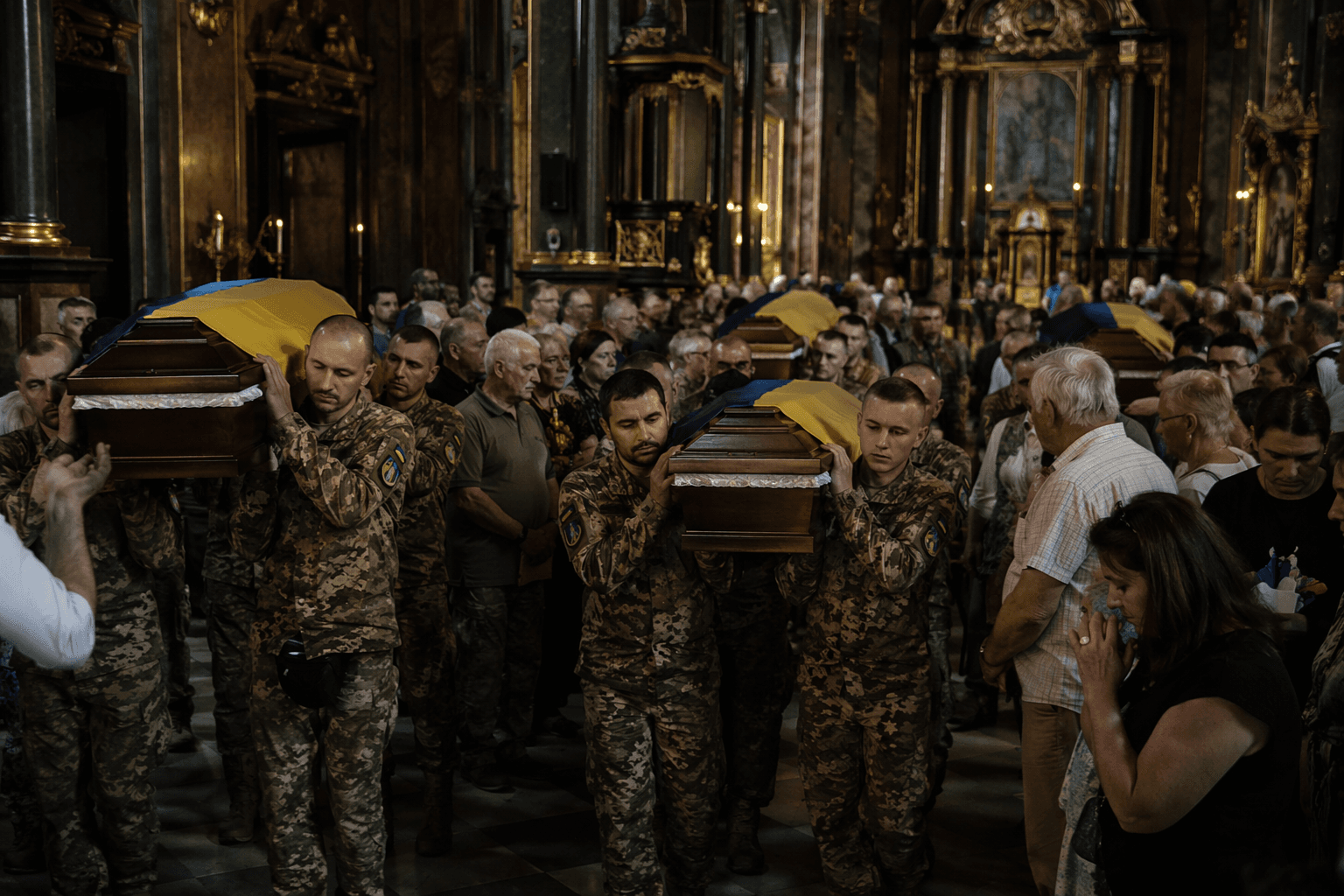
The bells at the Saints Peter and Paul Garrison Church in central Lviv have been calling mourners to a ritual that now arrives with almost clockwork certainty. Nearly every day, often around 11 a.m., soldiers killed in Russia’s full-scale invasion are carried into the church for funeral rites, a schedule that has made war feel less like an interruption than a fixed part of civic life.
The church has been run by military chaplains of the Ukrainian Greek Catholic Church since 2010 and serves as the main church of Ukraine’s military chaplaincy. Since February 2022, it has regularly hosted funerals for fallen soldiers, with priests including Taras Mykhalchuk and Father Nestor Kyzyk presiding over services that bind private loss to public duty. Kyzyk has said the state of war is a constant, a line that captures how Lviv now lives with mourning as part of the ordinary rhythm of the city.
That ritual does not end at the church doors. In Lviv, bodies of slain soldiers are brought home for burial, and the city’s mourning routines have become highly visible, with mourners, flags and military honors crossing streets that would otherwise be filled with the ordinary business of a western Ukrainian city. The funerals do more than mark a death. They make the cost of the war impossible to ignore, even for residents far from the front lines.
The burden is also visible at Lychakiv Cemetery, where Lviv began burying fallen soldiers in March 2022 in the Field of Honor, also known as the Field of Mars. By late 2025, city officials said the main military burial area had reached capacity, with only a handful of spaces left. Reuters reported in late 2025 that about 1,000 soldiers had already been buried at Lychakiv, and local officials said Lviv was preparing a new burial section within the historic cemetery.
Lychakiv’s scale gives the crisis a deeper historical weight. The cemetery was officially opened in 1786, and the Field of Mars had been used as a military burial site since the First World War. That long memory now sits beside the expanding wartime dead of today, as Lviv makes room for more graves and more funerals. In a city where loss is scheduled, the repetition itself has become a measure of endurance, and of how fully the war has settled into daily life.
This article was produced by Prism’s automated news system from verified source data, official records, and press releases, then run through automated quality and moderation checks before publishing. The system is built and supervised by the people who set the standards it runs under. Read our full AI policy.
Know something we missed? Have a correction or additional information?
Submit a Tip