India's private sector growth eases in May as export demand weakens
India’s private sector kept expanding in May, but export orders slowed to a 19-month low as Middle East conflict pushed up costs and shook confidence.
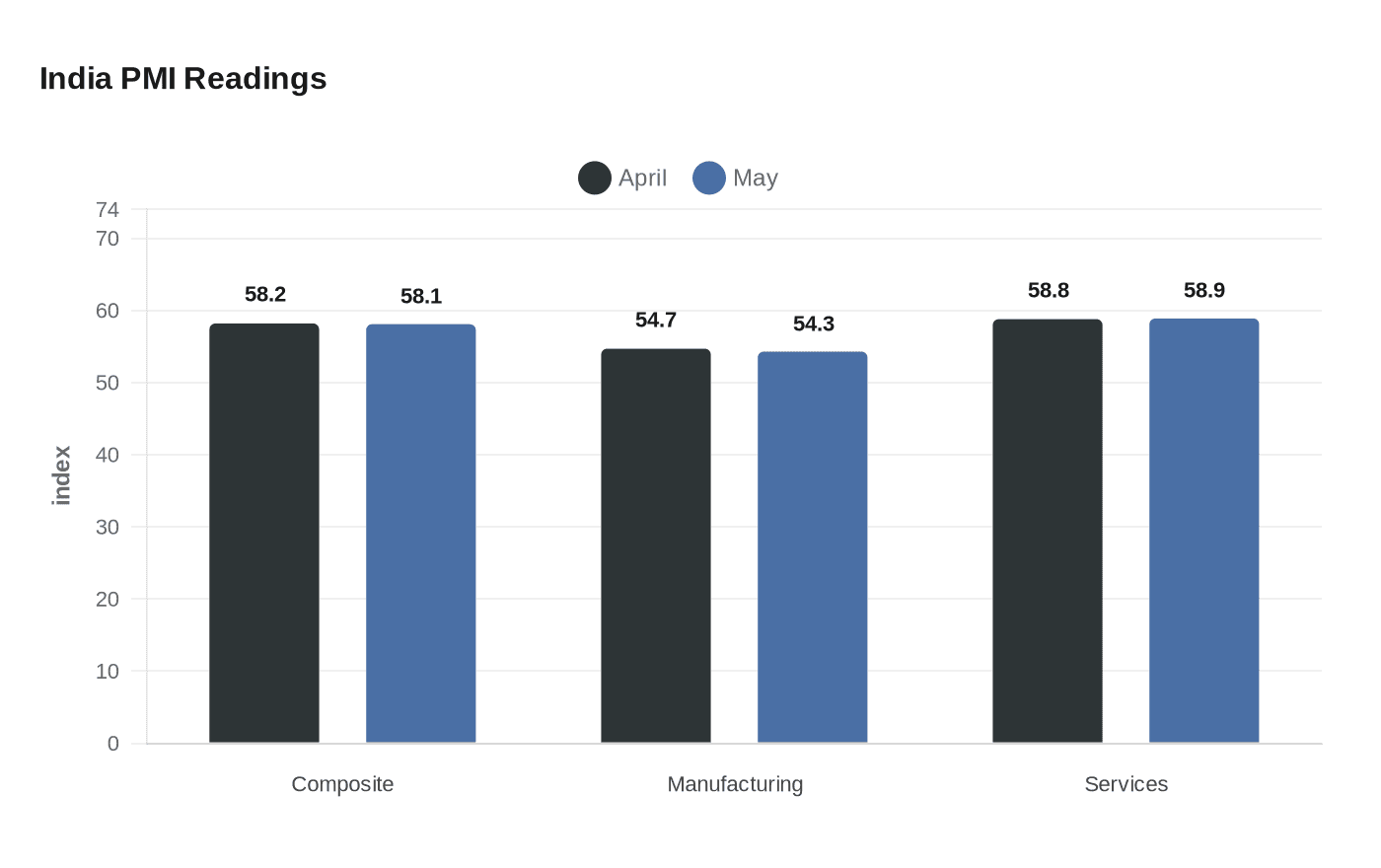
India’s private sector lost a little momentum in May, with growth still firm but increasingly exposed to shocks from abroad. The flash HSBC composite purchasing managers’ index slipped to 58.1 from 58.2 in April, just above the Reuters poll forecast of 58.0, showing that the economy remained well in expansion territory even as the pace of growth eased.
The slowdown came mainly from factories. The manufacturing PMI fell to 54.3 from 54.7, while the services PMI edged up to 58.9 from 58.8. That split matters: services continued to provide support, but manufacturing showed clearer strain as the Middle East conflict and softer international demand hit new work. New export orders across the private economy rose at their weakest pace in 19 months, and manufacturing new orders expanded at one of the slowest rates in nearly four years.
The pressure is showing up in prices as well as orders. Overall input costs rose at the steepest rate since July 2022, driven by higher energy, steel and food prices. Yet companies were able to raise output charges at the weakest pace since January, suggesting many firms absorbed part of the squeeze rather than fully passing it through to customers. Service providers also added staff at the greatest extent in nearly a year, while manufacturing hiring softened, a sign that labor demand is still intact even as margins are getting tighter.
Annabel Fiddes of S&P Global Market Intelligence warned that the balance could deteriorate if the twin forces of weaker demand and higher costs continue. “If cost pressures continue to mount and demand softens, business confidence and the broader economy could come under greater strain in the months ahead,” she said. The survey’s business-confidence reading fell to a three-month low, reinforcing the view that the conflict is now feeding into India not just through energy prices, but through trade routes, export planning and corporate investment decisions.
The broader backdrop gives that caution extra weight. The flash PMI is based on questionnaires sent to about 400 manufacturers and 400 service providers and is typically released about a week before final monthly data, making it an early read on market sentiment. It has now stayed above 50 for 58 straight months, underscoring the durability of India’s expansion. Still, the external drag is real: India’s merchandise trade deficit widened to $28.38 billion in April as shipments were disrupted and energy imports became costlier, while the World Bank’s April update said FY2027 growth could slow to 6.6% if Middle East headwinds persist. The government had estimated FY2025-26 growth at 7.4% in the Economic Survey tabled on January 29, but May’s PMI showed how quickly that outlook can be tested when conflict pushes through energy, shipping and confidence all at once.
Know something we missed? Have a correction or additional information?
Submit a Tip